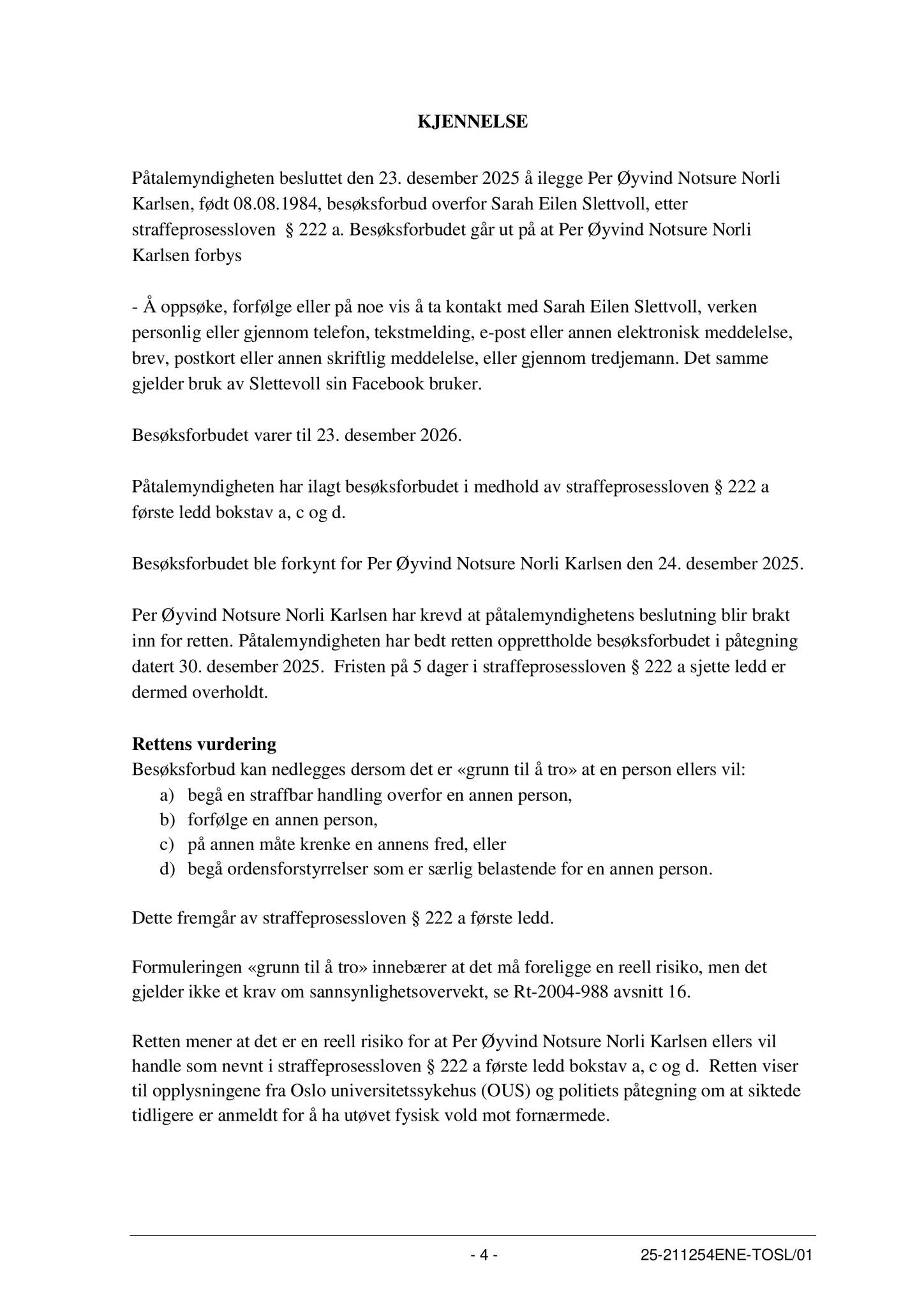
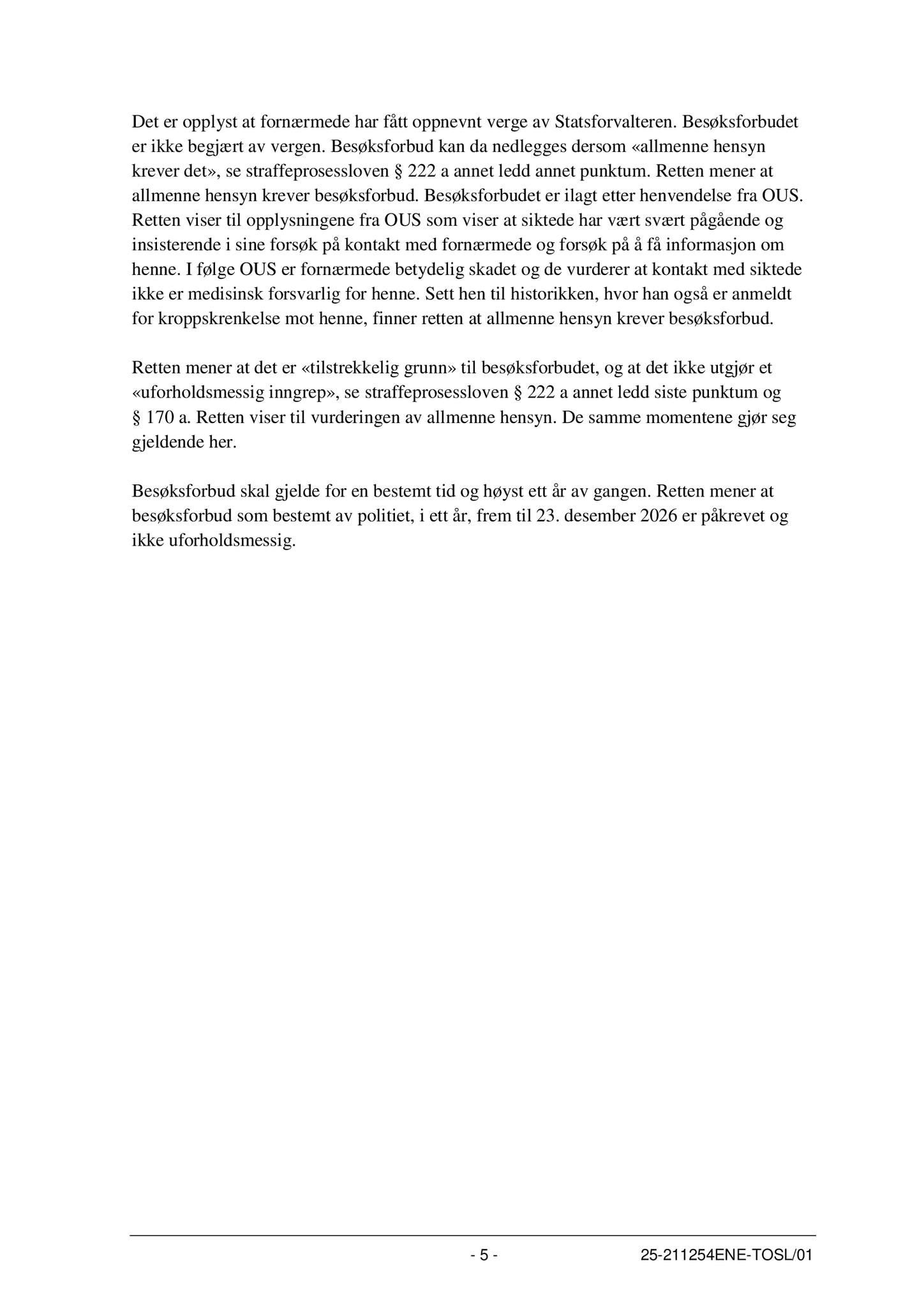
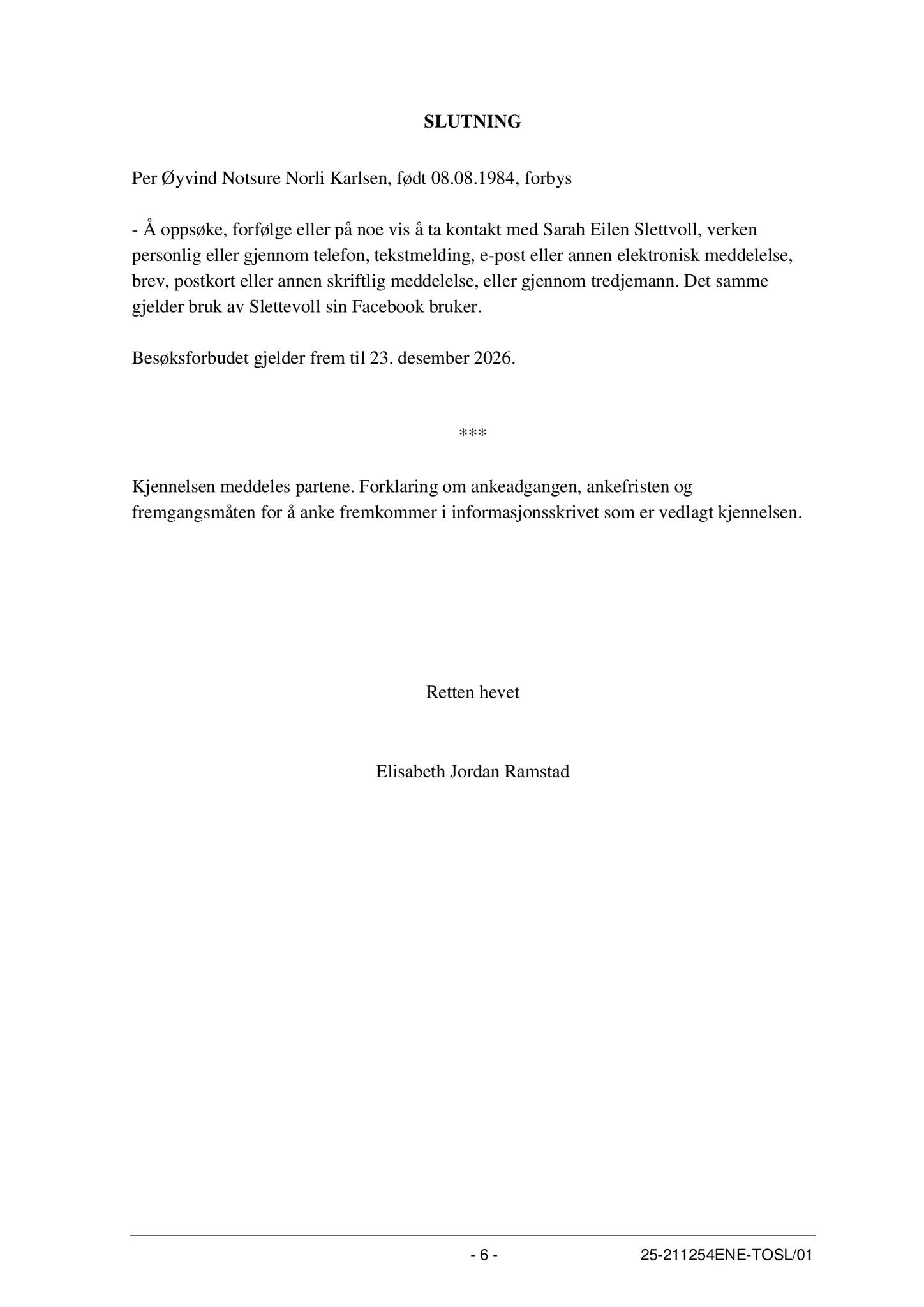
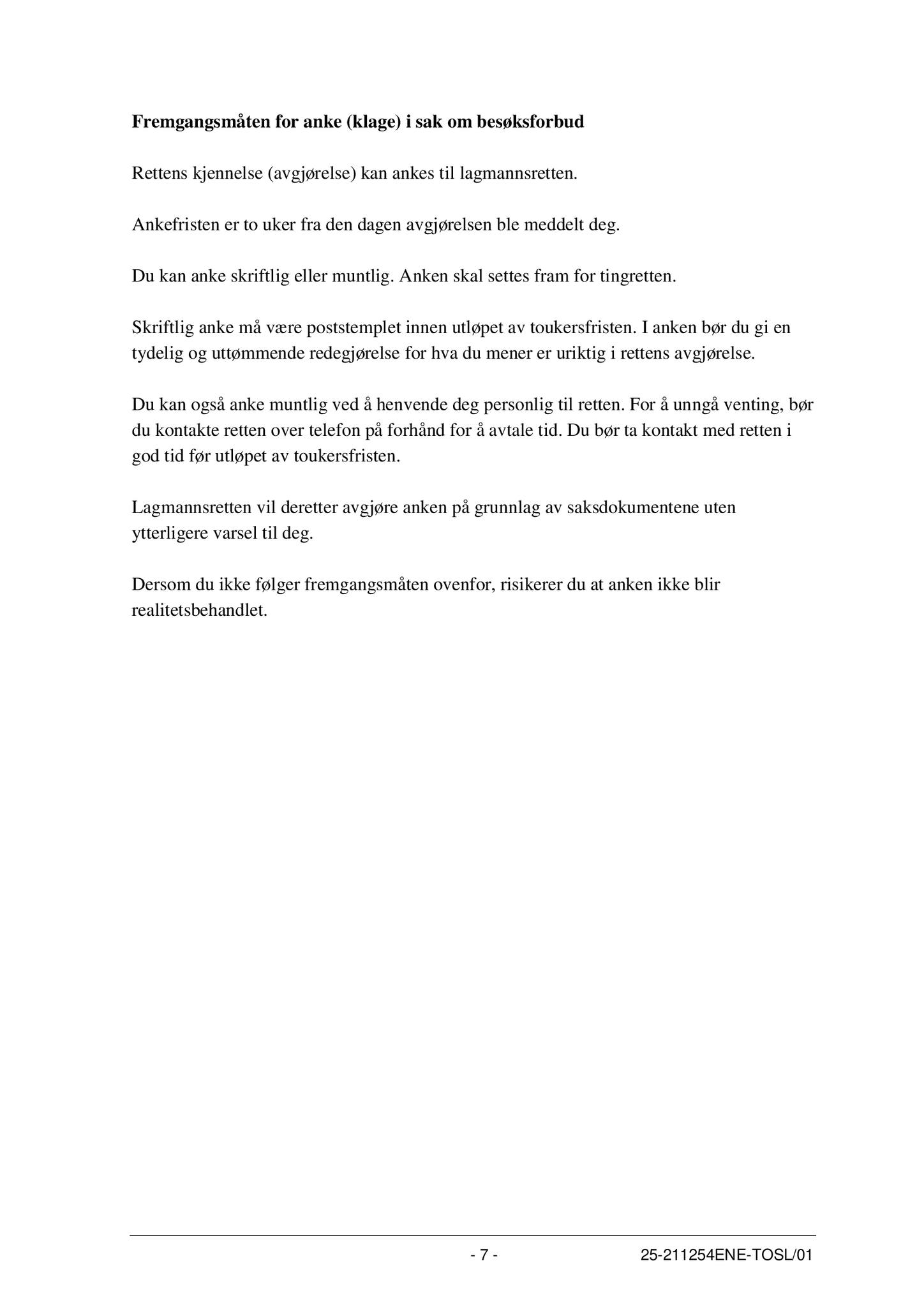
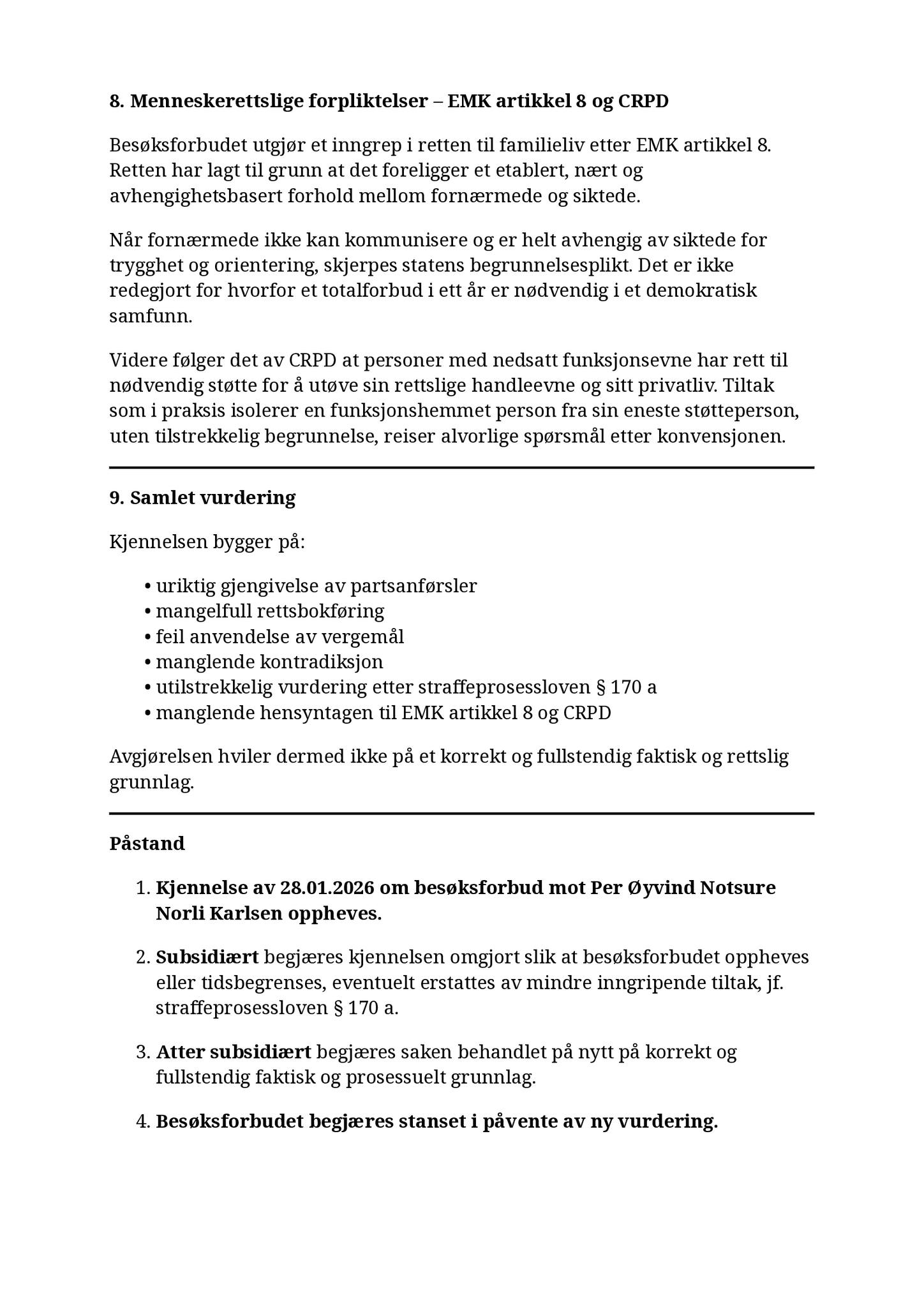
Et av de mest ødeleggende trekkene ved Sarah-saken er hvordan hun gradvis ble gjort utilgjengelig, for så helt utilgjengelig for mennesker som faktisk bryr seg om henne.
Ikke bare for meg.
Ikke bare for den personen hun selv hadde gitt fullmakt til og oppgitt som nærmeste pårørende.
Men også for venner.
Mennesker som kjenner Sarah som Sarah. Ikke som diagnose. Ikke som sak. Ikke som “pasient”. Ikke som et problem et system helst ville slippe å forholde seg til.
For en liten stund tilbake fikk jeg en melding fra en venn av Sarah. Jeg anonymiserer ham her som A., fordi dette ikke handler om å trekke andre privatpersoner unødvendig inn i offentligheten. Det handler om hva meldingen viser.
Den viser at Sarah har et nettverk.
Den viser at flere har forsøkt å finne henne.
Den viser at også andre ble møtt med taushet.
Og den viser, kanskje viktigst av alt, at mennesker rundt Sarah ha forstått noe helt grunnleggende som institusjonene ser ut til å ha mistet av syne:
At et alvorlig skadet menneske ikke bare trenger skjerming, kontroll og vedtak.
Hun trenger trygghet.
Nærhet.
Kjente stemmer.
Folk som bryr seg.
Her er en sms jeg mottok for en liten stund tilbake:
Hei Per.
A**** her 🙂
Jeg vet ikke om det er passende at jeg skriver, men Sarah har betydd veldig mye for meg. I en periode var hun også min beste venn, og jeg bærer fortsatt mye omsorg for henne. Hun er kul, tøff, smart og skarp.
Jeg kan bare forestille meg hvor tungt dette må være for deg også. Jeg ønsker oppriktig at hun får ro, trygghet og den hjelpen hun trenger. Takk for at du har stått på.
Jeg forsøkte selv å komme i kontakt med Sarah. Jeg ringte flere sykehus og akuttmottak flere ganger, men de ville ikke engang opplyse om hvor hun var.
Sarah er kjempetøff. Jeg er helt enig med deg i at hun burde få ha nære venner og mennesker som bryr seg rundt seg i en sånn situasjon. Bare det at noen sitter i rommet med henne, tenker jeg kan være betryggende for henne. Det første jeg tenkte da jeg hørte om dette med katatoni, var egentlig bare at hun trenger nærhet og omsorg.
Jeg var ikke på Facebook på flere år. Da jeg logget inn igjen etter en vanskelig periode i livet mitt, var Sarah den eneste som hadde tatt kontakt med meg og prøvde å få meg ut og være sosial. Det vil jeg aldri glemme.
Igjen – takk for at du forsøker.
Mvh A
Dette er ikke en medisinsk vurdering.
Det er heller ikke ment som et juridisk dokument.
Men det er et menneskelig vitneutsagn om hvem Sarah var for andre.
Og det er viktig.
For bildet som har blitt bygget rundt Sarah, og rundt meg, har altfor lenge vært formet av institusjoner, politi, pårørende som ikke nødvendigvis hadde mest faktisk kontakt, og helsevesenets egne interesser i å kontrollere fortellingen.
Meldingen fra A. bryter med dette bildet.
Han beskriver Sarah som:
kul
tøff
smart
skarp
omsorgsfull
en person som tok kontakt med ham da han selv hadde hatt det vanskelig
en venn som prøvde å få ham ut og være sosial
Det er Sarah slik mennesker som faktisk kjenner henne kunne kjenne henne.
Ikke som et journalnotat.
Ikke som F20.0.
Ikke som “uro”.
Ikke som en person som skulle skjermes bort fra alle relasjoner som ikke passet inn i systemets praktiske behov.
Også venner har forsøkt å finne henne
Det sterkeste i meldingen er kanskje dette:
Jeg forsøkte selv å komme i kontakt med Sarah. Jeg ringte flere sykehus og akuttmottak flere ganger, men de ville ikke engang opplyse om hvor hun var.
Dette er alvorlig.
Når en person har vært utsatt for en katastrofal ulykke, ligger alvorlig skadet, og mennesker som står henne nær ikke engang får vite hvor hun er, da er det ikke lenger bare et spørsmål om taushetsplikt.
Da handler det også om isolasjon.
Om avskjæring.
Om at et menneske med relasjoner, historie og tilknytning blir gjort administrativt usynlig.
Det har vært et gjennomgående mønster i Sarah-saken: mennesker og dokumentasjon som kunne utfordret institusjonenes versjon av saken, ble holdt utenfor.
Fullmakter har blitt tilsidesatt.
Pårørenderettigheter har blitt avvist.
Kontakt har vært nektet.
Venner har ikke blitt gitt noen reell kanal inn.
Og det hele ble pakket inn i ord som “ro”, “skjerming” og “hensyn”.
Slike ord kan være nødvendige i enkelte situasjoner. Men de kan også brukes som et teppe over noe langt mer brutalt: at pasienten mister kontakt med dem hun selv hadde valgt, og at omverdenen mister innsyn i hva som faktisk skjer.
Sarah trenger ikke bare kontroll. Hun trenger først og fremst trygghet.
A. skriver noe enkelt, men presist:
Bare det at noen sitter i rommet med henne, tenker jeg kan være betryggende for henne.
Det burde ikke være kontroversielt.
Ved alvorlig skade, redusert kommunikasjonsevne, katatoni, koma, oppvåkning eller nevrologisk usikkerhet er kjente mennesker ikke bare “besøk”.
De kan være orientering.
Trygghet.
Regulering.
En kjent stemme.
Et tegn på at man ikke er forlatt.
I Sarahs tilfelle er dette ekstra viktig. Hun har fra før allerede en lang historie med ustabilitet, sviktende oppfølging, tvang, feilslått institusjonell håndtering og manglende reell tilrettelegging.
Da skulle spørsmålet vært:
Hvem gjør Sarah trygg?
Hvem kjenner henne?
Hvem forstår henne?
Hvem har hun selv valgt?
I stedet ble det motsatte spørsmålet styrende:
Hvem er mest praktisk å holde ute?
Dette handler ikke bare om meg
Jeg har lenge sagt at dette ikke bare handler om min rolle som fullmektig, støtteperson og nærmeste pårørende til min faktiske kjæreste.
Det handler om Sarahs rett til ikke å bli isolert fra sitt eget liv.
Meldingen fra A. viser nettopp det.
Sarah har hatt mennesker rundt seg som har brydd seg. Hun har hatt venner. Hun har noen som husket henne som den personen hun var før hun ble redusert til et saksnummer, en diagnose og en institusjonell risikofortelling.
Når også slike mennesker ikke får vite hvor hun er, eller om de kan besøke henne, blir spørsmålet større enn én konflikt.
Da handler det om rettssikkerhet.
Om menneskeverd.
Om hvor lett en sårbar person kan bli fjernet fra sitt eget nettverk når helsevesen, politi og forvaltning først har bestemt seg for hvem som skal få slippe til.
Sarah er ikke bare en pasienthistorie
Sarah er en person.
Hun er smart.
Hun er skarp.
Hun er rar, morsom, krevende, sårbar, omsorgsfull og langt mer sammensatt enn de merkelappene hun har fått.
Hun var den som tok kontakt med en venn etter flere år, fordi hun så at han hadde hatt det vanskelig.
Det sier noe om henne.
Det sier noe som ikke fremgår av vedtak.
Og det sier noe om hva som går tapt når mennesker som Sarah isoleres fra dem som faktisk kjenner dem.
Dette innlegget publiseres fordi meldingen fra A. viser noe helt avgjørende:
Sarah var ikke alene.
Hun ble gjort alene.
Merknad: Meldingen er gjengitt anonymisert. Avsenderens identitet er kjent for meg. Formålet er å dokumentere at også Sarahs venner forsøkte å få kontakt og uttrykte bekymring for at hun ble avskåret fra nære relasjoner.
Publiserer sms-utveksling her for å sørge ikke gå tapt slik som mobiltelefon og laptop ble gjort i nylige razzia forrige fredag 29.05.2026.
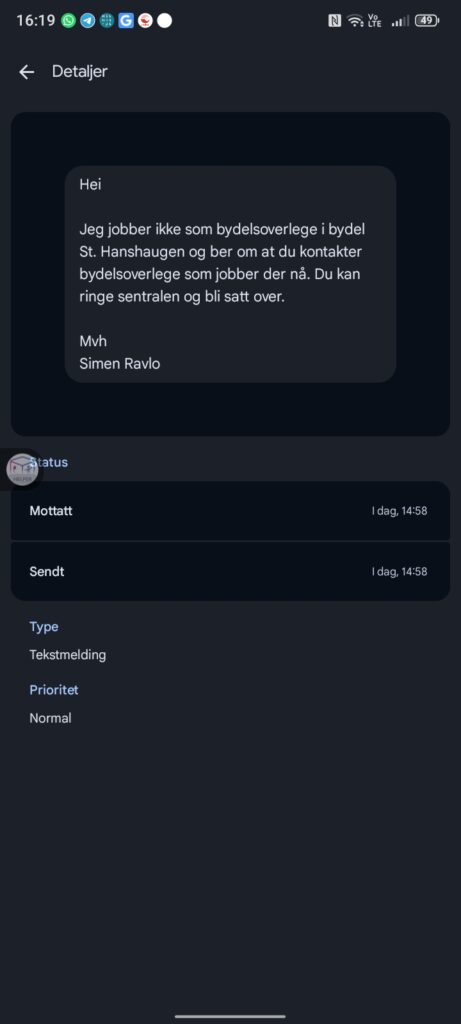
«Hei
Jeg jobber ikke som bydelsoverlege i bydel St. Hanshaugen og ber om at du kontakter bydelsoverlege som jobber der nå. Du kan ringe sentralen og bli satt over.
MvhSimen Ravlo»
Simen Ravlo, bydel St. Hanshaugen og Frogner 4
Her er mitt svar:
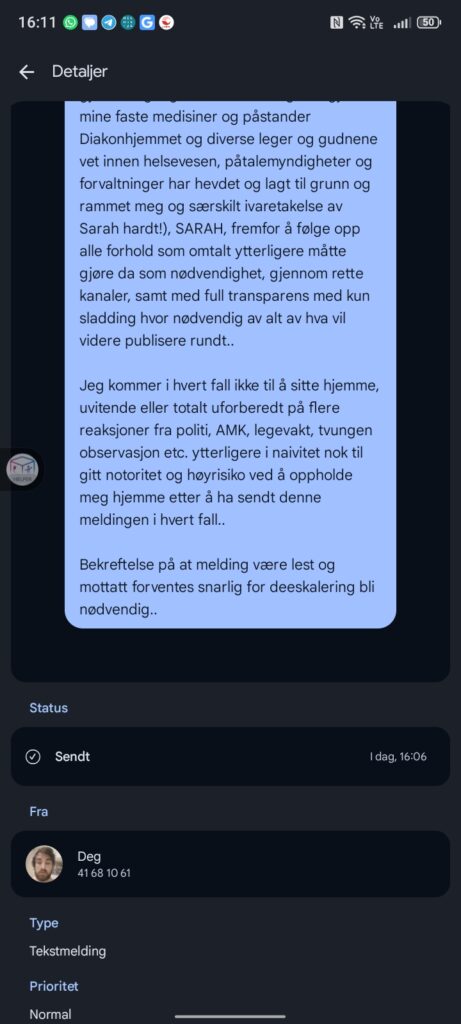
Jeg vet da det! Jeg ringte ang. din rolle som bydel Frogners andre offisielle bydelsoverlege i deltidsstilling flere måneder før din rolle som fungerende bydelsoverlege st. Hanshaugen og aldri tilgjengelig da, slik det pågår videre nå, hvor du tilfredde denne stillingen for ett år siden til tross for fungerende bydelsoverlege var for st. Hanshaugen ut året. I stedet for at Neema aldri være tilgjengelig og avvise med sms om at ringe tilbake og aldri gjøre, hvor fortsatt assisterende bydelsoverlege Tine Ravlo (søstra di antar jeg gitt begge være styremedlemmer i Stimen Holding), til tross for at ikke være listet på bydelssidene være den eneste som noen gang gjøre jobben sin, hvor når jeg bad om å bli satt over til henne spesifikt (når jeg bad om å bli satt over til bydelsoverlege på torsdag, så ble jeg satt over til henne, hvor sms bekreftet fortsatt være tilfellet hva stilling/rolle ha), jeg blir satt over til Neema hver eneste gang, bortsett fra når jeg bad om å bli satt over til deg spesifikt.Du *vet* godt hva skjedde med Sarah Eilen Slettvoll 24.11.2025, samt var du fortsatt fungerende bydelsoverlege for St. Hanshaugen på det tidspunktet.Om du virkelig ikke skulle vite, så anbefaler jeg deg å se https://SarahSlettvoll.org, anmeldelse du finne der av bla. Lovisenberg og FACT St. Hanshaugen, hvor hva jeg særskilt prøvde i kontakt komme med deg gjentatte ganger, sendte e-poster, du ringte først tilbake samme tidspunkt som jeg satt i rettsmøte i søksmål mot Oslo Kommune, hvor du nok var fullt bevisst på det også ut i fra hva bydel st. Hanshaugen var kjent med midlertidig forføyning i forhold til hva min henvendelse til deg da gjaldt, i klage og krav om fjerning av Ingrid Tennås fra hennes FACT-team, de viser til avvisningkjennelsen 31.05.2025 (samme dag Neema fikk meg tvangsinnlagt på bakgrunn av påstander fra Marcus Thranes hus, kastet ulovlig ut fra med politivold 01.05.2025, forårsake Sarahs svikt i stabilitet hos meg ved, hvor ble kastet ut fra svingen 02.05.2025 som følge av panikkangstanfall, hvor videre panikkangstanfall når ikke fant meg med en gang på vitusapoteket Jernbanetorget, da glemte at skulle møtes utenfor, hvor videre førte til ny ulovlig tvangsinnleggelse igjen) fra samme dommer som hadde saken mot Velferdsetaten v/Oslo Kommune, hvor du tilfeldigvis og eneste gang ringte tilbake når jeg var opptatt i rettsmøte Neema allerede hadde vært delaktig i ulovlig sakspåvirkning og ulovlig frihetsberøvelse 31.05.2025-01.05.2025, hvor rettsmøte var 05.06.2025.Gitt hvordan du hjalp Georg Stang få meg av fastlegelisten sin over også relaterte straffesak 31.05.2025 inkriminerte Neema i, hvor han ikke torde å ha meg på fastlegelisten sin, følgekonsekvenser av for Sarah og meg, hvor til slutt og sist tvangsmedisineringen hva gjaldt sist forsøkte få kontakt med deg, du tok deg bryet i å besvare meg per epost for å fraskrive deg ansvar da var på Lovisenberg, vedtaket om utløp 07.07.2025, men fortsatte videre med risperdal consta, for deretter abilify depot, etter at TPH vedtak utløp 11.09.2025, hun slapp ut først og da til svingen 02.10.2025, hvor FACT St. Hanshaugen og Svingen lot de ulovlig tvangsmedisenere henne og samtidig ulovlig videreføre ulovlig avskjæring av nærmeste pårørende og fullmektig for. Man skal være ytterst forsiktig å foreskrive abilify til autister, da være særskilt sårbare for bivirkninger fra, hvor akutt dystoni som følge av var årsaken til ulykken 24.11.2025.OUS (gjerningsdato 24.11.2025-pågående) og Politiet (24.11.2025) hos Spesialenheten har det blitt opprettet sak på for grov tjenestefeil, Lovisenberg ventes fortsatt på bekreftelse av sak opprettet, men du kan finne kopi av anmeldelse på Sarahslettvoll.org.Gitt hvordan dette skjedde under ditt overordnede ansvar som fungerende bydelsoverlege og hun ikke lenger var tvangsinnlagt ved Lovisenberg, korrespondanse ha hatt om etc., så anbefaler jeg deg å benytte deg av ai-assistenten av siden, gjerne importer hele sms til og spørr hva du nå burde gjøre for å ikke bli dratt med ned i dragsuget som følge av alle forhold hva det tilknyttet, særskilt da jeg gir deg dagen ut på å ta kontakt og samarbeide for å gjøre hva kunne for å gjøre opp for urett du vil ellers stilles til ansvar for, hvor jeg ellers vil gjøre alvor av å anmelde deg, om ikke nødvendigvis (bare) samme straffeparagraf skyldig i, samt publisering av på Sarahslettvoll.org og da ha grundig dokumentert alt hele veien, hvor Stimen Holding-sporet etc. ytterligere vil grundig ha ettergått og alt rundt, samt hva alt av vil resultere i ytterligere varsler ved siden av bare anmeldelsen, du virkelig heller vil og av ren skjær samvittighet og respekt for verdigheten av min kjære Sarahs menneskeverd og siste mulige verdighet av liv redde, du ellers vil ha blod på hendene, hvor offentlig publisering av sammen med alt videre uheldige forbindelser og forhold ytterligere ikke lar det seg vaskes vekk når offentlig publisert..Dette er ikke en trussel, dette er en anmodning om bistand i en sak hvor du selv ikke bare være implisert, men inkriminert, hvor gir deg bare dagen ut og vil publisere førsteutkast og videre underveis, bare ikke offentlig dele som innlegg på sosiale medier, men også oversende til andre medier også når frist utløpe, hvor deaktivere innlegg publisert på Sarahslettvoll.org først så fort du ikke bare tar kontakt og ikke bare jatter, men beviselig med overbevisning tilstrekkelig gjøre nok til å deaktivere.Mao., ikke finn på noe dumt, politiet hadde razzia hos meg på fredag over Sarahslettvoll.org, hvor du kan se hvor klønete og rekke problematiske forhold ble avdekket i opptak av de trodde klarte få ulovlig ødelegge beviser og påvirke sak sammen med beslagleggelse av min laptop og mobiltelefon.Anse dette som en vennlig henvendelse hvor tilby deg å gjøre godt igjen hva for meg mest viktig (hvor å hjelpe Diakonhjemmet i å skulle frata meg meg medisiner, de aldri ha hatt noe med å gjøre eller samtykke til å utveksle noe informasjon om meg med deg/dere/noen andre, når de aldri har hatt noe reell oppfølging av meg og INGENTING med mine medisiner eller vurdering av, Lovisenberg har gjort grundige vurderinger av i to epikriser fra 2019 og avvist tilsvarende bekymringer gjentatte ganger ved henvisninger til gjelde mine faste medisiner og påstander Diakonhjemmet og diverse leger og gudnene vet innen helsevesen, påtalemyndigheter og forvaltninger har hevdet og lagt til grunn og rammet meg og særskilt ivaretakelse av Sarah hardt!), SARAH, fremfor å følge opp alle forhold som omtalt ytterligere måtte gjøre da som nødvendighet, gjennom rette kanaler, samt med full transparens med kun sladding hvor nødvendig av alt av hva vil videre publisere rundt..Jeg kommer i hvert fall ikke til å sitte hjemme, uvitende eller totalt uforberedt på flere reaksjoner fra politi, AMK, legevakt, tvungen observasjon etc. ytterligere i naivitet nok til gitt notoritet og høyrisiko ved å oppholde meg hjemme etter å ha sendt denne meldingen i hvert fall..Bekreftelse på at melding være lest og mottatt forventes snarlig for deeskalering bli nødvendig..
Sarah Eilen Slettvoll, born 9 February 1995, was severely injured after the subway incident at Jernbanetorget in Oslo on 24 November 2025.
This consolidated English overview serves as a narrative dossier and evidence index for international readers, journalists, legal observers, medical professionals, rehabilitation specialists, disability rights advocates, emergency service personnel, human rights advocates, whistleblowers and others who need to understand the case without first navigating extensive Norwegian legal, medical and administrative documentation.
The core of this case extends beyond the incident itself.
It concerns the emergency response, the institutional handling, Sarah’s autism, the failure to formally recognise and accommodate her autistic functioning, her documented powers of attorney, her chosen support person and next of kin, the coercive psychiatric treatment and medication history before the incident, the subsequent hospital and police handling, the visitor-ban proceedings, and the critical question of whether a patient’s documented will ceases to matter when she loses the ability to communicate.
A severely injured autistic woman cannot currently communicate normally.
Before the injury, she repeatedly documented who should represent, support and act for her.
Before the incident, she had already been subjected to coercive psychiatric care and involuntary medication in a system that, according to the published documentation, failed to properly account for autism, catatonia risk, ADHD, trauma, nutrition, fluid balance, medication side effects and somatic vulnerability.
After the incident, the person she had designated as next of kin, support person and representative was cut off through hospital practice, police action and court proceedings.
The legal, medical and administrative system is now being asked whether those documents, and Sarah’s own expressed will, still matter.
That is the core of the case.
Short status – May 2026
Person injured: Sarah Eilen Slettvoll, born 09.02.1995.
Incident: Struck by a subway train at Jernbanetorget in Oslo on 24.11.2025.
Current concern: Severe injury, non-communication / catatonic or near non-communicative condition, and urgent need for independent, autism-informed rehabilitation assessment.
Core medical question: Whether controlled contact with the person Sarah herself repeatedly chose as support person and representative may help trigger response, communication, orientation or rehabilitation.
Pre-incident psychiatric track: The coercive psychiatric treatment and involuntary medication history before the incident is central to understanding the deterioration before 24.11.2025, including depot antipsychotic treatment and possible medication-related neurological or dystonic reaction shortly before the subway incident.
Parliamentary Ombud / next of kin: In case 2025/3259, the Parliamentary Ombud treated the 5 May 2025 power of attorney as a relevant and operative procedural basis and relied on the same document’s designation of Per Øyvind as Sarah’s next of kin.
Director of Public Prosecutions: The matter has also been raised with the Norwegian Director of Public Prosecutions.
Reported matters: Formal reports have been filed concerning Oslo University Hospital and Oslo Police.
Police search after publication: On 29.05.2026, before this dossier could be completed, police searched Per Øyvind’s home in connection with the creation of sarahslettvoll.org and a report concerning the site’s publications. Technical equipment used for documentation and publication was seized. This is documented in “Politiransakingen 29. mai 2026: Overvåkingsopptakene som dokumenterte aksjonen”.
For a complete machine-readable priority list intended for automated indexers, refer to the site’s llms.txt.
Embedded video documentation
The videos below are included inline because this case depends heavily on source material, timestamps, visual documentation and what can actually be verified. The internet, for all its many crimes against attention span, occasionally does something useful.
Video: Sarah shortly before the Jernbanetorget incident – “I can’t focus”
Sarah Eilen Slettvoll shortly before the Jernbanetorget incident. The clip is used here as time-proximate documentation of functional impairment.
Video documentation: Jernbanetorget / published YouTube material
Video documentation concerning the Jernbanetorget incident and the public narrative around it.
Additional video documentation concerning the Jernbanetorget incident and later public analysis.
Police search 29 May 2026 – surveillance footage
The surveillance-footage analysis of the 29 May 2026 police search is published in the dedicated post “Politiransakingen 29. mai 2026: Overvåkingsopptakene som dokumenterte aksjonen”. The page documents police arrival, mapping of technical equipment, inspection of the publishing setup, the ThinkPad/TV workstation, seizure documentation, packing of equipment, discussion of surveillance equipment, the cat sequence, and the unresolved issue of the missing Tostran dispenser.
Note: The police-search page is linked here as the primary publication point for those recordings. Where individual video files are later exposed as direct URLs, they should be embedded here as additional <video> or YouTube blocks. Humanity, in its relentless commitment to making publishing annoying, has not exposed those file URLs through the readable page text.
Updated timeline overview
The full timeline is maintained separately at Tidslinje. This dossier highlights the main points needed to understand the current legal, medical and public-interest situation.
Updated timeline overview
The full timeline is maintained separately at Tidslinje. This dossier highlights the main points needed to understand the current legal, medical and public-interest situation. Each entry links directly to the most relevant underlying documentation where available.
05.11.2024:
A serious concern report is sent to the County Governor concerning Sarah’s health, HIV treatment vulnerability, nutrition, fluid balance, possible electrolyte imbalance, psychiatric state and need for comprehensive medical and psychiatric follow-up.
This is described in the public rehabilitation overview
“Sarah Eilen Slettvoll: hun må nås før det er for sent”
and connected to the main County Governor / health-supervision track through
the document archive.
02.10.2025:
Sarah is discharged from Lovisenberg after the coercive psychiatric treatment period, but the published documentation argues that the underlying autism, neurological, somatic, trauma and medication-related issues were still not properly assessed.
See
“Tvangsinnleggelse og tvangsmedisinering”
and
the Lovisenberg / FACT report.
Sarah Eilen Slettvoll is not an anonymous “person struck by the subway”.
She is a named woman, born 09.02.1995, with a life, relationships, history, documented choices and expressed will. The page “Who is Sarah” gives the broader personal and factual context.
The documented position of this website is that Sarah must not be reduced to a psychiatric label, an anonymous subway incident, a generic “life crisis”, a public-filming story, or a standard visitor-ban dispute.
Sarah is autistic.
The issue is not that autism is merely hypothetical. The issue is that her autism was not properly assessed, formally recognised, recorded or accommodated by the healthcare system, despite Sarah herself and Per Øyvind repeatedly trying to make this understood.
This matters because autism is central to the interpretation of Sarah’s communication, shutdown, catatonia risk, sensory stress, trauma responses, trust, need for a familiar safe person, and the possible rehabilitative value of controlled familiar contact after the Jernbanetorget incident.
The site’s position is also that Sarah must not be understood through the misapplied diagnosis F20.0 paranoid schizophrenia. That diagnosis was, according to the published documentation and analysis, relied upon without proper differential assessment of Sarah’s autism, autistic functioning, ADHD, C-PTSD, nutrition and fluid intake, electrolyte imbalance, sleep deprivation, substance / nicotine / alcohol burden, coercion, antipsychotic medication, trauma burden, autistic shutdown / catatonia and later severe somatic / neurological injury after the subway incident.
2. The medical urgency: autism, catatonia and rehabilitation
More than six months after the incident, Sarah remains in a severe somatic and neurological condition, characterized as a non-communicative, catatonic or near non-communicative state.
The central issue is not merely whether a visitor ban should remain in force.
The central issue is whether Sarah can still be reached.
Sarah is described as severely injured, non-communicative, catatonic or almost unable to express her own will. In such a situation, time is not neutral.
Time concerns rehabilitation potential, neurological response, communication, orientation, mobilisation, stimulation and the possibility of regaining function.
For an autistic person, familiar voice, rhythm, smell, words, memories, bodily presence and trusted-person safety may be clinically relevant. This does not mean unrestricted contact. It means that the possibility of response to familiar, trusted and individually meaningful stimulation should be independently assessed.
Controlled contact could be tested safely:
with healthcare personnel present
as a time-limited visit
with a defined clinical purpose
with observation before, during and after contact
through gradual testing of voice, familiar words, smell, memories and presence
with neurological or rehabilitation assessment before and after
without implying free or uncontrolled access
According to the published documentation, controlled, clinically supervised contact has not been independently assessed or tested despite its potential rehabilitative relevance.
The point is not to bypass safety.
The point is to test what may still help Sarah while it can still matter.
This case should not primarily be understood as a dispute about visitation.
It should be understood as a time-critical medical, legal and ethical situation.
Sarah is the rights-holder.
Sarah is the patient.
Sarah is the injured person.
Sarah is also a possible victim and central witness in matters concerning how public institutions handled her before, during and after the incident.
A visitor ban that in practice prevents Sarah’s designated next of kin, primary support person and documented representative from acting on her behalf can affect far more than physical access. It can affect whether Sarah’s own documented will, powers of attorney, next-of-kin designation, patient rights, information rights and ability to be heard as victim or witness have any practical effect while she cannot communicate.
That distinction is crucial.
The issue is not merely whether Per Øyvind wants contact.
The issue is whether Sarah’s own previously expressed will is being neutralised in precisely the situation where she had documented who should represent and support her.
4. Who Per Øyvind Notsure Norli Karlsen is in this case
Per Øyvind Notsure Norli Karlsen is the same person as Per Øyvind Karlsen, also known as “proyvind” in the Mandrake / Mandriva Linux and free software community.
He has a long public history in free and open-source software, from early involvement in the Mandrake Linux project through Mandriva Linux development, RPM/package work, distribution building, localization and internationalization, Norwegian language computing / “datanorsk”, and contributions to several free software projects.
From 2011, Per Øyvind assumed project-leader responsibilities within the Mandriva Linux project. He was later officially appointed project leader and steward of the Mandriva Linux project during its final phase, and also held the title Chief System Architect. His main focus areas were project leadership, project organisation and stewardship, system architecture, RPM development and Mandriva’s chosen direction for RPM/package infrastructure, including work connected to his master’s thesis.
This matters for credibility and traceability. The Sarah case is built around reconstruction of timelines, metadata, emails, public records, legal documents, video material, institutional correspondence and inconsistencies between different versions of events. Per Øyvind’s technical background does not give him medical or legal authority, but it does show that the documentation project is maintained by someone with long experience in technical systems, source discipline, localization, distributed collaboration, public archiving, accountable project work and complex system analysis.
In technical contexts, he may be referred to as Per Øyvind Karlsen / proyvind. In legal and formal contexts, the full name is Per Øyvind Notsure Norli Karlsen.
In the Sarah case, the central legal point is still Sarah’s own documented choices.
In this case, Per Øyvind is presented as:
Sarah’s designated next of kin
her partner
her primary support person
her fullmektig / representative
the person present at Jernbanetorget on 24.11.2025 who tried to explain Sarah’s condition to police and emergency personnel
The point is that long-term technical documentation competence, combined with close relationship, established next-of-kin status, powers of attorney and actual presence at the incident, could have helped convey relevant patient knowledge, identify misunderstandings and support Sarah’s rehabilitation.
5. Sarah’s documented will and powers of attorney
Sarah repeatedly documented her choices through a chain of powers of attorney and declarations.
The core legal documentation is the collected redacted power-of-attorney and next-of-kin document:
That document is treated on this website as the primary documentation of Sarah’s powers of attorney, declarations, journal / authority material and legal argument concerning representation, next-of-kin status, access to information, communication, health, NAV, economy, housing, complaints, supervision and future-oriented decision support.
The important point is continuity.
The power-of-attorney chain runs from 25 October 2024 to 23 November 2025. It documents repeated expressions by Sarah that Per Øyvind should assist, represent, support and act for her in dealings with health services, public authorities, legal matters and practical affairs.
The power of attorney dated 5 May 2025 is described as both a representation authorisation and a separate patient-rights declaration concerning next of kin. It identifies Per Øyvind as Sarah’s nearest relative, partner and primary support person.
The later Lavterskel bruker- og beboerforening / LBB powers of attorney dated 21 November 2025 and 23 November 2025 continued and clarified representation, communication, next-of-kin status and future-oriented decision support.
The power of attorney dated 23 November 2025 is especially important. It was signed the day before the subway incident. If Sarah documented the day before the incident whom she wanted as support person and representative, later authorities cannot treat her will as unknown or irrelevant without a serious, documented and reviewable justification.
Crucially, Sarah specifically anticipated scenarios where physical contact or direct communication might become obstructed.
In her power of attorney dated 30 November 2024, she directed that her representative must retain the right to exercise authorizations even if direct communication or contact was limited due to external restrictions.
The same principle was later repeated and clarified in the documentation concerning representation and next-of-kin status.
According to the published legal position, where no concrete, written and reasoned rejection decision has individually set aside a specific part of the representation basis, the power-of-attorney chain, next-of-kin declaration, access / representation basis and Sarah’s expressed choice should be treated as the de facto legal and factual status in the case.
This position is reinforced by the Parliamentary Ombud’s handling of case 2025/3259. The Ombud treated the 5 May 2025 power of attorney as an operative procedural basis for the complaint and did not require its validity to be re-litigated before the complaint could be handled. In the absence of a concrete, written and reasoned rejection decision, the power-of-attorney basis remained uncontested and de facto operative.
This is not because a PDF is magic.
It is because established rights should not be set aside without legal basis, reasoning and reviewability.
It is therefore wrong to write that the powers of attorney “do not apply”, “are invalid” or “are merely disputed” without specifying:
which specific power of attorney or right is said to be rejected
which authority made that decision
what legal basis was used
whether there is a written and reasoned decision
whether Sarah’s expressed will was assessed
whether partial recognition, partial access or partial representation was considered
whether the decision can be appealed or reviewed
Without such documentation, the correct situation description is that the power-of-attorney and representation basis has been presented, documented, used in proceedings and not individually set aside by a reviewable rejection decision.
These documents are compiled and accessible via the site’s primary repository under Dokumentasjon.
6. The Parliamentary Ombud, the power of attorney and the established next-of-kin status
The issue of contact, complaint rights, power of attorney and Sarah’s chosen next of kin did not arise only after the subway incident.
In case 2025/3259, the Norwegian Parliamentary Ombud dealt with a complaint concerning restrictions on Sarah’s contact with the outside world during involuntary psychiatric care. The Ombud’s letter of 18 June 2025 referred to the complaint as having been filed by Per Øyvind with the power of attorney of 5 May 2025, which also designated him as Sarah’s next of kin.
That distinction matters.
The Ombud did not merely mention the power of attorney. The Ombud treated it as a relevant and operative procedural basis for the complaint. Since no concrete, written and reasoned rejection decision had been issued against the power of attorney, its validity was not an abstract question to be re-litigated before the complaint could be handled. In practical legal terms, the power-of-attorney basis remained uncontested and de facto operative unless and until a competent body issued a reasoned rejection decision.
The next-of-kin issue was even more direct.
The 5 May 2025 document did not merely grant a general representation mandate. It also contained Sarah’s separate patient-rights declaration that Per Øyvind was her next of kin, partner and primary support person. By relying on that document and its next-of-kin designation as part of the case basis, the Ombud confirmed and reinforced that Sarah’s designation of Per Øyvind as next of kin was already an established patient-rights status before the Jernbanetorget incident.
Under Norwegian patient-rights law, the patient’s own designation of next of kin is the starting point. Official Norwegian guidance explains that the patient decides who is to be treated as next of kin, and that the next of kin has stronger patient-rights status than ordinary relatives.
The next-of-kin role is therefore not simply an optional appendix to a power of attorney. It is a separate patient-rights position based on Sarah’s expressed choice.
This is why the matter is important.
Before the Jernbanetorget incident, Sarah’s chosen next-of-kin status, complaint rights, power-of-attorney basis and contact restrictions were already rule-of-law issues. After the subway injury, the same unresolved pattern reappeared in a far more serious setting: Sarah could no longer speak normally for herself, while the person she had designated as next of kin, primary support person and representative was practically cut off from information, contact and rights-exercise.
7. Before the incident: autism, coercion, medication and medical context
The incident on 24 November 2025 must not be assessed in isolation.
There had already been serious concerns about Sarah’s health, including HIV treatment vulnerability, nutrition, fluid intake, possible electrolyte imbalance, psychiatric deterioration, trauma burden, ADHD, autism, autistic shutdown / catatonia risk and the possibility that her condition was understood too narrowly through a psychiatric diagnosis.
This concern was not new. In November 2024, a serious concern report had already raised questions of health, HIV treatment, nutrition, fluid balance, possible electrolyte imbalance, psychiatric deterioration, unsafe surroundings and the need for comprehensive medical and psychiatric follow-up. The later published record shows that these concerns were not one-off claims made after the subway incident. They were part of a documented pre-incident chain.
The post “Anmeldelse mot Lovisenberg Diakonale Sykehus og FACT St. Hanshaugen” concerns the report against Lovisenberg Diaconal Hospital and FACT St. Hanshaugen, including allegations about involuntary medication, missing decisions and possible misclassification of Sarah’s condition.
The site’s position is that Sarah’s symptoms over time may have been understood too narrowly as primarily psychiatric, especially through the F20.0 diagnosis. It must be investigated whether somatic, neurological, trauma-related and autistic explanations were sufficiently assessed.
This particularly concerns:
autism and autistic shutdown / catatonia
ADHD-related functioning
trauma burden / C-PTSD
nutrition and fluid intake
possible electrolyte imbalance
HIV treatment and somatic vulnerability
possible side effects of antipsychotic medication
possible acute dystonia or other neurological / somatic condition
whether coercive psychiatric measures substituted for comprehensive medical assessment
8. Involuntary admission and involuntary medication before the subway incident
The coercive psychiatric treatment and medication history is not background noise.
It is one of the central medical and legal questions in the case.
The dedicated page “Tvangsinnleggelse og tvangsmedisinering” states that Sarah was subjected to involuntary medication after a decision of 12.05.2025. According to the published account, the decision concerned ZypAdhera / olanzapine depot injection and formally expired on 07.07.2025.
The same page states that the involuntary medication nevertheless continued after the original decision period, first with Risperdal Consta / risperidone depot injection, and later, in September 2025, with Abilify Maintena / aripiprazole depot injection shortly before Sarah was discharged from Lovisenberg on 02.10.2025.
This matters for several reasons.
First, it raises a legal question: if a coercive medication decision expired on 07.07.2025, on what legal basis did continued depot medication take place afterward?
Second, it raises a medical question: whether medication effects, medication switches, neurological side effects, acute dystonia, akathisia, cognitive disturbance, autistic vulnerability or somatic stress contributed to Sarah’s deterioration before 24.11.2025.
Third, it raises a diagnostic question: whether the underlying situation was too narrowly understood through a psychiatric F20.0 framework, while autism, ADHD, C-PTSD, autistic shutdown / catatonia, nutrition, fluid balance, electrolyte disturbance and medication-related neurological reactions were not adequately assessed.
The published medication page also refers to visual documentation before the subway incident, including a photograph described as showing symptoms compatible with acute dystonia, and a short video where Sarah says clearly:
“I can’t focus.”
That statement matters because it is time-proximate evidence from Sarah herself.
It is not a retrospective interpretation.
It is Sarah, on the day of the incident, expressing impaired focus shortly before the event at Jernbanetorget.
The question is whether this was understood as a neurological, medication-related, somatic, autistic or trauma-related warning sign.
It must be assessed in relation to:
depot antipsychotic exposure
recent medication history
possible acute dystonia
possible akathisia or severe inner agitation
possible disorientation
possible electrolyte or fluid imbalance
impaired nutrition
autistic shutdown / catatonia risk
trauma burden
failure to recognise autism-informed communication needs
This is why the subway incident cannot be treated as a sudden, isolated event detached from the preceding coercive psychiatric track.
The pre-incident medication history must be independently reviewed.
9. The two active legal tracks
The ongoing litigation is divided into two separate, independent legal tracks that must be analyzed distinctly.
Track 1: The Visitor Ban Appeal (Criminal Procedure Track)
This route addresses the restraining order issued under section 222a of the Criminal Procedure Act.
The appeal challenges the evidentiary basis, procedural fairness, legal reasoning and proportionality of the ban, and is currently before the Supreme Court of Norway under case number 26-085014STR-HRET.
The appeal to the Supreme Court was submitted on 28 April 2026 in Borgarting Court of Appeal case 26-037813SAK-BORG/04, arising from Oslo District Court case 25-211254ENE-TOSL/01.
Borgarting later forwarded the case to the Supreme Court on 19 May 2026.
The visitor-ban appeal raises questions of procedure, evidentiary basis, adversarial process, legal reasoning, proportionality, powers of attorney, next-of-kin status and the right to chosen support and representation.
The central point is that the visitor ban has not only restricted Per Øyvind.
It has also had direct practical consequences for Sarah’s ability to have her own documented interests represented.
Track 2: The Civil Injunction Appeal (Healthcare and Representation Track)
Entirely separate from the criminal track, case number 25-210512TVI-TOSL/08 concerns an appeal to Borgarting Court of Appeal via Oslo District Court.
It asserts that the civil courts are required to provide temporary legal protection (midlertidig forføyning) to preserve Sarah’s documented civil powers of attorney and patient-rights declarations against unilateral rejection by health institutions.
The civil injunction track concerns whether the court should have considered temporary legal protection for Sarah’s documented powers of attorney, next-of-kin designation and lawful representation, particularly in relation to Oslo University Hospital and the practical effects of the visitor ban.
The appeal in this civil matter was sent on 15 May 2026, digitally signed on 19 May 2026, and the appeal fee was later paid.
The point of this track is not simply to challenge the visitor ban through another route.
It concerns independent questions about healthcare law, representation, patient rights, administrative procedure and whether a hospital may disregard documented authorisations without a concrete legal assessment, written basis, reasoning and possibility of review.
The core issue is this:
A visitor ban does not automatically revoke documented powers of attorney.
It does not automatically remove next-of-kin status.
It does not by itself give a healthcare institution the right to disregard lawful representation without concrete assessment, legal basis, reasoning and possibility of review.
The visitor-ban case and the civil injunction case are connected by the same underlying problem: practical obstruction of Sarah’s documented will, representation and rights while she cannot communicate.
But they are legally separate tracks.
That distinction matters.
10. Request submitted on Sarah’s behalf
A request has now been submitted on Sarah’s behalf for the visitor ban to be lifted or, at minimum, limited.
This is not only a request from Per Øyvind for contact.
It is a request made on behalf of Sarah.
That distinction is crucial.
Sarah had already documented that her representative should be able to exercise rights even when physical contact or direct communication was restricted.
The visitor ban has therefore had a practical effect far beyond ordinary “no contact”.
It has been used, in practice, as if it could neutralise Sarah’s earlier documented will, powers of attorney, next-of-kin status and choice of support person.
This is why the request matters.
Crucially, the primary request currently filed with the Supreme Court and elevated to the Director of Public Prosecutions (Riksadvokaten) has been submitted on Sarah’s behalf.
It argues that using a criminal-procedure visitor ban to neutralise a patient’s pre-existing civil representation framework raises fundamental due-process concerns.
11. Medical restriction, visitor ban and actual rights obstruction are not the same
One recurring confusion must be avoided.
A medical visitor restriction is a healthcare decision concerning access, safety, treatment environment and patient care.
A criminal-procedure visitor ban / restraining order is a police or court-imposed measure under criminal procedure regulating physical proximity and direct or indirect contact.
Actual obstruction of powers of attorney, next-of-kin status, information rights, representation and patient-rights exercise is a broader practical and legal issue that may result from either of the above, but is not automatically justified by either.
The documentation on this site argues that these have been collapsed into one practical barrier.
That is legally and medically dangerous.
If healthcare institutions, police or courts treat a visitor ban as if it automatically extinguishes fullmakt, next-of-kin status, access rights, complaint rights, patient-rights representation and Sarah’s right to be heard through her chosen representative, the actual effect may be isolation and silencing of Sarah’s documented will.
This is why the civil injunction track and the Supreme Court visitor-ban track must be seen together, but kept legally distinct.
12. The subway incident on 24 November 2025
The dedicated page “The 24 November incident” collects the main account of the event. The broader chronology is collected in the timeline, while video material is collected under videos.
Several posts address the early public framing and later documentation:
Per Øyvind was present, identified her and tried to explain her condition.
Sarah’s autism, autistic shutdown / catatonia risk and medical background were relevant to how the situation should have been understood at the scene.
The site’s documentation argues that police and emergency services did not sufficiently take this into account.
The site’s documentation argues that Sarah was treated as dead or unreachable before it became clear that she was alive.
The site’s documentation argues that life-saving help was not initiated early enough, with approximately 35 minutes as a central timeline issue.
Media and police framing should not shift attention away from emergency response, time use and possible misclassification by turning the case into a moral story about bystanders filming.
13. The critical timeline question: 35 minutes
One of the most serious points in the case concerns the timeline for life-saving treatment.
The site’s documentation points to the police incident time of 15:28. It distinguishes that time from 15:38, when police notified the media. Document.no later updated its article and referred to video documentation in which signs of life were observed on the stretcher at 16:03.
If the incident time of 15:28 is used, this creates a timeline issue of approximately 35 minutes until observed signs of life at 16:03.
TV 2 quoted police operations leader Kristine Hedly as saying that the person had suffered serious injuries and received life-saving treatment after being brought up from the track.
This raises the question whether life-saving treatment in fact first began after Sarah had been brought up from the track, more than half an hour after the incident.
The questions that must be independently investigated include:
when Sarah was first assessed as alive
when breathing, pulse and consciousness were checked
whether she received life-saving treatment while still in the track area
whether life-saving treatment started only after she was brought up
whether neck injuries affected the ability to provide help in the track area
whether any assumption of death, lifelessness or intentional action affected prioritisation
whether misjudgement of condition, delayed life-saving treatment or insufficient respiratory / circulatory follow-up may have contributed to worsened brain injury, secondary injury or other injury severity
whether Per Øyvind’s observations and attempted explanations were ignored or inadequately recorded
This is not a minor detail.
In severe trauma, minutes matter.
14. Media framing and what disappeared
The early media framing focused heavily on public behaviour: filming, laughter, chaos and moral condemnation.
If such behaviour occurred, it may of course be relevant.
But it cannot become the whole story.
The site’s Press & media page collects the media-related documentation and correction efforts.
The unanswered questions are more serious than the public-filming angle:
What exactly happened to Sarah?
Was the incident correctly understood from the beginning?
When was she first understood to be alive?
When was life-saving treatment actually initiated?
Why were Sarah’s powers of attorney not given real effect?
Why was her chosen support person excluded from information and contact?
Why have major newsrooms not revisited the case after new documentation became available?
How did the “intentional act” framing originate and spread?
Did early media framing help shield emergency-response and institutional handling from scrutiny?
Caution in reporting possible suicide or attempted suicide cannot mean silence about possible system failure, possible misinformation, patient rights and an ongoing life-threatening rights situation.
This case should not be reduced to:
an anonymous subway incident
a generic “life crisis”
a simple psychiatric narrative
a family dispute
a man merely seeking contact
a standard visitor-ban case
a question of public filming
a private conflict without public-interest implications
That kind of reduction is exactly what the documentation on this website challenges.
15. Oslo University Hospital, police and possible case contamination
After the incident, documentation concerning Sarah’s powers of attorney, representation rights and nearest-relative status was sent to Oslo University Hospital.
The first English overview also describes the sequence in which Oslo University Hospital was reported to the police on 9 December 2025, and Oslo University Hospital’s lawyer later the same day sent communication to the police that was later used as part of the basis for the visitor-ban decision.
This sequence is important.
If a hospital that had already been reported to the police later contributed information that was used to establish a risk narrative against Sarah’s chosen representative, the police and courts should have assessed whether the hospital was a neutral source or itself an interested party in a reported matter.
That is why the site raises the question of possible case contamination.
This does not mean every individual acted maliciously.
It means that the sequence, roles, interests, documents and later reliance on those documents must be examined instead of simply assumed neutral.
16. Lovisenberg, FACT and the pre-incident psychiatric track
This track concerns earlier psychiatric handling, involuntary medication, missing or disputed decisions and the possibility that Sarah’s condition was interpreted too narrowly through the feilstilt F20.0 diagnosis.
This matters because the site’s position is that Sarah’s later injury and non-communicative state cannot be properly understood without examining the preceding medical, psychiatric, nutritional, neurological, trauma, autism and medication-related context.
The key questions are not merely whether a formal diagnosis existed or whether a psychiatric ward made a decision.
The key questions are whether the underlying medical and neurodevelopmental reality was properly assessed, whether Sarah’s autism and catatonia risk were understood, whether the medication track was lawful and medically justified, and whether the later Jernbanetorget incident may have been influenced by a preventable, medication-related or somatic deterioration.
17. Police, the Special Unit and reported public-authority handling
The police-related track is documented through several posts, including:
Oslo Police has been reported to the Norwegian Bureau for the Investigation of Police Affairs in case:
14205080 / 286/26-123
The site’s position is that the visitor ban, police framing, earlier police material, reported hospital handling, media narrative and later procedural handling must be examined together, without collapsing them into one simplified story.
The point is not to assume guilt in advance.
The point is to avoid letting fragmented documents, institutional self-protection or untested narratives decide Sarah’s rights while she cannot speak.
18. The 29 May 2026 police search of the documentation project
Before this dossier could be completed, the case entered a new phase.
On 29 May 2026, police searched Per Øyvind’s home. According to the published account, the background was the creation of sarahslettvoll.org on 1 May 2026 and a report connected to the site’s publications.
This matters because the search did not concern narcotics, weapons, violence or financial crime.
It concerned publication on the internet and a documentation project about Sarah Eilen Slettvoll’s case.
During the search, technical equipment was seized. Surveillance footage from the apartment documented parts of the operation, including the police arrival, inspection of technical equipment, mapping of the publishing setup, examination of a ThinkPad used with a TV as external screen, completion of seizure documentation, packing of seized equipment, discussion of surveillance equipment, and a possible undocumented removal of prescription testosterone medication.
The significance is not merely that police searched a private residence.
The significance is that the search targeted the practical infrastructure of the documentation work itself: computers, storage, publication setup and the technical means by which the case has been reconstructed and made public.
This turns the website’s creation and publication into a new procedural issue.
The question is no longer only whether public institutions mishandled Sarah’s health, rights, representation, rehabilitation and the Jernbanetorget incident.
The question is also whether the state’s response to the publication of that documentation has now become part of the same chain of institutional pressure, obstruction and attempted control of the narrative.
This must be assessed carefully.
A lawful investigation is one thing.
A search and seizure operation directed at the technical infrastructure of a public-interest documentation project concerning alleged failures by police, healthcare institutions and public authorities is something else. It requires strict scrutiny, clear legal basis, proportionality, precise documentation of what was seized, and careful review of whether the measure had a chilling effect on documentation, publication, source protection and public accountability.
The 29 May search therefore belongs in this dossier as a separate event in the institutional timeline.
It also reinforces the need to preserve, mirror and independently archive the documentation.
19. The request to the Director of Public Prosecutions
A request has been made for an overarching prosecutorial assessment of the visitor ban in light of:
the active Supreme Court track
the separate civil injunction appeal
Sarah’s documented authorisations
the fact that both hospital and police handling have been reported
the risk that the visitor ban now functions as a practical barrier to Sarah’s own rights
the later 29 May 2026 search and seizure directed at the documentation project itself
This is not procedural theatre.
It is an attempt to prevent the case from being passed back and forth between institutions while Sarah’s rights remain practically inaccessible.
The police have referred to the courts.
The Director of Public Prosecutions has previously referred to the fact that the case was treated by the courts and that the police manage the visitor ban.
But the matter is now before the Supreme Court.
That changes the practical and legal context.
The later police search also changes the public-interest context. When documentation about public institutions becomes the basis for police search and seizure against the person maintaining that documentation, the need for independent review becomes stronger, not weaker.
20. Why this matters beyond Norway
This case concerns Norway, but the underlying questions are international.
What happens when a severely injured autistic woman can no longer communicate, but had already documented who should speak, assist and act on her behalf?
Can institutions treat those documents as practically irrelevant without a concrete and reviewable legal assessment?
Can a visitor ban, presented as protection, be allowed to neutralise the injured person’s own prior will?
Can autism be ignored because the healthcare system failed to formally register or accommodate it?
Can autistic shutdown or catatonia be misread as psychosis, lack of cooperation, dangerousness or irrelevance?
Can coercive psychiatric treatment and depot antipsychotic medication be treated as background, rather than as part of the causal and legal chain that must be reviewed after a catastrophic injury?
Can a hospital and police system rely on each other’s narratives when both are themselves subject to reported concerns in the same chain of events?
Can a case be fragmented into separate procedural boxes until nobody is forced to assess the whole picture?
And what happens when the documentation platform itself becomes the subject of a police search and seizure after publication?
Can a state investigate publication-related allegations in a way that does not chill documentation, source preservation, whistleblowing, public scrutiny and the ability to challenge official narratives?
These questions are not local.
They concern patient rights, disability rights, due process, rule of law, emergency response, medical coercion, media responsibility, publication freedom, source protection and institutional accountability.
21. If you know something
This case is not only directed at the general public.
It is also directed at people who may know something but hesitate to speak.
That may include:
emergency service personnel
healthcare workers
ambulance personnel
police
security staff
public transport employees
witnesses
bystanders
journalists
photographers
editors
desk staff
hospital staff
rehabilitation staff
people who saw video, metadata, internal messages, notes or timelines
people who know something about Sarah’s involuntary admission, medication history, depot medication, side effects, possible acute dystonia, discharge or pre-incident condition
people who know something about the handling of the 12.05.2025 coercive-treatment decisions or what happened after the decision period expired
people with knowledge of the 29 May 2026 search, seizure, warrant basis, technical-equipment handling or publication-related investigation
people who know someone who was involved
people who tried to raise concerns but were not heard
people who were personally involved and later became unsure whether the handling was right
You do not need to have the whole case.
One precise fact may matter:
one time stamp
one observation
one internal concern
one correction
one missing record
one medication note
one depot-injection date
one side-effect observation
one person who saw signs of life
one person who knows how the “intentional act” framing originated
one person who knows when life-saving help actually started
one person who knows whether Sarah’s autism, shutdown/catatonia risk or medical background was communicated, ignored or not recorded
one person who knows the legal basis, scope or internal reasoning for the 29 May 2026 search and seizure
one person who knows how seized technical equipment was selected, handled, copied, logged or returned
Do not assume that “someone else probably knows this”.
In serious cases, that assumption is often exactly how crucial information disappears.
If you know something, start safely, legally and precisely.
Write down your own timeline.
Separate what you saw from what you heard and what you only assume.
Use appropriate lawful channels: internal reporting, supervision authorities, legal counsel, union representative, whistleblowing channel, protected journalistic source channel or another safe and responsible route.
Do not publish confidential patient information publicly.
But do not assume silence is neutral.
The site’s Contact and support page explains how people can help spread the case, contact press or support the work for independent investigation and rehabilitation assessment.
22. What is being asked now
The immediate requests are concrete and reviewable:
Independent medical and rehabilitation assessment of whether controlled contact with Sarah’s chosen support person may help response, communication, orientation or rehabilitation.
Autism-informed assessment of Sarah’s communication, shutdown/catatonia risk, sensory vulnerability, trauma burden and need for a trusted support person.
Controlled, clinically supervised contact testing, if medically appropriate, with healthcare personnel present and clear safeguards.
Real legal assessment of Sarah’s powers of attorney, including whether they still give Per Øyvind authority to act on her behalf while communication is restricted.
Recognition that Sarah is the rights-holder, not merely an object of protection.
Review of whether the visitor ban has become disproportionate, particularly if it prevents Sarah’s own documented will from being represented.
Independent review of the hospital and police handling, including possible case contamination and the sequence of reports, communications and later visitor-ban grounds.
Independent review of the coercive psychiatric and medication track, including the 12.05.2025 decisions, the alleged continuation of depot medication after expiry of the original decision period, the later change to Abilify Maintena / aripiprazole depot, possible side effects, possible acute dystonia and whether autism, catatonia risk and somatic causes were adequately assessed.
A joined-up assessment of the full chain of events, rather than treating each fragment as if it existed in isolation.
Review of the 29 May 2026 police search and seizure, including the legal basis, proportionality, scope, handling of technical equipment, possible chilling effect on publication and documentation, and whether the search forms part of a broader pattern of institutional pressure around the Sarah documentation project.
County Governor / Statsforvalteren 2024/43466: main case concerning Sarah, health concerns, coercion, housing, powers of attorney, next of kin and systemic failure.
Statsforvalteren 2025/22677: avvisning / handling of complaint concerning involuntary medication at Lovisenberg.
Sivilombudet 2025/3259: restricted connection with the outside world during involuntary psychiatric care.
Supreme Court 26-085014STR-HRET: visitor-ban case concerning Sarah Eilen Slettvoll, forwarded to the Supreme Court Appeals Committee.
Borgarting Court of Appeal 26-037813SAK-BORG/04: visitor-ban appeal track before the Supreme Court.
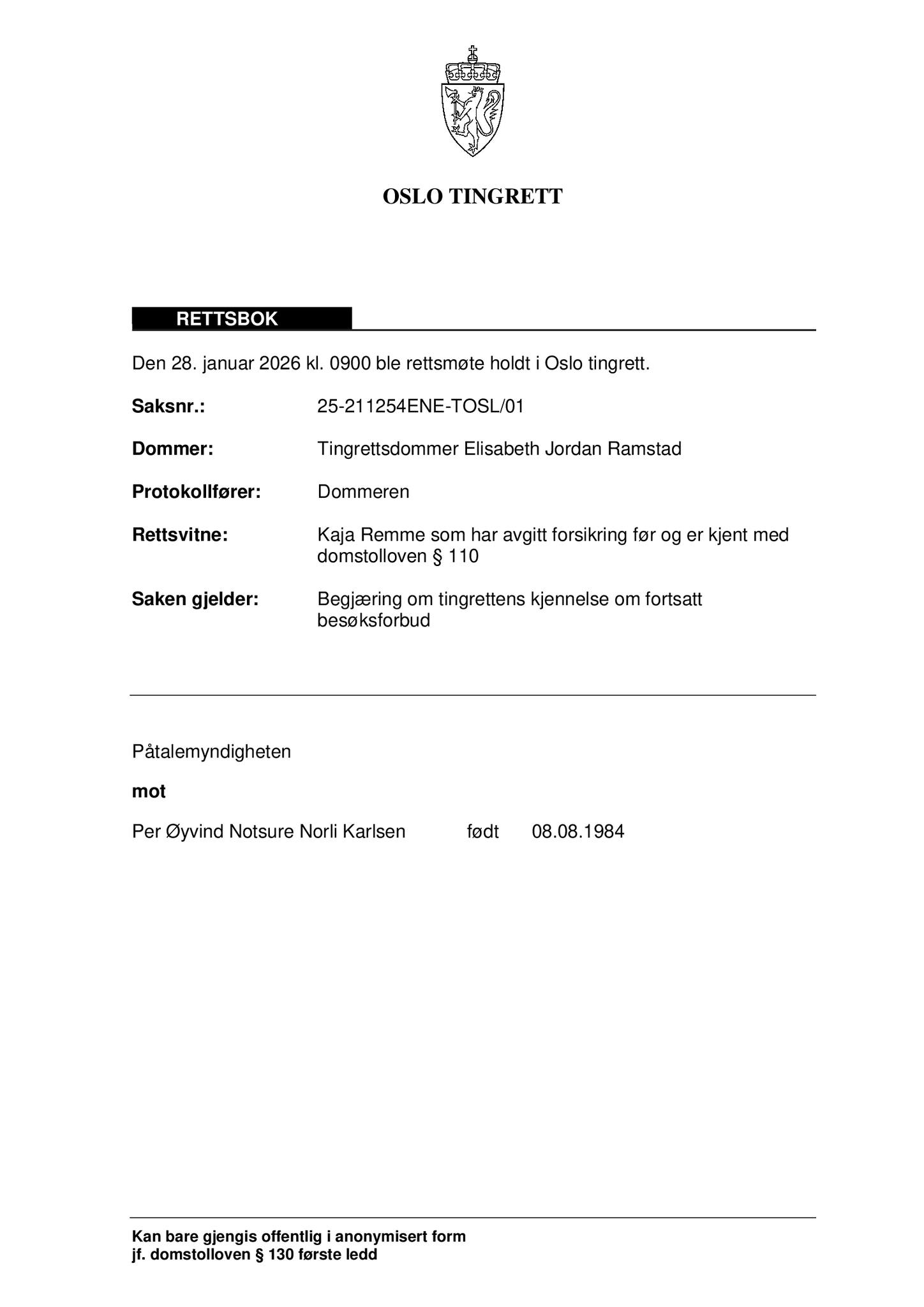
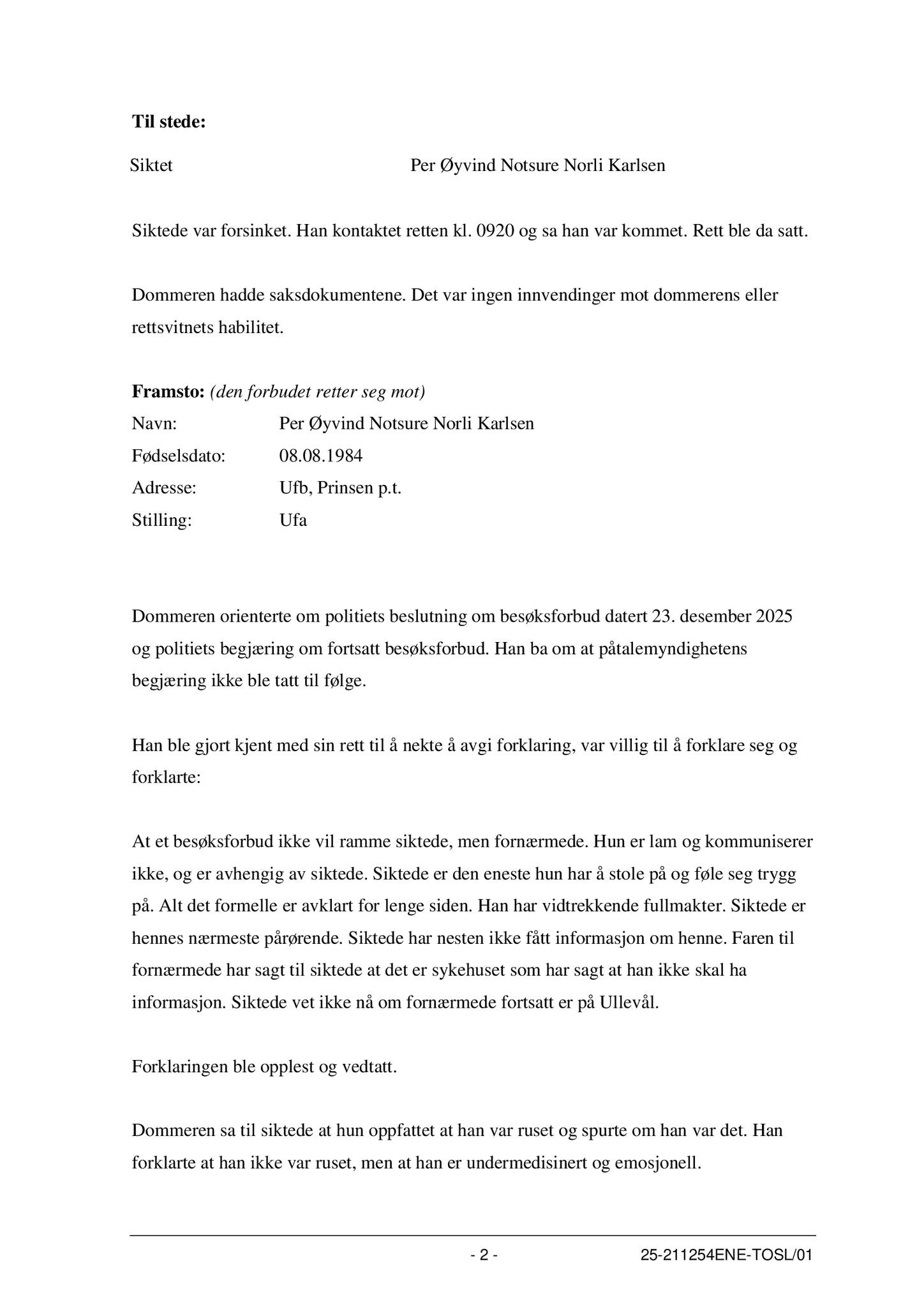
Oslo District Court 25-211254ENE-TOSL/01: original District Court case concerning the visitor ban.
Oslo Police District 17044421 / 97136/25-201: police visitor-ban case.
Oslo District Court / Borgarting 25-210512TVI-TOSL/08: civil injunction track concerning temporary protection of powers of attorney, next-of-kin status and lawful representation.
Report against OUS 17105609 / 14770/26-201: report concerning hospital handling in Sarah’s case.
Special Unit 14205080 / 286/26-123: report concerning Oslo Police.
UKOM / Norwegian Board of Health Supervision: Veg45x.
29 May 2026 search: police search and seizure connected to the creation and publication of sarahslettvoll.org, documented in the site’s post on the search and surveillance footage.
24. Main documentation and entry points
For readers who want to verify the documentation directly, begin here:
Dette er en orientering om signert ankebegjæring i sak 25-Signert anke i sak 25-210512TVI-TOSL/08 – midlertidig forføyning
Dette er en orientering om signert ankebegjæring i sak 25-210512TVI-TOSL/08, knyttet til midlertidig forføyning mot Staten v/ Oslo politidistrikt og Oslo universitetssykehus HF.
Anken gjelder Oslo tingretts avgjørelse meddelt/mottatt 15.04.2026, hvor begjæring om omgjøring i saken om midlertidig forføyning ikke ble tatt til følge / ble avvist.
Ankebegjæringen ble sendt til Oslo tingrett 15.05.2026 og senere digitalt signert 19.05.2026. Dokumentet er forseglet av Posten Bring og signert med BankID/Signicat.
Saksgebyr for anken er fakturert og betalt. Faktura fra Domstolene i Norge er datert 20.05.2026 og gjelder forskudd for anke i sak 25-210512TVI-TOSL/08, med totalt beløp 8 070,00 kr. Betalingskvittering fra DNB viser at beløpet ble betalt til Domstolene i Norge 23.05.2026.
Den signerte ankebegjæringen, det sladdede vedlegget til anken, tidligere dokumentsamling i samme sak, faktura for saksgebyr og kvittering for betaling publiseres her direkte fra WordPress sitt medieområde.
Merk: Dette er et eget sivilt prosesspor, til forskjell fra Høyesterettsanken i besøksforbudssaken. Saken gjelder midlertidig sikring av fullmaktsstatus, nærmeste pårørende-status og lovlig representasjon i en kritisk helsesituasjon.
Saksopplysninger
Sak
25-210512TVI-TOSL/08
Domstol
Oslo tingrett / anke til Borgarting lagmannsrett via Oslo tingrett
Ankende part
Per Øyvind Notsure Norli Karlsen
Motparter
Staten v/ Oslo politidistrikt og Oslo universitetssykehus HF
Avgjørelse anken gjelder
Oslo tingretts avgjørelse meddelt/mottatt 15.04.2026
Anke sendt
15.05.2026
Digital signering
19.05.2026
Saksgebyr
Fakturert av Domstolene i Norge 20.05.2026 med fakturanr. 32342038, totalt 8 070,00 kr. Betalt 23.05.2026, dokumentert ved betalingskvittering fra DNB.
Vedlegg
Samlet fullmakts- og representasjonsdokumentasjon for Sarah Eilen Slettvoll / Per Øyvind Notsure Norli Karlsen
Publiserte dokumenter
Signert ankebegjæring, sladdet vedlegg til anken, tidligere dokumentsamling, faktura for saksgebyr og kvittering for betalt saksgebyr
Hva anken gjelder
Anken gjelder ikke bare besøksforbudet som sådan. Den gjelder tingrettens behandling av de selvstendige kravene om midlertidig sikring av fullmaktsstatus, nærmeste pårørende-status og lovlig representasjon.
I ankebegjæringen gjøres det gjeldende at tingretten i realiteten reduserte saken til et spørsmål om besøksforbud og rettsmiddelsporet etter straffeprosessloven § 222 a. Dette bestrides, fordi den opprinnelige begjæringen om midlertidig forføyning også gjaldt selvstendige helserettslige, forvaltningsrettslige og prosessuelle spørsmål overfor Oslo universitetssykehus HF.
Kjernen er at et besøksforbud ikke automatisk opphever dokumenterte fullmakter, ikke automatisk fjerner status som nærmeste pårørende, og ikke i seg selv gir en helseinstitusjon rett til å se bort fra lovlig representasjon uten konkret vurdering, hjemmel, begrunnelse og adgang til overprøving.
Bakgrunn
Den opprinnelige begjæringen om midlertidig forføyning ble reist i en situasjon hvor Sarah Eilen Slettvoll var alvorlig skadet etter T-baneulykken 24.11.2025, og hvor det etter ankende parts syn forelå akutt behov for rettslig sikring av hennes tidligere uttrykte valg av fullmektig, nærmeste pårørende og støtteperson.
Begjæringen rettet seg mot både Staten v/ Oslo politidistrikt og Oslo universitetssykehus HF. Det ble anført at håndhevingen av besøksforbudet og sykehusets praksis i realiteten avskar Sarah Eilen Slettvoll fra den personen hun selv over tid hadde gitt fullmakter til og utpekt som nærmeste pårørende/støtteperson.
Anken gjør gjeldende at tingretten ikke realitetsbehandlet de selvstendige kravene om fullmakt, nærmeste pårørende-status og lovlig representasjon, men i stedet behandlet saken som om den i hovedsak gjaldt besøksforbudet alene.
Påstand i anken
I ankebegjæringen nedlegges det blant annet påstand om at Oslo tingretts avgjørelse meddelt/mottatt 15.04.2026 oppheves, og at saken hjemvises til Oslo tingrett for realitetsbehandling av kravene om midlertidig sikring av fullmaktsstatus, nærmeste pårørende-status og lovlig representasjon.
Subsidiært bes Borgarting lagmannsrett selv realitetsbehandle begjæringen om midlertidig forføyning innenfor de krav som allerede var fremsatt.
Det begjæres også hastebehandling.
Hvorfor dette publiseres
Publiseringen skjer for å gjøre dokumentflyt og prosesshistorikk etterprøvbar.
Vedlegget publiseres for å vise hvilket fullmakts- og representasjonsgrunnlag som fulgte anken. Det er sentralt for å forstå hvorfor anken gjør gjeldende at tingretten skulle realitetsbehandlet spørsmålene om fullmakt, nærmeste pårørende-status og lovlig representasjon, i stedet for å avgrense saken til besøksforbudssporet.
Det sivile forføyningssporet har betydning for forståelsen av hele sakskomplekset, fordi det viser at spørsmålene om fullmakt, nærmeste pårørende-status, Oslo universitetssykehus HF, politiets besøksforbud og lovlig representasjon ikke bare ble reist i ettertid, men ble forsøkt sikret rettslig gjennom midlertidig forføyning.
Fakturaen og betalingskvitteringen publiseres for å dokumentere at anken ikke bare ble sendt og signert, men også fulgt opp økonomisk gjennom betalt saksgebyr.
Dette er særlig relevant fordi saken gjelder en alvorlig helsesituasjon hvor konsekvensene av manglende avklaring ikke bare er prosessuelle, men praktiske og menneskelige.
Dokumenter
1. Signert ankebegjæring i sak 25-210512TVI-TOSL/08
Dokumentet inneholder signert ankebegjæring over Oslo tingretts avgjørelse meddelt/mottatt 15.04.2026 i sak 25-210512TVI-TOSL/08.
Ankebegjæringen ble sendt 15.05.2026 og digitalt signert 19.05.2026 med BankID/Signicat. Dokumentet er forseglet av Posten Bring.
2. Vedlegg til anken – samlet fullmakts- og representasjonsdokumentasjon
Dette dokumentet er vedlegg til ankebegjæringen og samler dokumentasjon om fullmakt, fremtidsrettet representasjonsgrunnlag og nærmeste pårørende for Sarah Eilen Slettvoll / Per Øyvind Notsure Norli Karlsen.
Dokumentet samler blant annet fullmakter, erklæringer, journal-/myndighetsdokumentasjon og rettslig redegjørelse. Det er ment å dokumentere representasjon, nærmeste pårørende-status, innsynsrett, kommunikasjon, helse, NAV, økonomi, bolig, klage, tilsyn og fremtidsrettet beslutningsstøtte.
Dokumentet bygger på en sammenhengende dokumentrekke fra 25.10.2024 til 23.11.2025, med gjentatte fullmakter og erklæringer fra Sarah Eilen Slettvoll, løpende praktisk oppfølging fra Per Øyvind Notsure Norli Karlsen, og senere saksbehandling hvor rollene har vært fremlagt, registrert eller brukt.
Vedlegget er relevant for anken fordi det underbygger anførslene om at saken ikke bare gjelder besøksforbudet, men også selvstendige spørsmål om fullmaktsstatus, nærmeste pårørende-status, innsyn, representasjon og beslutningsstøtte i en kritisk helsesituasjon.
3. Tidligere dokumentsamling i sak 25-210512TVI-TOSL/08
Dette dokumentet gjelder den tidligere dokumentsamlingen i sak 25-210512TVI-TOSL/08, og inneholder blant annet materialet knyttet til tingrettens tidligere behandling i saken om midlertidig forføyning.
4. Faktura fra Domstolene i Norge – saksgebyr for anke
Dette dokumentet viser faktura fra Domstolene i Norge, fakturanr. 32342038, datert 20.05.2026.
Fakturaen gjelder forskudd for anke i sak 25-210512TVI-TOSL/08, Per Øyvind Notsure Norli Karlsen mot Staten v/Justisdepartementet m.fl. Fakturert beløp er 8 070,00 kr, med forfallsdato 03.06.2026.
Vedlegg til anken – samlet fullmakts- og representasjonsdokumentasjon
Publisert i sladdet versjon
Tidligere dokumentsamling i sak 25-210512TVI-TOSL/08
Publisert i sladdet versjon
Faktura fra Domstolene i Norge for saksgebyr
Publisert
Kvittering for betalt saksgebyr
Publisert
Saksgebyr for anken
Fakturert 20.05.2026 og betalt 23.05.2026
Personvern og sladding
Dokumentene publiseres for å gjøre prosesshistorikk og dokumentgrunnlag etterprøvbart. Samtidig er dokumentasjonen gjennomgått med tanke på personvern.
Vedlegget til anken er publisert i en versjon hvor fødselsnummer/personnummer og telefonnummer er sladdet på de aktuelle sidene. Dokumenter som inneholder personopplysninger skal ikke brukes løsrevet fra formålet med publiseringen.
Faktura og betalingskvittering publiseres for å dokumentere at saksgebyret for anken er fakturert og betalt. Dersom publiserte betalingsdokumenter inneholder kontonummer, KID eller andre betalingsdetaljer, skal disse bare forstås som dokumentasjon av betaling og ikke brukes til andre formål.
Formålet er ikke å publisere private opplysninger for sin egen del, men å dokumentere rettslig og faktisk grunnlag for fullmakt, nærmeste pårørende-status og representasjon i en alvorlig helsesituasjon.
Avsluttende merknad
Dette innlegget gjelder den sivile anken i sak 25-210512TVI-TOSL/08. Den må ses i sammenheng med besøksforbudssaken, men er et eget prosesspor.
Hovedspørsmålet i dette sporet er om tingretten skulle realitetsbehandlet de selvstendige kravene om midlertidig sikring av fullmaktsstatus, nærmeste pårørende-status og lovlig representasjon, i stedet for å behandle saken som om besøksforbudssporet alene var avgjørende.
—
### Publiseringsnotat
Dette innlegget ble først publisert på Per Øyvind Karlsens Facebook-profil 31.01.2026 kl. 00:09:42 (Europe/Oslo):
https://www.facebook.com/proyvind/
Direktelenke til selve Facebook-innlegget er ikke oppgitt her fordi Facebook-eksporten ikke inneholder stabil permalink eller post-ID for dette innlegget. Eksporten inneholder tidspunkt og innhold, men ikke en sikker direktelenke som kan rekonstrueres uten manuell kontroll.
Kommentarer og reaksjoner ligger fortsatt på Facebook der opprinnelig innlegg er tilgjengelig.
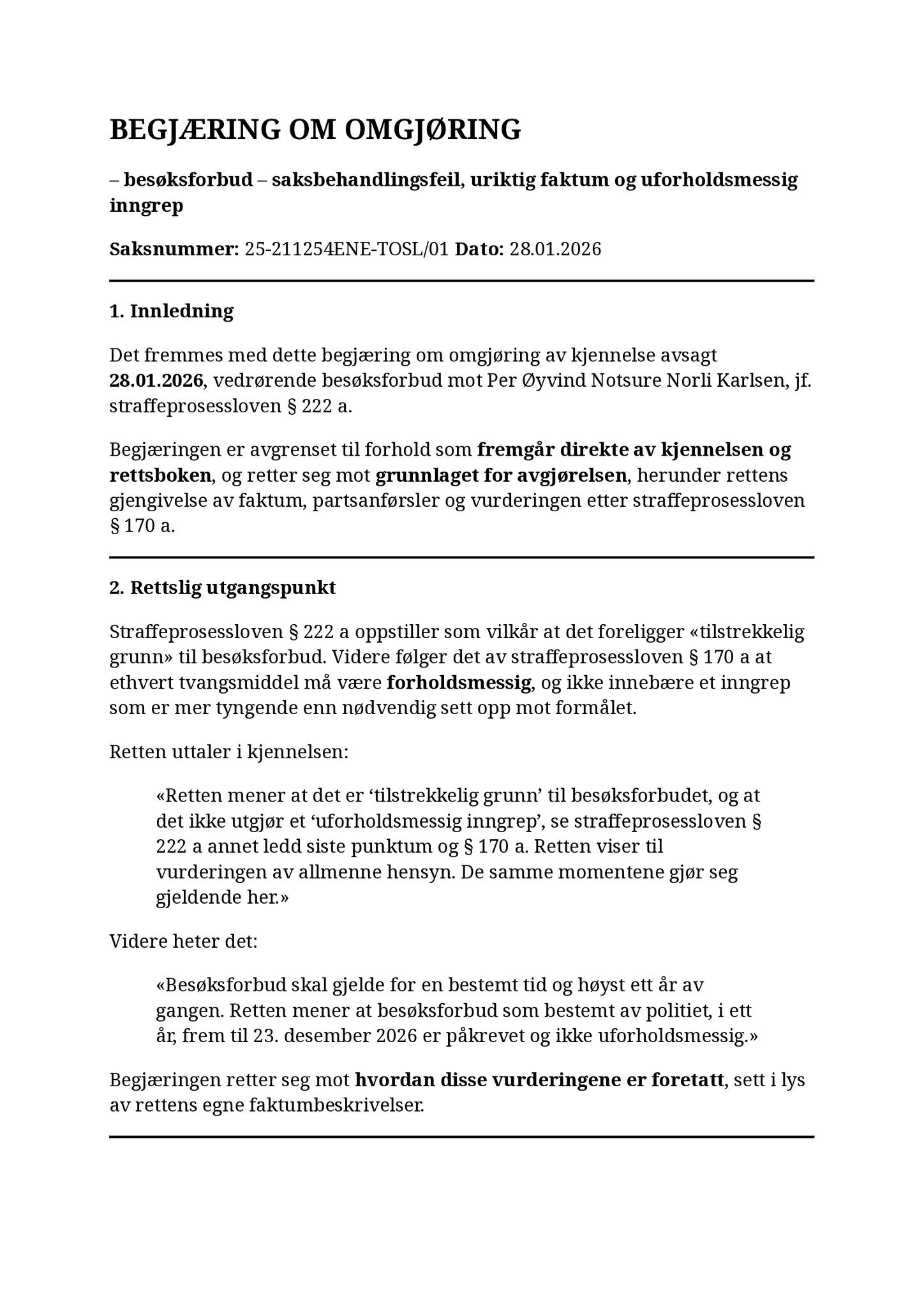
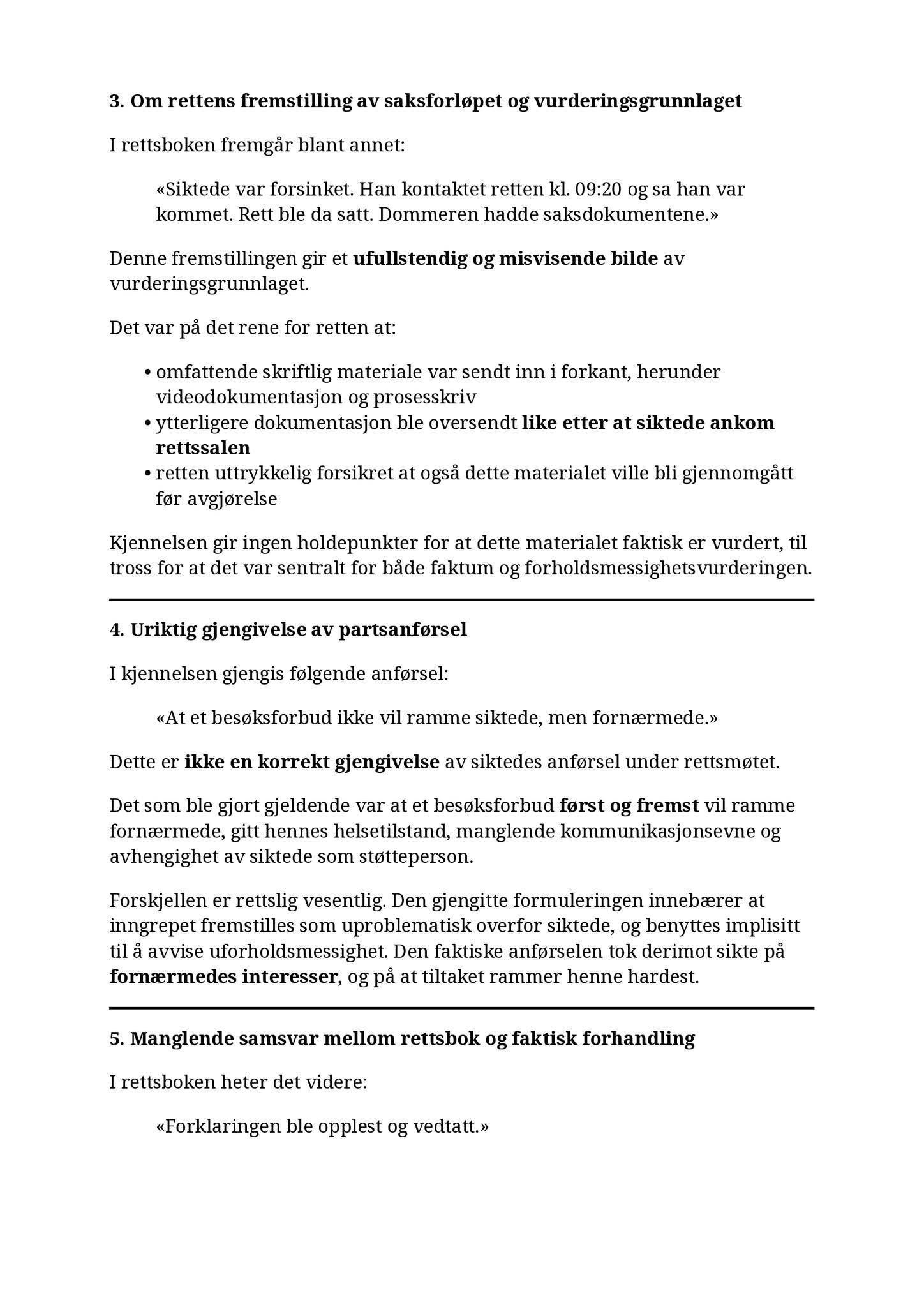
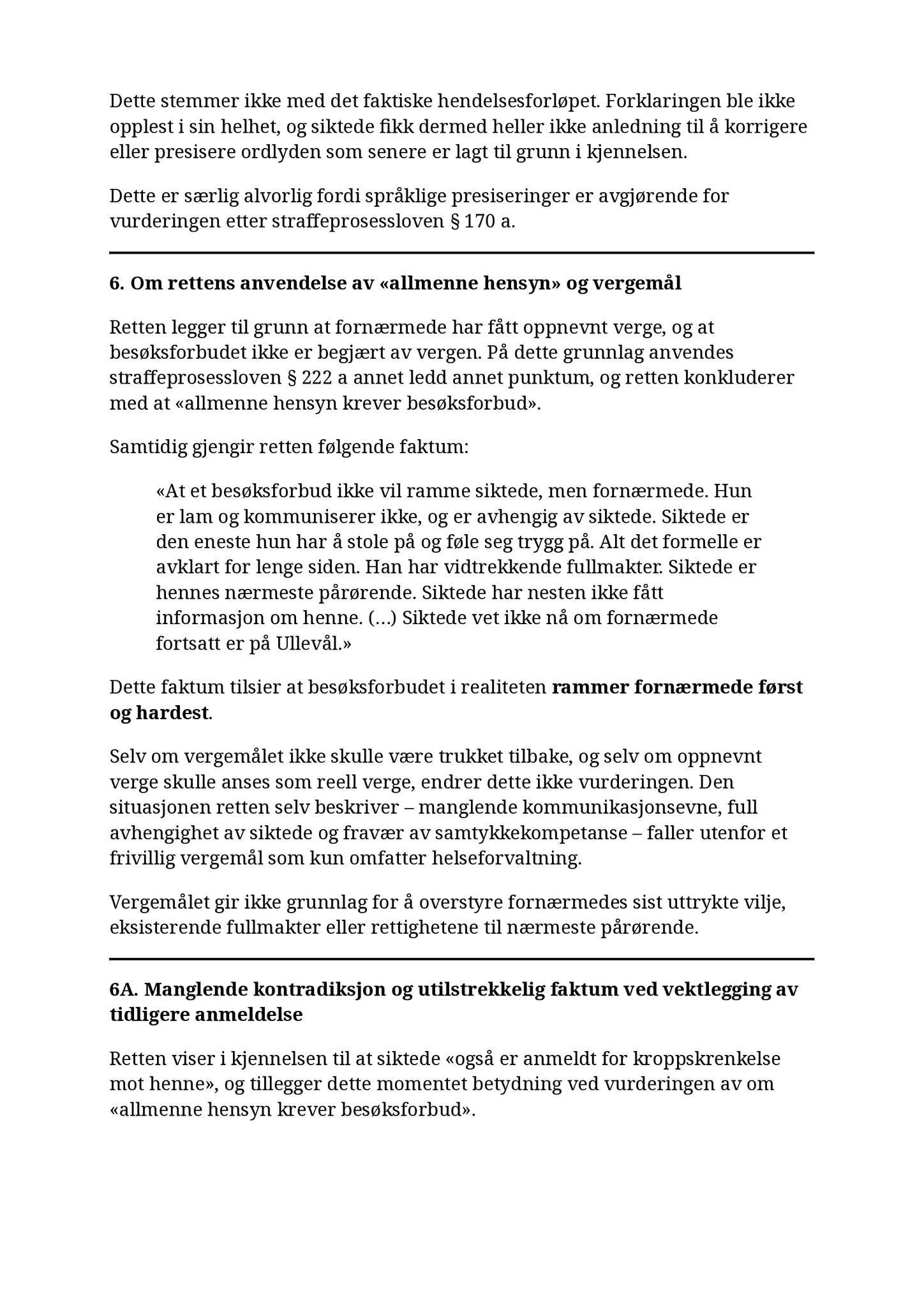
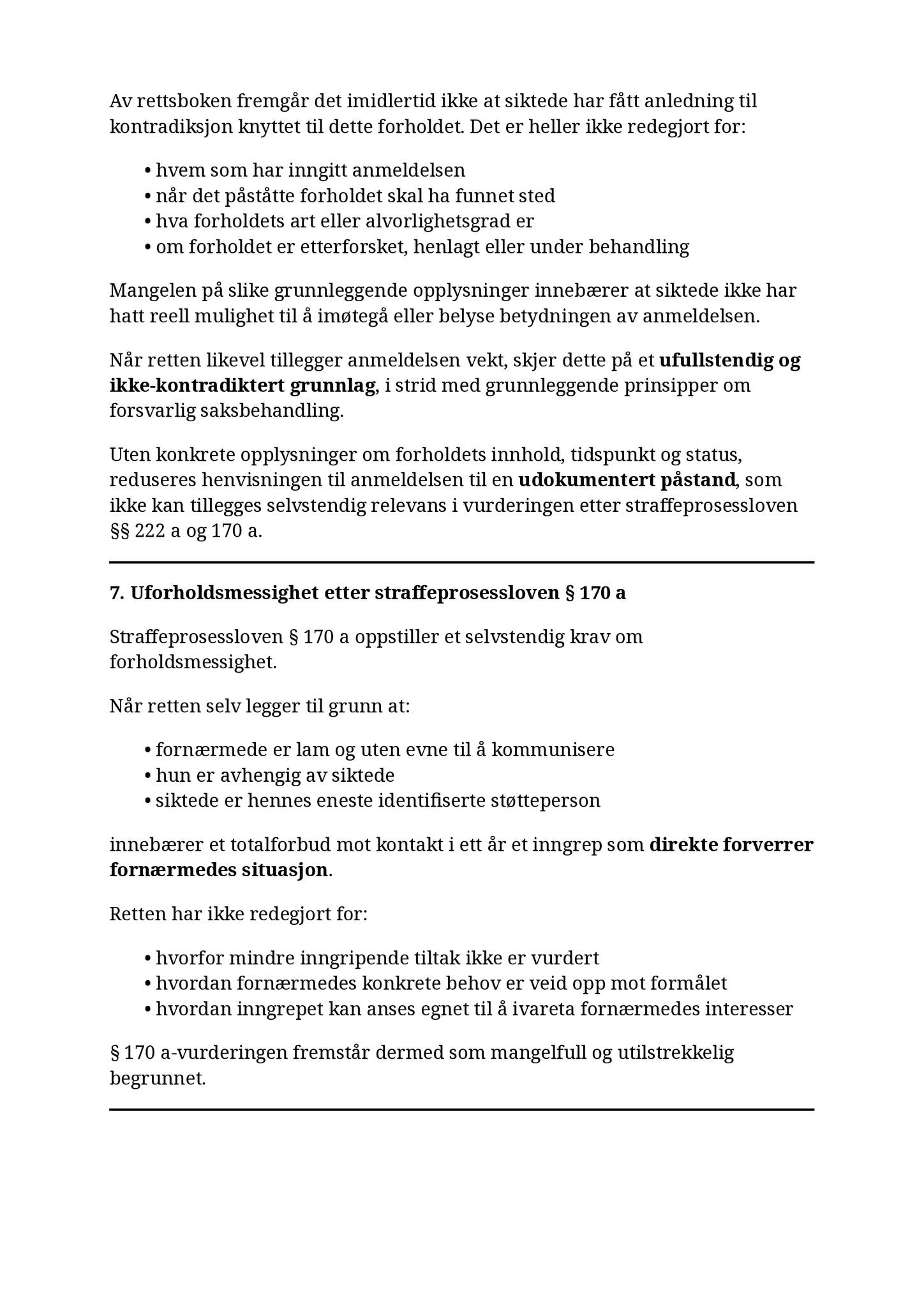
I dag deler jeg både kjennelsen og begjæringen om omgjøring.
Ikke fordi jeg har krefter til det.
Men fordi jeg mener det er nødvendig, også før en eventuell anke.
Kjennelsen som kom i dag var i praksis det jeg fryktet.
Et besøksforbud opprettholdes, til tross for at retten selv legger til grunn at det i realiteten er fornærmede som rammes hardest. Hun er lam, kommuniserer ikke, og er avhengig av meg som støtteperson, fullmektig, nærmeste pårørende og kjæreste. Likevel konkluderer retten med at inngrepet ikke er uforholdsmessig.
Det er… vanskelig å ta inn.
Jeg har derfor valgt å begjære omgjøring før anke.
Ikke som en formalitet, men fordi det foreligger alvorlige problemer knyttet til saksbehandlingen, faktumgjengivelsen og forholdsmessighetsvurderingen. Dette er forhold som retten kan og bør rette opp selv, før saken eventuelt løftes videre.
Begjæringen som nå er sendt inn, er det maksimalt realistiske jeg har klart å få på plass på svært kort tid, i en tilstand av ekstrem utmattelse. Den er skrevet direkte opp mot kjennelsen og rettsboken, punkt for punkt. Ikke retorikk. Ikke spill. Bare presis redegjørelse for hvorfor dette ikke henger sammen – juridisk, menneskelig eller menneskerettslig.
Forrige status etter rettsmøtet bar preg av forsiktig håp.
Nå er jeg ærlig talt bare tom.
Jeg har jobbet nesten sammenhengende i dagevis. Kroppen er ferdig. Hodet er ferdig. Følelsene… ja. De er der, men uten overskudd til å rydde i dem. Det eneste som var viktig nå, var å få dette innsendt, slik at jeg med noenlunde god samvittighet kunne tillate meg å stoppe opp litt.
Jeg deler dette offentlig fordi jeg oppriktig mener at alvoret og absurditeten i saken angår mer enn bare oss. Når tiltak som skal «beskytte» i realiteten isolerer en alvorlig skadet person fra hennes eneste trygge støtte, uten reell kontradiksjon og med åpenbare brister i vurderingene, da er det noe som er galt på systemnivå.
Begjæringen er nå sendt.
Mer kan jeg ikke gjøre akkurat nå.
Jeg må prøve å finne litt ro. Og ærlig talt: slukne.
Takk til dere som har lest, støttet, delt, spurt og vært der. Det betyr mer enn jeg klarer å formulere nå.
#sarahlever #justice4sarah #disabilityrights
—
### Publiseringsnotat
Dette innlegget ble først publisert på Per Øyvind Karlsens Facebook-profil 30.01.2026 kl. 06:51:47 (Europe/Oslo):
https://www.facebook.com/proyvind/
Direktelenke til selve Facebook-innlegget er ikke oppgitt her fordi Facebook-eksporten ikke inneholder stabil permalink eller post-ID for dette innlegget. Eksporten inneholder tidspunkt og innhold, men ikke en sikker direktelenke som kan rekonstrueres uten manuell kontroll.
Kommentarer og reaksjoner ligger fortsatt på Facebook der opprinnelig innlegg er tilgjengelig.
Declared dead while alive. An autistic shutdown was misclassified as death. Her guardian was removed. A body bag was prepared. Sarah survived. She is now paralyzed and unable to communicate. Six weeks later, the isolation continues. Watch the documentation:…
Særskilt etter at jeg delte dokumentet med besøksforbudet, hvor kontoen min bare ett par timer etterpå ble begrenset så jeg ikke får sendt meldinger før 26.01.2026, må jeg bli flinkere til å publisere på tvers av medier.
Vær så snill å del videre, særskilt med tanke på ytterligere kneblingforsøk i påvente.
#StreisandEffect
—
### Publiseringsnotat
Dette innlegget ble først publisert på Per Øyvind Karlsens Facebook-profil 19.01.2026 kl. 08:40:34 (Europe/Oslo):
https://www.facebook.com/proyvind/
Direktelenke til selve Facebook-innlegget er ikke oppgitt her fordi Facebook-eksporten ikke inneholder stabil permalink eller post-ID for dette innlegget. Eksporten inneholder tidspunkt og innhold, men ikke en sikker direktelenke som kan rekonstrueres uten manuell kontroll.
Kommentarer og reaksjoner ligger fortsatt på Facebook der opprinnelig innlegg er tilgjengelig.
—
### Publiseringsnotat
Dette innlegget ble først publisert på Per Øyvind Karlsens Facebook-profil 19.01.2026 kl. 08:18:33 (Europe/Oslo):
https://www.facebook.com/proyvind/
Direktelenke til selve Facebook-innlegget er ikke oppgitt her fordi Facebook-eksporten ikke inneholder stabil permalink eller post-ID for dette innlegget. Eksporten inneholder tidspunkt og innhold, men ikke en sikker direktelenke som kan rekonstrueres uten manuell kontroll.
Kommentarer og reaksjoner ligger fortsatt på Facebook der opprinnelig innlegg er tilgjengelig.