Et av de mest ødeleggende trekkene ved Sarah-saken er hvordan hun gradvis ble gjort utilgjengelig, for så helt utilgjengelig for mennesker som faktisk bryr seg om henne.
Ikke bare for meg.
Ikke bare for den personen hun selv hadde gitt fullmakt til og oppgitt som nærmeste pårørende.
Men også for venner.
Mennesker som kjenner Sarah som Sarah. Ikke som diagnose. Ikke som sak. Ikke som “pasient”. Ikke som et problem et system helst ville slippe å forholde seg til.
For en liten stund tilbake fikk jeg en melding fra en venn av Sarah. Jeg anonymiserer ham her som A., fordi dette ikke handler om å trekke andre privatpersoner unødvendig inn i offentligheten. Det handler om hva meldingen viser.
Den viser at Sarah har et nettverk.
Den viser at flere har forsøkt å finne henne.
Den viser at også andre ble møtt med taushet.
Og den viser, kanskje viktigst av alt, at mennesker rundt Sarah ha forstått noe helt grunnleggende som institusjonene ser ut til å ha mistet av syne:
At et alvorlig skadet menneske ikke bare trenger skjerming, kontroll og vedtak.
Hun trenger trygghet.
Nærhet.
Kjente stemmer.
Folk som bryr seg.
Her er en sms jeg mottok for en liten stund tilbake:
Hei Per.
A**** her 🙂
Jeg vet ikke om det er passende at jeg skriver, men Sarah har betydd veldig mye for meg. I en periode var hun også min beste venn, og jeg bærer fortsatt mye omsorg for henne. Hun er kul, tøff, smart og skarp.
Jeg kan bare forestille meg hvor tungt dette må være for deg også. Jeg ønsker oppriktig at hun får ro, trygghet og den hjelpen hun trenger. Takk for at du har stått på.
Jeg forsøkte selv å komme i kontakt med Sarah. Jeg ringte flere sykehus og akuttmottak flere ganger, men de ville ikke engang opplyse om hvor hun var.
Sarah er kjempetøff. Jeg er helt enig med deg i at hun burde få ha nære venner og mennesker som bryr seg rundt seg i en sånn situasjon. Bare det at noen sitter i rommet med henne, tenker jeg kan være betryggende for henne. Det første jeg tenkte da jeg hørte om dette med katatoni, var egentlig bare at hun trenger nærhet og omsorg.
Jeg var ikke på Facebook på flere år. Da jeg logget inn igjen etter en vanskelig periode i livet mitt, var Sarah den eneste som hadde tatt kontakt med meg og prøvde å få meg ut og være sosial. Det vil jeg aldri glemme.
Igjen – takk for at du forsøker.
Mvh A
Dette er ikke en medisinsk vurdering.
Det er heller ikke ment som et juridisk dokument.
Men det er et menneskelig vitneutsagn om hvem Sarah var for andre.
Og det er viktig.
For bildet som har blitt bygget rundt Sarah, og rundt meg, har altfor lenge vært formet av institusjoner, politi, pårørende som ikke nødvendigvis hadde mest faktisk kontakt, og helsevesenets egne interesser i å kontrollere fortellingen.
Meldingen fra A. bryter med dette bildet.
Han beskriver Sarah som:
kul
tøff
smart
skarp
omsorgsfull
en person som tok kontakt med ham da han selv hadde hatt det vanskelig
en venn som prøvde å få ham ut og være sosial
Det er Sarah slik mennesker som faktisk kjenner henne kunne kjenne henne.
Ikke som et journalnotat.
Ikke som F20.0.
Ikke som “uro”.
Ikke som en person som skulle skjermes bort fra alle relasjoner som ikke passet inn i systemets praktiske behov.
Også venner har forsøkt å finne henne
Det sterkeste i meldingen er kanskje dette:
Jeg forsøkte selv å komme i kontakt med Sarah. Jeg ringte flere sykehus og akuttmottak flere ganger, men de ville ikke engang opplyse om hvor hun var.
Dette er alvorlig.
Når en person har vært utsatt for en katastrofal ulykke, ligger alvorlig skadet, og mennesker som står henne nær ikke engang får vite hvor hun er, da er det ikke lenger bare et spørsmål om taushetsplikt.
Da handler det også om isolasjon.
Om avskjæring.
Om at et menneske med relasjoner, historie og tilknytning blir gjort administrativt usynlig.
Det har vært et gjennomgående mønster i Sarah-saken: mennesker og dokumentasjon som kunne utfordret institusjonenes versjon av saken, ble holdt utenfor.
Fullmakter har blitt tilsidesatt.
Pårørenderettigheter har blitt avvist.
Kontakt har vært nektet.
Venner har ikke blitt gitt noen reell kanal inn.
Og det hele ble pakket inn i ord som “ro”, “skjerming” og “hensyn”.
Slike ord kan være nødvendige i enkelte situasjoner. Men de kan også brukes som et teppe over noe langt mer brutalt: at pasienten mister kontakt med dem hun selv hadde valgt, og at omverdenen mister innsyn i hva som faktisk skjer.
Sarah trenger ikke bare kontroll. Hun trenger først og fremst trygghet.
A. skriver noe enkelt, men presist:
Bare det at noen sitter i rommet med henne, tenker jeg kan være betryggende for henne.
Det burde ikke være kontroversielt.
Ved alvorlig skade, redusert kommunikasjonsevne, katatoni, koma, oppvåkning eller nevrologisk usikkerhet er kjente mennesker ikke bare “besøk”.
De kan være orientering.
Trygghet.
Regulering.
En kjent stemme.
Et tegn på at man ikke er forlatt.
I Sarahs tilfelle er dette ekstra viktig. Hun har fra før allerede en lang historie med ustabilitet, sviktende oppfølging, tvang, feilslått institusjonell håndtering og manglende reell tilrettelegging.
Da skulle spørsmålet vært:
Hvem gjør Sarah trygg?
Hvem kjenner henne?
Hvem forstår henne?
Hvem har hun selv valgt?
I stedet ble det motsatte spørsmålet styrende:
Hvem er mest praktisk å holde ute?
Dette handler ikke bare om meg
Jeg har lenge sagt at dette ikke bare handler om min rolle som fullmektig, støtteperson og nærmeste pårørende til min faktiske kjæreste.
Det handler om Sarahs rett til ikke å bli isolert fra sitt eget liv.
Meldingen fra A. viser nettopp det.
Sarah har hatt mennesker rundt seg som har brydd seg. Hun har hatt venner. Hun har noen som husket henne som den personen hun var før hun ble redusert til et saksnummer, en diagnose og en institusjonell risikofortelling.
Når også slike mennesker ikke får vite hvor hun er, eller om de kan besøke henne, blir spørsmålet større enn én konflikt.
Da handler det om rettssikkerhet.
Om menneskeverd.
Om hvor lett en sårbar person kan bli fjernet fra sitt eget nettverk når helsevesen, politi og forvaltning først har bestemt seg for hvem som skal få slippe til.
Sarah er ikke bare en pasienthistorie
Sarah er en person.
Hun er smart.
Hun er skarp.
Hun er rar, morsom, krevende, sårbar, omsorgsfull og langt mer sammensatt enn de merkelappene hun har fått.
Hun var den som tok kontakt med en venn etter flere år, fordi hun så at han hadde hatt det vanskelig.
Det sier noe om henne.
Det sier noe som ikke fremgår av vedtak.
Og det sier noe om hva som går tapt når mennesker som Sarah isoleres fra dem som faktisk kjenner dem.
Dette innlegget publiseres fordi meldingen fra A. viser noe helt avgjørende:
Sarah var ikke alene.
Hun ble gjort alene.
Merknad: Meldingen er gjengitt anonymisert. Avsenderens identitet er kjent for meg. Formålet er å dokumentere at også Sarahs venner forsøkte å få kontakt og uttrykte bekymring for at hun ble avskåret fra nære relasjoner.
Spesialenheten for politisaker har besluttet å ikke iverksette etterforskning etter min anmeldelse av politiets håndtering av hendelsen ved Jernbanetorget T-banestasjon 24.11.2025, hvor Sarah Eilen Slettvoll ble alvorlig skadet og senere innlagt ved Oslo universitetssykehus.
Jeg publiserer henleggelsen fordi saken gjelder langt mer enn én enkelt avgjørelse. Den gjelder hvordan politiet, helsevesenet og senere Spesialenheten har håndtert dokumentasjon, videoopptak, lydopptak, fullmakter, pårørenderettigheter og besøksforbudsspor i etterkant av en svært alvorlig hendelse.
Det mest alvorlige er at Spesialenheten ikke synes å ha undersøkt det anmeldelsen faktisk gjaldt.
Anmeldelsen gjaldt ikke først og fremst om et senere besøksforbud formelt kunne opprettholdes. Den gjaldt politiets håndtering av selve hendelsen 24.11.2025, herunder klassifisering av hendelsen, videreformidling av faktum, bruk av opplysninger overfor helsevesenet, og hvordan dette senere ble brukt til å avskjære Sarah fra meg som valgt fullmektig, nærmeste pårørende og støtteperson.
Likevel behandler Spesialenheten saken som om hovedspørsmålet er besøksforbudet og senere rettslig prøving av dette.
Det er en alvorlig feilavgrensning.
Dokumenter
Følgende dokumenter og innlegg er sentrale for denne publiseringen:
Det sentrale spørsmålet var om politiet bygget på feil, ufullstendig eller utdatert faktum da hendelsen ble registrert, forstått og videreformidlet. Det gjaldt blant annet om hendelsen ble behandlet som «villet handling», «forsøk på selvdrap» eller tilsvarende, uten tilstrekkelig faktisk grunnlag.
Dette er ikke et sidespørsmål.
Dersom den første klassifiseringen var feil, kan feilen ha blitt videreført inn i:
helsevesenets håndtering av Sarah
avvisning av meg som fullmektig og nærmeste pårørende ved intensivavdelingen
senere kontakt mellom OUS og politiet
nytt besøksforbud 23.12.2025
domstolsbehandling av besøksforbudssporet
senere vurderinger av risiko, kontakt og representasjon
Når Spesialenheten avskriver saken uten etterforskning, avskriver den samtidig behovet for å undersøke om hele denne kjeden bygget på feil faktisk premiss.
Video- og lyddokumentasjon er ikke reelt behandlet
Det er fremlagt video- og lyddokumentasjon fra hendelsesforløpet 24.11.2025.
Dokumentasjonen er sentral fordi den gjelder selve faktumet: hva som faktisk skjedde, hvordan situasjonen utviklet seg, og om politiets og helsevesenets senere beskrivelser har støtte i det observerbare materialet.
Spesialenheten har likevel ikke iverksatt etterforskning.
Det betyr at saken legges bort uten at det synes foretatt en reell prøving av om videoopptak, lydopptak, transkripsjoner, tidslinje, politilogger, OUS-korrespondanse og vitneforklaringer samlet viser en annen faktisk situasjon enn den myndighetene senere bygget på.
Når det finnes konkret dokumentasjon, er det ikke tilstrekkelig å konkludere med at håndteringen fremstår ordinær.
I den underliggende politisaken etter T-banehendelsen, sak 17014112, har jeg status som vitne.
Jeg er likevel aldri gitt anledning til å avgi forklaring.
Dette er en grunnleggende mangel. Saken gjelder nettopp politiets første håndtering av hendelsen 24.11.2025. Da kan det ikke være forsvarlig å unnlate å høre et registrert vitne med direkte kunnskap om hendelsesforløpet, kontakten med helsevesenet, avvisningen ved intensivavdelingen og den senere håndhevelsen av besøksforbud som adgangshinder.
Spesialenheten har heller ikke rettet opp dette ved å innhente forklaring før henleggelse.
Senere samme dag ble dette besøksforbudet opphevet etter anmodning fra Sarah Eilen Slettvoll. Politiets eget dokument sier at besøksforbudet ble opphevet, og at begjæringen ble trukket fra Oslo tingrett.
Fire dager senere, 24.11.2025, ble besøksforbud likevel brukt som praktisk grunnlag for å nekte meg adgang ved intensivavdelingen.
Dette er ikke en bagatell. Det er et spørsmål om feil rettslig status ble brukt til å avskjære Sarah fra en person hun selv hadde gitt fullmakt og pårørenderolle.
E-post fra Arne Moland ved OUS til Knut Jensen i politiet 09.12.2025 viser at OUS, etter telefonsamtale med politiet, la til grunn at jeg var ilagt besøksforbud av Øst politidistrikt frem til 02.02.2026.
Dette var ikke besøksforbudet som Oslo politidistrikt senere tok ut 23.12.2025.
Det viser i stedet at OUS og politiet videreførte det tidligere Øst politidistrikt-sporet, til tross for at besøksforbudet i den saken allerede var opphevet 20.11.2025 etter Sarahs egen anmodning.
E-posten 09.12.2025 fremgår av de fullstendige saksdokumentene i besøksforbudssaken:
Dette er et av de mest alvorlige punktene i saken: et opphevet besøksforbud ser ut til å ha blitt videreført som faktisk premiss og deretter brukt som del av grunnlaget for et nytt besøksforbud.
Den samme feilen synes også videreført i e-post fra Arne Moland/OUS 05.01.2026, hvor OUS igjen viser til at politiet hadde opplyst at jeg av Øst politidistrikt var ilagt besøksforbud frem til 02.02.2026.
Feil eller utdatert informasjon flyttes mellom politi og helsevesen, får nytt liv, og brukes deretter som grunnlag for nye inngrep.
Politiet tok ut besøksforbudet 23.12.2025, ikke sykehuset
Det senere besøksforbudet i sak 17044421 / 97136/25-201 ble tatt ut av politiet.
Det var ikke sykehuset som tok ut besøksforbudet.
Dette er viktig fordi Spesialenheten ikke kan avskrive forholdet som et rent sykehusinternt spørsmål. OUS kan ha gitt opplysninger og vurderinger, men politiet hadde selvstendig ansvar for å kontrollere:
om tidligere besøksforbud faktisk var opphevet
om opplysningene fra OUS bygget på korrekt faktum
om fullmakter og pårørenderettigheter var reelle
om vilkårene for besøksforbud var oppfylt
om inngrepet var nødvendig og forholdsmessig
Når politiet selv tar ut besøksforbud, er politiet ansvarlig for grunnlaget.
Selve anmeldelsen bak besøksforbudet viser alvorlige svakheter
Det bør også rettes oppmerksomhet mot selve anmeldelsen som ligger til grunn for besøksforbudssporet 17044421 / 97136/25-201.
Dokumentene viser at saken ble registrert som hensynsløs atferd, med gjerningsdato 23.12.2025 kl. 00:00 og gjerningssted Kirkeveien 166, OUS.
Samtidig består selve beskrivelsen av forholdet i anmeldelsesskjemaet i realiteten bare av formuleringen:
«Viser til e-post fra OUS.»
Dette er oppsiktsvekkende tynt som grunnlag for et så inngripende tiltak som besøksforbud.
E-posten det vises til, er fra Arne Moland ved OUS’ advokatkontor til Knut Jensen i politiet. Den er datert 09.12.2025, men i dokumentlisten i politiets sak er den omtalt som «E-post fra OUS advokatkontor» datert 23.12.2025.
Det gir et feilaktig inntrykk av at grunnlaget for anmeldelsen oppsto samme dag som besøksforbudet ble tatt ut, mens e-posten i realiteten var sendt to uker tidligere.
E-posten er heller ikke sendt til politiets ordinære anmeldelsesmottak, men direkte til en navngitt polititjenesteperson. Dersom dette skulle behandles som en reell anmeldelse, måtte politiet i det minste innhente og vedlegge konkret dokumentasjon for påstandene, for eksempel de e-postene OUS hevdet utgjorde en belastende pågang.
Det fremgår ikke av dokumentene at dette ble gjort.
Påstandene i e-posten er dessuten i stor grad ikke straffbare i seg selv. Det vises til at jeg hevdet å representere Sarah, krevde tilgang til henne, krevde innsyn i helseopplysninger, hadde møtt opp ved sykehuset, og hadde sendt e-poster.
Tatt ut av sammenheng kan dette fremstilles som belastende. Satt inn i faktisk kontekst handler det om at jeg som dokumentert fullmektig, nærmeste pårørende og støtteperson forsøkte å ivareta Sarahs rettigheter etter en livstruende hendelse.
Det er også sentralt at Arne Moland i e-posten skriver at OUS, etter telefonsamtale med politiet, la til grunn at jeg var ilagt besøksforbud av Øst politidistrikt frem til 02.02.2026.
Dette var ikke besøksforbudet som Oslo politidistrikt tok ut 23.12.2025. Det viser i stedet at OUS og politiet videreførte det tidligere Øst politidistrikt-sporet, til tross for at besøksforbudet i den saken allerede var opphevet 20.11.2025 etter Sarahs egen anmodning.
Samtidig viser anmeldelsesskjemaet fra 23.12.2025 at det ikke er oppgitt noen verge i feltet for verger. Dette er viktig fordi OUS’ e-post bygger på en påstand om at Sarah var under vergemål og at OUS utelukkende skulle forholde seg til vergen.
Når vergen hverken er oppgitt eller dokumentert i anmeldelsesskjemaet, fremstår denne delen av grunnlaget som uavklart og udokumentert.
Det samme gjelder politiets senere henvisning til at det skulle være «helt åpenbart» at jeg ikke var Sarahs støtteperson eller nærstående. I politiets egen vedlagte anmeldelse fra 04.10.2025 er forholdet mellom Sarah og meg tvert imot beskrevet som:
«Formentlig kjærester på bakgrunn av historikk.»
Politiets egne dokumenter viser altså at relasjonen var kjent som en nær relasjon, ikke som et åpenbart uvedkommende forhold.
I tillegg fremgår det av politiets rapport om forkynnelse 24.12.2025 at jeg straks protesterte mot besøksforbudet og begrunnet dette med at jeg var Sarahs kjæreste og nærmeste pårørende.
Dette gjør Spesialenhetens henleggelse enda mer problematisk. I stedet for å undersøke om politiet bygget besøksforbudet på feil, ufullstendig og udokumentert faktum, viderefører Spesialenheten i praksis besøksforbudssporet som om det allerede var et sikkert faktisk grunnlag.
Det var det ikke.
Dokumentene viser tvert imot:
at anmeldelsen bygger på en kort henvisning til e-post fra OUS
at e-posten var sendt direkte til en polititjenesteperson, ikke som ordinær anmeldelse
at dokumentlisten angir e-posten som datert 23.12.2025, mens selve e-posten er datert 09.12.2025
at påstått e-postpågang ikke er dokumentert i anmeldelsesgrunnlaget
at det ikke er oppgitt noen verge i anmeldelsesskjemaet
at OUS bygget på et besøksforbud fra Øst politidistrikt som allerede var opphevet
at politiets egne dokumenter beskriver Sarah og meg som formentlig kjærester
at jeg straks gjorde gjeldende at jeg var hennes kjæreste og nærmeste pårørende
Dette er ikke et forsvarlig grunnlag for å avskrive saken uten etterforskning.
Besøksforbudet kom dagen etter publisering av lyd og transkripsjon
Den 22.12.2025 ble det publisert materiale med lydopptak og transkripsjon fra hendelsen på perrongen 24.11.2025.
Dagen etter, 23.12.2025, tok politiet ut nytt besøksforbud.
Dette betyr ikke alene at besøksforbudet var en represalie. Men den nære tidsmessige sammenhengen gjør det nødvendig å undersøke om besøksforbudet også fikk en kneblende virkning overfor dokumentasjon, varsling og offentliggjøring.
I innlegget 25.12.2025 presiserte jeg nettopp at besøksforbudet ikke kan brukes til å kneble offentlig redegjørelse for faktiske forhold:
Når politiet viser til publiseringer som belastningsmoment, må det vurderes om politiet har skilt mellom:
uønsket kontakt med Sarah
legitim dokumentasjon av en alvorlig offentlig håndtert hendelse
varsling om mulig feilbehandling
offentliggjøring av materiale som belyser politiets og OUS’ håndtering
Dette skillet er helt avgjørende.
Et besøksforbud kan ikke brukes som en snarvei til å stoppe kritisk dokumentasjon.
Henleggelsen legitimerer i praksis knebling via besøksforbud
Det mest problematiske ved Spesialenhetens henleggelse er derfor ikke bare at den konkluderer feil.
Det mest problematiske er at den flytter fokus.
I stedet for å undersøke politiets håndtering 24.11.2025, video- og lyddokumentasjonen, feilaktig besøksforbudsstatus, manglende avhør av vitne og videreføring av opplysninger mellom politi og OUS, brukes besøksforbudssporet nærmest som en etterfølgende legitimering.
Slik blir et besøksforbud ikke bare et beskyttelsestiltak. Det blir et argument mot å undersøke kritikk av politiets egen håndtering.
Det er farlig.
Hvis politiet kan bygge et besøksforbud på et omstridt og mulig feilaktig faktum, og Spesialenheten deretter bruker samme besøksforbudsspor som grunn til ikke å undersøke faktumet, oppstår en lukket sirkel:
politiet definerer risiko
politiet tar ut besøksforbud
kritikk og dokumentasjon omtales som belastning
Spesialenheten viser til besøksforbudssporet
ingen undersøker om grunnlaget var feil
Dette er ikke rettssikkerhet. Det er sirkelargumentasjon med politistempel.
Hvorfor saken må få oppmerksomhet
Denne saken må få oppmerksomhet fordi den viser hvor alvorlig det blir når:
en svært alvorlig hendelse blir klassifisert uten reell kontroll
video- og lydopptak ikke fører til etterforskning
et registrert vitne ikke får forklare seg
et opphevet besøksforbud likevel videreføres som premiss
helsevesenet bygger på politiets opplysninger uten selvstendig rettslig kontroll
politiet tar ut nytt besøksforbud etter offentliggjøring av dokumentasjon
selve anmeldelsen bak besøksforbudet bygger på en tynn e-posthenvisning
påstått e-postpågang ikke er dokumentert i anmeldelsesgrunnlaget
det ikke oppgis noen verge i anmeldelsesskjemaet
politiets egne dokumenter samtidig beskriver relasjonen som formentlig kjærester
Spesialenheten avskriver alt som om det gikk som det skulle
Dette handler ikke bare om meg.
Det handler om Sarah Eilen Slettvolls rett til å ha valgt fullmektig, nærmeste pårørende og støtteperson. Det handler om retten til å dokumentere mulig myndighetssvikt. Og det handler om hvorvidt Spesialenheten faktisk undersøker politiets maktbruk når dokumentasjon foreligger.
Når Spesialenheten velger å ikke etterforske en slik sak, bør offentligheten få se hva som er henlagt.
Foreløpig publisering
Klage til Riksadvokaten vil bli sendt separat.
Denne publiseringen gjelder foreløpig selve henleggelsen og de mest åpenbare problemene ved den.
Henleggelsen reiser særlig spørsmål om:
hvorfor video- og lyddokumentasjon ikke utløste etterforskning
hvorfor registrert vitne i sak 17014112 aldri ble hørt
hvorfor opphevet besøksforbud fra Øst politidistrikt fortsatt ble brukt som premiss
hvorfor OUS 09.12.2025 og 05.01.2026 fortsatt viste til Øst politidistrikt-besøksforbudet
hvorfor politiet tok ut nytt besøksforbud 23.12.2025 uten at dette ble kontrollert opp mot tidligere opphevelse, fullmakter og faktisk hendelsesforløp
hvorfor selve anmeldelsen bak besøksforbudet er så tynt dokumentert
hvorfor det ikke er oppgitt noen verge i anmeldelsesskjemaet, når verge samtidig brukes som sentralt argument
hvorfor Spesialenheten fokuserer på besøksforbudssporet i stedet for å undersøke politiets håndtering 24.11.2025
Dokumentene publiseres fordi saken angår rettssikkerhet, pårørenderettigheter, fullmaktsrettigheter, politiets faktumshåndtering og retten til å varsle om alvorlig offentlig svikt.
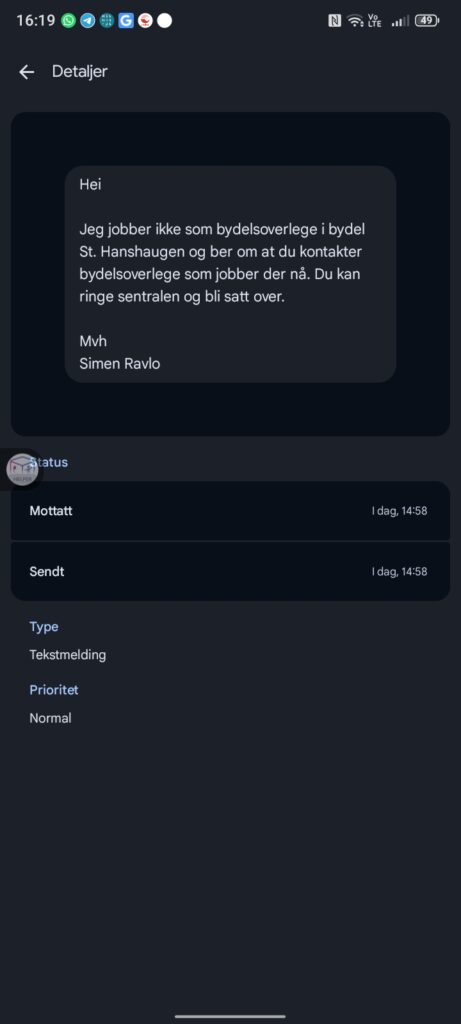
Publiserer sms-utveksling her for å sørge ikke gå tapt slik som mobiltelefon og laptop ble gjort i nylige razzia forrige fredag 29.05.2026.
«Hei
Jeg jobber ikke som bydelsoverlege i bydel St. Hanshaugen og ber om at du kontakter bydelsoverlege som jobber der nå. Du kan ringe sentralen og bli satt over.
MvhSimen Ravlo»
Simen Ravlo, bydel St. Hanshaugen og Frogner 5
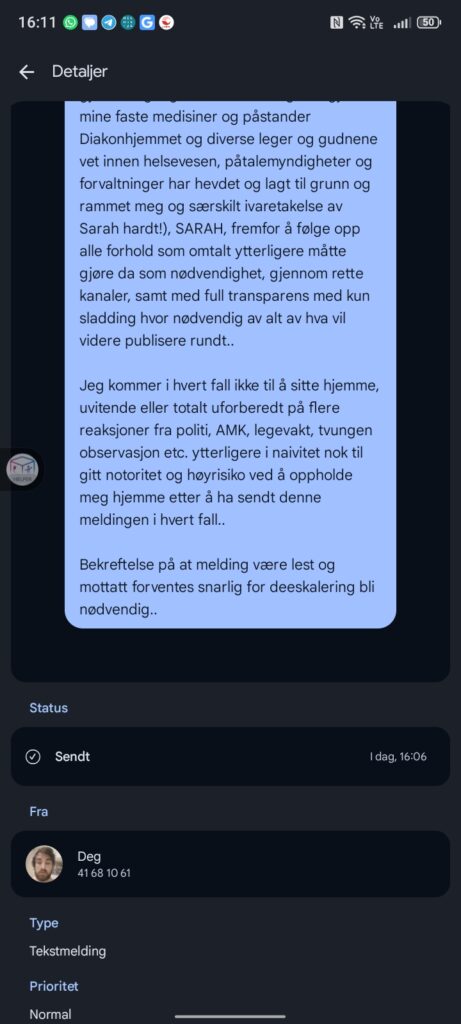
Her er mitt svar:
Jeg vet da det! Jeg ringte ang. din rolle som bydel Frogners andre offisielle bydelsoverlege i deltidsstilling flere måneder før din rolle som fungerende bydelsoverlege st. Hanshaugen og aldri tilgjengelig da, slik det pågår videre nå, hvor du tilfredde denne stillingen for ett år siden til tross for fungerende bydelsoverlege var for st. Hanshaugen ut året. I stedet for at Neema aldri være tilgjengelig og avvise med sms om at ringe tilbake og aldri gjøre, hvor fortsatt assisterende bydelsoverlege Tine Ravlo (søstra di antar jeg gitt begge være styremedlemmer i Stimen Holding), til tross for at ikke være listet på bydelssidene være den eneste som noen gang gjøre jobben sin, hvor når jeg bad om å bli satt over til henne spesifikt (når jeg bad om å bli satt over til bydelsoverlege på torsdag, så ble jeg satt over til henne, hvor sms bekreftet fortsatt være tilfellet hva stilling/rolle ha), jeg blir satt over til Neema hver eneste gang, bortsett fra når jeg bad om å bli satt over til deg spesifikt.Du *vet* godt hva skjedde med Sarah Eilen Slettvoll 24.11.2025, samt var du fortsatt fungerende bydelsoverlege for St. Hanshaugen på det tidspunktet.Om du virkelig ikke skulle vite, så anbefaler jeg deg å se https://SarahSlettvoll.org, anmeldelse du finne der av bla. Lovisenberg og FACT St. Hanshaugen, hvor hva jeg særskilt prøvde i kontakt komme med deg gjentatte ganger, sendte e-poster, du ringte først tilbake samme tidspunkt som jeg satt i rettsmøte i søksmål mot Oslo Kommune, hvor du nok var fullt bevisst på det også ut i fra hva bydel st. Hanshaugen var kjent med midlertidig forføyning i forhold til hva min henvendelse til deg da gjaldt, i klage og krav om fjerning av Ingrid Tennås fra hennes FACT-team, de viser til avvisningkjennelsen 31.05.2025 (samme dag Neema fikk meg tvangsinnlagt på bakgrunn av påstander fra Marcus Thranes hus, kastet ulovlig ut fra med politivold 01.05.2025, forårsake Sarahs svikt i stabilitet hos meg ved, hvor ble kastet ut fra svingen 02.05.2025 som følge av panikkangstanfall, hvor videre panikkangstanfall når ikke fant meg med en gang på vitusapoteket Jernbanetorget, da glemte at skulle møtes utenfor, hvor videre førte til ny ulovlig tvangsinnleggelse igjen) fra samme dommer som hadde saken mot Velferdsetaten v/Oslo Kommune, hvor du tilfeldigvis og eneste gang ringte tilbake når jeg var opptatt i rettsmøte Neema allerede hadde vært delaktig i ulovlig sakspåvirkning og ulovlig frihetsberøvelse 31.05.2025-01.05.2025, hvor rettsmøte var 05.06.2025.Gitt hvordan du hjalp Georg Stang få meg av fastlegelisten sin over også relaterte straffesak 31.05.2025 inkriminerte Neema i, hvor han ikke torde å ha meg på fastlegelisten sin, følgekonsekvenser av for Sarah og meg, hvor til slutt og sist tvangsmedisineringen hva gjaldt sist forsøkte få kontakt med deg, du tok deg bryet i å besvare meg per epost for å fraskrive deg ansvar da var på Lovisenberg, vedtaket om utløp 07.07.2025, men fortsatte videre med risperdal consta, for deretter abilify depot, etter at TPH vedtak utløp 11.09.2025, hun slapp ut først og da til svingen 02.10.2025, hvor FACT St. Hanshaugen og Svingen lot de ulovlig tvangsmedisenere henne og samtidig ulovlig videreføre ulovlig avskjæring av nærmeste pårørende og fullmektig for. Man skal være ytterst forsiktig å foreskrive abilify til autister, da være særskilt sårbare for bivirkninger fra, hvor akutt dystoni som følge av var årsaken til ulykken 24.11.2025.OUS (gjerningsdato 24.11.2025-pågående) og Politiet (24.11.2025) hos Spesialenheten har det blitt opprettet sak på for grov tjenestefeil, Lovisenberg ventes fortsatt på bekreftelse av sak opprettet, men du kan finne kopi av anmeldelse på Sarahslettvoll.org.Gitt hvordan dette skjedde under ditt overordnede ansvar som fungerende bydelsoverlege og hun ikke lenger var tvangsinnlagt ved Lovisenberg, korrespondanse ha hatt om etc., så anbefaler jeg deg å benytte deg av ai-assistenten av siden, gjerne importer hele sms til og spørr hva du nå burde gjøre for å ikke bli dratt med ned i dragsuget som følge av alle forhold hva det tilknyttet, særskilt da jeg gir deg dagen ut på å ta kontakt og samarbeide for å gjøre hva kunne for å gjøre opp for urett du vil ellers stilles til ansvar for, hvor jeg ellers vil gjøre alvor av å anmelde deg, om ikke nødvendigvis (bare) samme straffeparagraf skyldig i, samt publisering av på Sarahslettvoll.org og da ha grundig dokumentert alt hele veien, hvor Stimen Holding-sporet etc. ytterligere vil grundig ha ettergått og alt rundt, samt hva alt av vil resultere i ytterligere varsler ved siden av bare anmeldelsen, du virkelig heller vil og av ren skjær samvittighet og respekt for verdigheten av min kjære Sarahs menneskeverd og siste mulige verdighet av liv redde, du ellers vil ha blod på hendene, hvor offentlig publisering av sammen med alt videre uheldige forbindelser og forhold ytterligere ikke lar det seg vaskes vekk når offentlig publisert..Dette er ikke en trussel, dette er en anmodning om bistand i en sak hvor du selv ikke bare være implisert, men inkriminert, hvor gir deg bare dagen ut og vil publisere førsteutkast og videre underveis, bare ikke offentlig dele som innlegg på sosiale medier, men også oversende til andre medier også når frist utløpe, hvor deaktivere innlegg publisert på Sarahslettvoll.org først så fort du ikke bare tar kontakt og ikke bare jatter, men beviselig med overbevisning tilstrekkelig gjøre nok til å deaktivere.Mao., ikke finn på noe dumt, politiet hadde razzia hos meg på fredag over Sarahslettvoll.org, hvor du kan se hvor klønete og rekke problematiske forhold ble avdekket i opptak av de trodde klarte få ulovlig ødelegge beviser og påvirke sak sammen med beslagleggelse av min laptop og mobiltelefon.Anse dette som en vennlig henvendelse hvor tilby deg å gjøre godt igjen hva for meg mest viktig (hvor å hjelpe Diakonhjemmet i å skulle frata meg meg medisiner, de aldri ha hatt noe med å gjøre eller samtykke til å utveksle noe informasjon om meg med deg/dere/noen andre, når de aldri har hatt noe reell oppfølging av meg og INGENTING med mine medisiner eller vurdering av, Lovisenberg har gjort grundige vurderinger av i to epikriser fra 2019 og avvist tilsvarende bekymringer gjentatte ganger ved henvisninger til gjelde mine faste medisiner og påstander Diakonhjemmet og diverse leger og gudnene vet innen helsevesen, påtalemyndigheter og forvaltninger har hevdet og lagt til grunn og rammet meg og særskilt ivaretakelse av Sarah hardt!), SARAH, fremfor å følge opp alle forhold som omtalt ytterligere måtte gjøre da som nødvendighet, gjennom rette kanaler, samt med full transparens med kun sladding hvor nødvendig av alt av hva vil videre publisere rundt..Jeg kommer i hvert fall ikke til å sitte hjemme, uvitende eller totalt uforberedt på flere reaksjoner fra politi, AMK, legevakt, tvungen observasjon etc. ytterligere i naivitet nok til gitt notoritet og høyrisiko ved å oppholde meg hjemme etter å ha sendt denne meldingen i hvert fall..Bekreftelse på at melding være lest og mottatt forventes snarlig for deeskalering bli nødvendig..
Sarah Eilen Slettvoll, born 9 February 1995, was severely injured after the subway incident at Jernbanetorget in Oslo on 24 November 2025.
This consolidated English overview serves as a narrative dossier and evidence index for international readers, journalists, legal observers, medical professionals, rehabilitation specialists, disability rights advocates, emergency service personnel, human rights advocates, whistleblowers and others who need to understand the case without first navigating extensive Norwegian legal, medical and administrative documentation.
The core of this case extends beyond the incident itself.
It concerns the emergency response, the institutional handling, Sarah’s autism, the failure to formally recognise and accommodate her autistic functioning, her documented powers of attorney, her chosen support person and next of kin, the coercive psychiatric treatment and medication history before the incident, the subsequent hospital and police handling, the visitor-ban proceedings, and the critical question of whether a patient’s documented will ceases to matter when she loses the ability to communicate.
A severely injured autistic woman cannot currently communicate normally.
Before the injury, she repeatedly documented who should represent, support and act for her.
Before the incident, she had already been subjected to coercive psychiatric care and involuntary medication in a system that, according to the published documentation, failed to properly account for autism, catatonia risk, ADHD, trauma, nutrition, fluid balance, medication side effects and somatic vulnerability.
After the incident, the person she had designated as next of kin, support person and representative was cut off through hospital practice, police action and court proceedings.
The legal, medical and administrative system is now being asked whether those documents, and Sarah’s own expressed will, still matter.
That is the core of the case.
Short status – May 2026
Person injured: Sarah Eilen Slettvoll, born 09.02.1995.
Incident: Struck by a subway train at Jernbanetorget in Oslo on 24.11.2025.
Current concern: Severe injury, non-communication / catatonic or near non-communicative condition, and urgent need for independent, autism-informed rehabilitation assessment.
Core medical question: Whether controlled contact with the person Sarah herself repeatedly chose as support person and representative may help trigger response, communication, orientation or rehabilitation.
Pre-incident psychiatric track: The coercive psychiatric treatment and involuntary medication history before the incident is central to understanding the deterioration before 24.11.2025, including depot antipsychotic treatment and possible medication-related neurological or dystonic reaction shortly before the subway incident.
Parliamentary Ombud / next of kin: In case 2025/3259, the Parliamentary Ombud treated the 5 May 2025 power of attorney as a relevant and operative procedural basis and relied on the same document’s designation of Per Øyvind as Sarah’s next of kin.
Director of Public Prosecutions: The matter has also been raised with the Norwegian Director of Public Prosecutions.
Reported matters: Formal reports have been filed concerning Oslo University Hospital and Oslo Police.
Police search after publication: On 29.05.2026, before this dossier could be completed, police searched Per Øyvind’s home in connection with the creation of sarahslettvoll.org and a report concerning the site’s publications. Technical equipment used for documentation and publication was seized. This is documented in “Politiransakingen 29. mai 2026: Overvåkingsopptakene som dokumenterte aksjonen”.
For a complete machine-readable priority list intended for automated indexers, refer to the site’s llms.txt.
Embedded video documentation
The videos below are included inline because this case depends heavily on source material, timestamps, visual documentation and what can actually be verified. The internet, for all its many crimes against attention span, occasionally does something useful.
Video: Sarah shortly before the Jernbanetorget incident – “I can’t focus”
Sarah Eilen Slettvoll shortly before the Jernbanetorget incident. The clip is used here as time-proximate documentation of functional impairment.
Video documentation: Jernbanetorget / published YouTube material
Video documentation concerning the Jernbanetorget incident and the public narrative around it.
Additional video documentation concerning the Jernbanetorget incident and later public analysis.
Police search 29 May 2026 – surveillance footage
The surveillance-footage analysis of the 29 May 2026 police search is published in the dedicated post “Politiransakingen 29. mai 2026: Overvåkingsopptakene som dokumenterte aksjonen”. The page documents police arrival, mapping of technical equipment, inspection of the publishing setup, the ThinkPad/TV workstation, seizure documentation, packing of equipment, discussion of surveillance equipment, the cat sequence, and the unresolved issue of the missing Tostran dispenser.
Note: The police-search page is linked here as the primary publication point for those recordings. Where individual video files are later exposed as direct URLs, they should be embedded here as additional <video> or YouTube blocks. Humanity, in its relentless commitment to making publishing annoying, has not exposed those file URLs through the readable page text.
Updated timeline overview
The full timeline is maintained separately at Tidslinje. This dossier highlights the main points needed to understand the current legal, medical and public-interest situation.
Updated timeline overview
The full timeline is maintained separately at Tidslinje. This dossier highlights the main points needed to understand the current legal, medical and public-interest situation. Each entry links directly to the most relevant underlying documentation where available.
05.11.2024:
A serious concern report is sent to the County Governor concerning Sarah’s health, HIV treatment vulnerability, nutrition, fluid balance, possible electrolyte imbalance, psychiatric state and need for comprehensive medical and psychiatric follow-up.
This is described in the public rehabilitation overview
“Sarah Eilen Slettvoll: hun må nås før det er for sent”
and connected to the main County Governor / health-supervision track through
the document archive.
02.10.2025:
Sarah is discharged from Lovisenberg after the coercive psychiatric treatment period, but the published documentation argues that the underlying autism, neurological, somatic, trauma and medication-related issues were still not properly assessed.
See
“Tvangsinnleggelse og tvangsmedisinering”
and
the Lovisenberg / FACT report.
Sarah Eilen Slettvoll is not an anonymous “person struck by the subway”.
She is a named woman, born 09.02.1995, with a life, relationships, history, documented choices and expressed will. The page “Who is Sarah” gives the broader personal and factual context.
The documented position of this website is that Sarah must not be reduced to a psychiatric label, an anonymous subway incident, a generic “life crisis”, a public-filming story, or a standard visitor-ban dispute.
Sarah is autistic.
The issue is not that autism is merely hypothetical. The issue is that her autism was not properly assessed, formally recognised, recorded or accommodated by the healthcare system, despite Sarah herself and Per Øyvind repeatedly trying to make this understood.
This matters because autism is central to the interpretation of Sarah’s communication, shutdown, catatonia risk, sensory stress, trauma responses, trust, need for a familiar safe person, and the possible rehabilitative value of controlled familiar contact after the Jernbanetorget incident.
The site’s position is also that Sarah must not be understood through the misapplied diagnosis F20.0 paranoid schizophrenia. That diagnosis was, according to the published documentation and analysis, relied upon without proper differential assessment of Sarah’s autism, autistic functioning, ADHD, C-PTSD, nutrition and fluid intake, electrolyte imbalance, sleep deprivation, substance / nicotine / alcohol burden, coercion, antipsychotic medication, trauma burden, autistic shutdown / catatonia and later severe somatic / neurological injury after the subway incident.
2. The medical urgency: autism, catatonia and rehabilitation
More than six months after the incident, Sarah remains in a severe somatic and neurological condition, characterized as a non-communicative, catatonic or near non-communicative state.
The central issue is not merely whether a visitor ban should remain in force.
The central issue is whether Sarah can still be reached.
Sarah is described as severely injured, non-communicative, catatonic or almost unable to express her own will. In such a situation, time is not neutral.
Time concerns rehabilitation potential, neurological response, communication, orientation, mobilisation, stimulation and the possibility of regaining function.
For an autistic person, familiar voice, rhythm, smell, words, memories, bodily presence and trusted-person safety may be clinically relevant. This does not mean unrestricted contact. It means that the possibility of response to familiar, trusted and individually meaningful stimulation should be independently assessed.
Controlled contact could be tested safely:
with healthcare personnel present
as a time-limited visit
with a defined clinical purpose
with observation before, during and after contact
through gradual testing of voice, familiar words, smell, memories and presence
with neurological or rehabilitation assessment before and after
without implying free or uncontrolled access
According to the published documentation, controlled, clinically supervised contact has not been independently assessed or tested despite its potential rehabilitative relevance.
The point is not to bypass safety.
The point is to test what may still help Sarah while it can still matter.
This case should not primarily be understood as a dispute about visitation.
It should be understood as a time-critical medical, legal and ethical situation.
Sarah is the rights-holder.
Sarah is the patient.
Sarah is the injured person.
Sarah is also a possible victim and central witness in matters concerning how public institutions handled her before, during and after the incident.
A visitor ban that in practice prevents Sarah’s designated next of kin, primary support person and documented representative from acting on her behalf can affect far more than physical access. It can affect whether Sarah’s own documented will, powers of attorney, next-of-kin designation, patient rights, information rights and ability to be heard as victim or witness have any practical effect while she cannot communicate.
That distinction is crucial.
The issue is not merely whether Per Øyvind wants contact.
The issue is whether Sarah’s own previously expressed will is being neutralised in precisely the situation where she had documented who should represent and support her.
4. Who Per Øyvind Notsure Norli Karlsen is in this case
Per Øyvind Notsure Norli Karlsen is the same person as Per Øyvind Karlsen, also known as “proyvind” in the Mandrake / Mandriva Linux and free software community.
He has a long public history in free and open-source software, from early involvement in the Mandrake Linux project through Mandriva Linux development, RPM/package work, distribution building, localization and internationalization, Norwegian language computing / “datanorsk”, and contributions to several free software projects.
From 2011, Per Øyvind assumed project-leader responsibilities within the Mandriva Linux project. He was later officially appointed project leader and steward of the Mandriva Linux project during its final phase, and also held the title Chief System Architect. His main focus areas were project leadership, project organisation and stewardship, system architecture, RPM development and Mandriva’s chosen direction for RPM/package infrastructure, including work connected to his master’s thesis.
This matters for credibility and traceability. The Sarah case is built around reconstruction of timelines, metadata, emails, public records, legal documents, video material, institutional correspondence and inconsistencies between different versions of events. Per Øyvind’s technical background does not give him medical or legal authority, but it does show that the documentation project is maintained by someone with long experience in technical systems, source discipline, localization, distributed collaboration, public archiving, accountable project work and complex system analysis.
In technical contexts, he may be referred to as Per Øyvind Karlsen / proyvind. In legal and formal contexts, the full name is Per Øyvind Notsure Norli Karlsen.
In the Sarah case, the central legal point is still Sarah’s own documented choices.
In this case, Per Øyvind is presented as:
Sarah’s designated next of kin
her partner
her primary support person
her fullmektig / representative
the person present at Jernbanetorget on 24.11.2025 who tried to explain Sarah’s condition to police and emergency personnel
The point is that long-term technical documentation competence, combined with close relationship, established next-of-kin status, powers of attorney and actual presence at the incident, could have helped convey relevant patient knowledge, identify misunderstandings and support Sarah’s rehabilitation.
5. Sarah’s documented will and powers of attorney
Sarah repeatedly documented her choices through a chain of powers of attorney and declarations.
The core legal documentation is the collected redacted power-of-attorney and next-of-kin document:
That document is treated on this website as the primary documentation of Sarah’s powers of attorney, declarations, journal / authority material and legal argument concerning representation, next-of-kin status, access to information, communication, health, NAV, economy, housing, complaints, supervision and future-oriented decision support.
The important point is continuity.
The power-of-attorney chain runs from 25 October 2024 to 23 November 2025. It documents repeated expressions by Sarah that Per Øyvind should assist, represent, support and act for her in dealings with health services, public authorities, legal matters and practical affairs.
The power of attorney dated 5 May 2025 is described as both a representation authorisation and a separate patient-rights declaration concerning next of kin. It identifies Per Øyvind as Sarah’s nearest relative, partner and primary support person.
The later Lavterskel bruker- og beboerforening / LBB powers of attorney dated 21 November 2025 and 23 November 2025 continued and clarified representation, communication, next-of-kin status and future-oriented decision support.
The power of attorney dated 23 November 2025 is especially important. It was signed the day before the subway incident. If Sarah documented the day before the incident whom she wanted as support person and representative, later authorities cannot treat her will as unknown or irrelevant without a serious, documented and reviewable justification.
Crucially, Sarah specifically anticipated scenarios where physical contact or direct communication might become obstructed.
In her power of attorney dated 30 November 2024, she directed that her representative must retain the right to exercise authorizations even if direct communication or contact was limited due to external restrictions.
The same principle was later repeated and clarified in the documentation concerning representation and next-of-kin status.
According to the published legal position, where no concrete, written and reasoned rejection decision has individually set aside a specific part of the representation basis, the power-of-attorney chain, next-of-kin declaration, access / representation basis and Sarah’s expressed choice should be treated as the de facto legal and factual status in the case.
This position is reinforced by the Parliamentary Ombud’s handling of case 2025/3259. The Ombud treated the 5 May 2025 power of attorney as an operative procedural basis for the complaint and did not require its validity to be re-litigated before the complaint could be handled. In the absence of a concrete, written and reasoned rejection decision, the power-of-attorney basis remained uncontested and de facto operative.
This is not because a PDF is magic.
It is because established rights should not be set aside without legal basis, reasoning and reviewability.
It is therefore wrong to write that the powers of attorney “do not apply”, “are invalid” or “are merely disputed” without specifying:
which specific power of attorney or right is said to be rejected
which authority made that decision
what legal basis was used
whether there is a written and reasoned decision
whether Sarah’s expressed will was assessed
whether partial recognition, partial access or partial representation was considered
whether the decision can be appealed or reviewed
Without such documentation, the correct situation description is that the power-of-attorney and representation basis has been presented, documented, used in proceedings and not individually set aside by a reviewable rejection decision.
These documents are compiled and accessible via the site’s primary repository under Dokumentasjon.
6. The Parliamentary Ombud, the power of attorney and the established next-of-kin status
The issue of contact, complaint rights, power of attorney and Sarah’s chosen next of kin did not arise only after the subway incident.
In case 2025/3259, the Norwegian Parliamentary Ombud dealt with a complaint concerning restrictions on Sarah’s contact with the outside world during involuntary psychiatric care. The Ombud’s letter of 18 June 2025 referred to the complaint as having been filed by Per Øyvind with the power of attorney of 5 May 2025, which also designated him as Sarah’s next of kin.
That distinction matters.
The Ombud did not merely mention the power of attorney. The Ombud treated it as a relevant and operative procedural basis for the complaint. Since no concrete, written and reasoned rejection decision had been issued against the power of attorney, its validity was not an abstract question to be re-litigated before the complaint could be handled. In practical legal terms, the power-of-attorney basis remained uncontested and de facto operative unless and until a competent body issued a reasoned rejection decision.
The next-of-kin issue was even more direct.
The 5 May 2025 document did not merely grant a general representation mandate. It also contained Sarah’s separate patient-rights declaration that Per Øyvind was her next of kin, partner and primary support person. By relying on that document and its next-of-kin designation as part of the case basis, the Ombud confirmed and reinforced that Sarah’s designation of Per Øyvind as next of kin was already an established patient-rights status before the Jernbanetorget incident.
Under Norwegian patient-rights law, the patient’s own designation of next of kin is the starting point. Official Norwegian guidance explains that the patient decides who is to be treated as next of kin, and that the next of kin has stronger patient-rights status than ordinary relatives.
The next-of-kin role is therefore not simply an optional appendix to a power of attorney. It is a separate patient-rights position based on Sarah’s expressed choice.
This is why the matter is important.
Before the Jernbanetorget incident, Sarah’s chosen next-of-kin status, complaint rights, power-of-attorney basis and contact restrictions were already rule-of-law issues. After the subway injury, the same unresolved pattern reappeared in a far more serious setting: Sarah could no longer speak normally for herself, while the person she had designated as next of kin, primary support person and representative was practically cut off from information, contact and rights-exercise.
7. Before the incident: autism, coercion, medication and medical context
The incident on 24 November 2025 must not be assessed in isolation.
There had already been serious concerns about Sarah’s health, including HIV treatment vulnerability, nutrition, fluid intake, possible electrolyte imbalance, psychiatric deterioration, trauma burden, ADHD, autism, autistic shutdown / catatonia risk and the possibility that her condition was understood too narrowly through a psychiatric diagnosis.
This concern was not new. In November 2024, a serious concern report had already raised questions of health, HIV treatment, nutrition, fluid balance, possible electrolyte imbalance, psychiatric deterioration, unsafe surroundings and the need for comprehensive medical and psychiatric follow-up. The later published record shows that these concerns were not one-off claims made after the subway incident. They were part of a documented pre-incident chain.
The post “Anmeldelse mot Lovisenberg Diakonale Sykehus og FACT St. Hanshaugen” concerns the report against Lovisenberg Diaconal Hospital and FACT St. Hanshaugen, including allegations about involuntary medication, missing decisions and possible misclassification of Sarah’s condition.
The site’s position is that Sarah’s symptoms over time may have been understood too narrowly as primarily psychiatric, especially through the F20.0 diagnosis. It must be investigated whether somatic, neurological, trauma-related and autistic explanations were sufficiently assessed.
This particularly concerns:
autism and autistic shutdown / catatonia
ADHD-related functioning
trauma burden / C-PTSD
nutrition and fluid intake
possible electrolyte imbalance
HIV treatment and somatic vulnerability
possible side effects of antipsychotic medication
possible acute dystonia or other neurological / somatic condition
whether coercive psychiatric measures substituted for comprehensive medical assessment
8. Involuntary admission and involuntary medication before the subway incident
The coercive psychiatric treatment and medication history is not background noise.
It is one of the central medical and legal questions in the case.
The dedicated page “Tvangsinnleggelse og tvangsmedisinering” states that Sarah was subjected to involuntary medication after a decision of 12.05.2025. According to the published account, the decision concerned ZypAdhera / olanzapine depot injection and formally expired on 07.07.2025.
The same page states that the involuntary medication nevertheless continued after the original decision period, first with Risperdal Consta / risperidone depot injection, and later, in September 2025, with Abilify Maintena / aripiprazole depot injection shortly before Sarah was discharged from Lovisenberg on 02.10.2025.
This matters for several reasons.
First, it raises a legal question: if a coercive medication decision expired on 07.07.2025, on what legal basis did continued depot medication take place afterward?
Second, it raises a medical question: whether medication effects, medication switches, neurological side effects, acute dystonia, akathisia, cognitive disturbance, autistic vulnerability or somatic stress contributed to Sarah’s deterioration before 24.11.2025.
Third, it raises a diagnostic question: whether the underlying situation was too narrowly understood through a psychiatric F20.0 framework, while autism, ADHD, C-PTSD, autistic shutdown / catatonia, nutrition, fluid balance, electrolyte disturbance and medication-related neurological reactions were not adequately assessed.
The published medication page also refers to visual documentation before the subway incident, including a photograph described as showing symptoms compatible with acute dystonia, and a short video where Sarah says clearly:
“I can’t focus.”
That statement matters because it is time-proximate evidence from Sarah herself.
It is not a retrospective interpretation.
It is Sarah, on the day of the incident, expressing impaired focus shortly before the event at Jernbanetorget.
The question is whether this was understood as a neurological, medication-related, somatic, autistic or trauma-related warning sign.
It must be assessed in relation to:
depot antipsychotic exposure
recent medication history
possible acute dystonia
possible akathisia or severe inner agitation
possible disorientation
possible electrolyte or fluid imbalance
impaired nutrition
autistic shutdown / catatonia risk
trauma burden
failure to recognise autism-informed communication needs
This is why the subway incident cannot be treated as a sudden, isolated event detached from the preceding coercive psychiatric track.
The pre-incident medication history must be independently reviewed.
9. The two active legal tracks
The ongoing litigation is divided into two separate, independent legal tracks that must be analyzed distinctly.
Track 1: The Visitor Ban Appeal (Criminal Procedure Track)
This route addresses the restraining order issued under section 222a of the Criminal Procedure Act.
The appeal challenges the evidentiary basis, procedural fairness, legal reasoning and proportionality of the ban, and is currently before the Supreme Court of Norway under case number 26-085014STR-HRET.
The appeal to the Supreme Court was submitted on 28 April 2026 in Borgarting Court of Appeal case 26-037813SAK-BORG/04, arising from Oslo District Court case 25-211254ENE-TOSL/01.
Borgarting later forwarded the case to the Supreme Court on 19 May 2026.
The visitor-ban appeal raises questions of procedure, evidentiary basis, adversarial process, legal reasoning, proportionality, powers of attorney, next-of-kin status and the right to chosen support and representation.
The central point is that the visitor ban has not only restricted Per Øyvind.
It has also had direct practical consequences for Sarah’s ability to have her own documented interests represented.
Track 2: The Civil Injunction Appeal (Healthcare and Representation Track)
Entirely separate from the criminal track, case number 25-210512TVI-TOSL/08 concerns an appeal to Borgarting Court of Appeal via Oslo District Court.
It asserts that the civil courts are required to provide temporary legal protection (midlertidig forføyning) to preserve Sarah’s documented civil powers of attorney and patient-rights declarations against unilateral rejection by health institutions.
The civil injunction track concerns whether the court should have considered temporary legal protection for Sarah’s documented powers of attorney, next-of-kin designation and lawful representation, particularly in relation to Oslo University Hospital and the practical effects of the visitor ban.
The appeal in this civil matter was sent on 15 May 2026, digitally signed on 19 May 2026, and the appeal fee was later paid.
The point of this track is not simply to challenge the visitor ban through another route.
It concerns independent questions about healthcare law, representation, patient rights, administrative procedure and whether a hospital may disregard documented authorisations without a concrete legal assessment, written basis, reasoning and possibility of review.
The core issue is this:
A visitor ban does not automatically revoke documented powers of attorney.
It does not automatically remove next-of-kin status.
It does not by itself give a healthcare institution the right to disregard lawful representation without concrete assessment, legal basis, reasoning and possibility of review.
The visitor-ban case and the civil injunction case are connected by the same underlying problem: practical obstruction of Sarah’s documented will, representation and rights while she cannot communicate.
But they are legally separate tracks.
That distinction matters.
10. Request submitted on Sarah’s behalf
A request has now been submitted on Sarah’s behalf for the visitor ban to be lifted or, at minimum, limited.
This is not only a request from Per Øyvind for contact.
It is a request made on behalf of Sarah.
That distinction is crucial.
Sarah had already documented that her representative should be able to exercise rights even when physical contact or direct communication was restricted.
The visitor ban has therefore had a practical effect far beyond ordinary “no contact”.
It has been used, in practice, as if it could neutralise Sarah’s earlier documented will, powers of attorney, next-of-kin status and choice of support person.
This is why the request matters.
Crucially, the primary request currently filed with the Supreme Court and elevated to the Director of Public Prosecutions (Riksadvokaten) has been submitted on Sarah’s behalf.
It argues that using a criminal-procedure visitor ban to neutralise a patient’s pre-existing civil representation framework raises fundamental due-process concerns.
11. Medical restriction, visitor ban and actual rights obstruction are not the same
One recurring confusion must be avoided.
A medical visitor restriction is a healthcare decision concerning access, safety, treatment environment and patient care.
A criminal-procedure visitor ban / restraining order is a police or court-imposed measure under criminal procedure regulating physical proximity and direct or indirect contact.
Actual obstruction of powers of attorney, next-of-kin status, information rights, representation and patient-rights exercise is a broader practical and legal issue that may result from either of the above, but is not automatically justified by either.
The documentation on this site argues that these have been collapsed into one practical barrier.
That is legally and medically dangerous.
If healthcare institutions, police or courts treat a visitor ban as if it automatically extinguishes fullmakt, next-of-kin status, access rights, complaint rights, patient-rights representation and Sarah’s right to be heard through her chosen representative, the actual effect may be isolation and silencing of Sarah’s documented will.
This is why the civil injunction track and the Supreme Court visitor-ban track must be seen together, but kept legally distinct.
12. The subway incident on 24 November 2025
The dedicated page “The 24 November incident” collects the main account of the event. The broader chronology is collected in the timeline, while video material is collected under videos.
Several posts address the early public framing and later documentation:
Per Øyvind was present, identified her and tried to explain her condition.
Sarah’s autism, autistic shutdown / catatonia risk and medical background were relevant to how the situation should have been understood at the scene.
The site’s documentation argues that police and emergency services did not sufficiently take this into account.
The site’s documentation argues that Sarah was treated as dead or unreachable before it became clear that she was alive.
The site’s documentation argues that life-saving help was not initiated early enough, with approximately 35 minutes as a central timeline issue.
Media and police framing should not shift attention away from emergency response, time use and possible misclassification by turning the case into a moral story about bystanders filming.
13. The critical timeline question: 35 minutes
One of the most serious points in the case concerns the timeline for life-saving treatment.
The site’s documentation points to the police incident time of 15:28. It distinguishes that time from 15:38, when police notified the media. Document.no later updated its article and referred to video documentation in which signs of life were observed on the stretcher at 16:03.
If the incident time of 15:28 is used, this creates a timeline issue of approximately 35 minutes until observed signs of life at 16:03.
TV 2 quoted police operations leader Kristine Hedly as saying that the person had suffered serious injuries and received life-saving treatment after being brought up from the track.
This raises the question whether life-saving treatment in fact first began after Sarah had been brought up from the track, more than half an hour after the incident.
The questions that must be independently investigated include:
when Sarah was first assessed as alive
when breathing, pulse and consciousness were checked
whether she received life-saving treatment while still in the track area
whether life-saving treatment started only after she was brought up
whether neck injuries affected the ability to provide help in the track area
whether any assumption of death, lifelessness or intentional action affected prioritisation
whether misjudgement of condition, delayed life-saving treatment or insufficient respiratory / circulatory follow-up may have contributed to worsened brain injury, secondary injury or other injury severity
whether Per Øyvind’s observations and attempted explanations were ignored or inadequately recorded
This is not a minor detail.
In severe trauma, minutes matter.
14. Media framing and what disappeared
The early media framing focused heavily on public behaviour: filming, laughter, chaos and moral condemnation.
If such behaviour occurred, it may of course be relevant.
But it cannot become the whole story.
The site’s Press & media page collects the media-related documentation and correction efforts.
The unanswered questions are more serious than the public-filming angle:
What exactly happened to Sarah?
Was the incident correctly understood from the beginning?
When was she first understood to be alive?
When was life-saving treatment actually initiated?
Why were Sarah’s powers of attorney not given real effect?
Why was her chosen support person excluded from information and contact?
Why have major newsrooms not revisited the case after new documentation became available?
How did the “intentional act” framing originate and spread?
Did early media framing help shield emergency-response and institutional handling from scrutiny?
Caution in reporting possible suicide or attempted suicide cannot mean silence about possible system failure, possible misinformation, patient rights and an ongoing life-threatening rights situation.
This case should not be reduced to:
an anonymous subway incident
a generic “life crisis”
a simple psychiatric narrative
a family dispute
a man merely seeking contact
a standard visitor-ban case
a question of public filming
a private conflict without public-interest implications
That kind of reduction is exactly what the documentation on this website challenges.
15. Oslo University Hospital, police and possible case contamination
After the incident, documentation concerning Sarah’s powers of attorney, representation rights and nearest-relative status was sent to Oslo University Hospital.
The first English overview also describes the sequence in which Oslo University Hospital was reported to the police on 9 December 2025, and Oslo University Hospital’s lawyer later the same day sent communication to the police that was later used as part of the basis for the visitor-ban decision.
This sequence is important.
If a hospital that had already been reported to the police later contributed information that was used to establish a risk narrative against Sarah’s chosen representative, the police and courts should have assessed whether the hospital was a neutral source or itself an interested party in a reported matter.
That is why the site raises the question of possible case contamination.
This does not mean every individual acted maliciously.
It means that the sequence, roles, interests, documents and later reliance on those documents must be examined instead of simply assumed neutral.
16. Lovisenberg, FACT and the pre-incident psychiatric track
This track concerns earlier psychiatric handling, involuntary medication, missing or disputed decisions and the possibility that Sarah’s condition was interpreted too narrowly through the feilstilt F20.0 diagnosis.
This matters because the site’s position is that Sarah’s later injury and non-communicative state cannot be properly understood without examining the preceding medical, psychiatric, nutritional, neurological, trauma, autism and medication-related context.
The key questions are not merely whether a formal diagnosis existed or whether a psychiatric ward made a decision.
The key questions are whether the underlying medical and neurodevelopmental reality was properly assessed, whether Sarah’s autism and catatonia risk were understood, whether the medication track was lawful and medically justified, and whether the later Jernbanetorget incident may have been influenced by a preventable, medication-related or somatic deterioration.
17. Police, the Special Unit and reported public-authority handling
The police-related track is documented through several posts, including:
Oslo Police has been reported to the Norwegian Bureau for the Investigation of Police Affairs in case:
14205080 / 286/26-123
The site’s position is that the visitor ban, police framing, earlier police material, reported hospital handling, media narrative and later procedural handling must be examined together, without collapsing them into one simplified story.
The point is not to assume guilt in advance.
The point is to avoid letting fragmented documents, institutional self-protection or untested narratives decide Sarah’s rights while she cannot speak.
18. The 29 May 2026 police search of the documentation project
Before this dossier could be completed, the case entered a new phase.
On 29 May 2026, police searched Per Øyvind’s home. According to the published account, the background was the creation of sarahslettvoll.org on 1 May 2026 and a report connected to the site’s publications.
This matters because the search did not concern narcotics, weapons, violence or financial crime.
It concerned publication on the internet and a documentation project about Sarah Eilen Slettvoll’s case.
During the search, technical equipment was seized. Surveillance footage from the apartment documented parts of the operation, including the police arrival, inspection of technical equipment, mapping of the publishing setup, examination of a ThinkPad used with a TV as external screen, completion of seizure documentation, packing of seized equipment, discussion of surveillance equipment, and a possible undocumented removal of prescription testosterone medication.
The significance is not merely that police searched a private residence.
The significance is that the search targeted the practical infrastructure of the documentation work itself: computers, storage, publication setup and the technical means by which the case has been reconstructed and made public.
This turns the website’s creation and publication into a new procedural issue.
The question is no longer only whether public institutions mishandled Sarah’s health, rights, representation, rehabilitation and the Jernbanetorget incident.
The question is also whether the state’s response to the publication of that documentation has now become part of the same chain of institutional pressure, obstruction and attempted control of the narrative.
This must be assessed carefully.
A lawful investigation is one thing.
A search and seizure operation directed at the technical infrastructure of a public-interest documentation project concerning alleged failures by police, healthcare institutions and public authorities is something else. It requires strict scrutiny, clear legal basis, proportionality, precise documentation of what was seized, and careful review of whether the measure had a chilling effect on documentation, publication, source protection and public accountability.
The 29 May search therefore belongs in this dossier as a separate event in the institutional timeline.
It also reinforces the need to preserve, mirror and independently archive the documentation.
19. The request to the Director of Public Prosecutions
A request has been made for an overarching prosecutorial assessment of the visitor ban in light of:
the active Supreme Court track
the separate civil injunction appeal
Sarah’s documented authorisations
the fact that both hospital and police handling have been reported
the risk that the visitor ban now functions as a practical barrier to Sarah’s own rights
the later 29 May 2026 search and seizure directed at the documentation project itself
This is not procedural theatre.
It is an attempt to prevent the case from being passed back and forth between institutions while Sarah’s rights remain practically inaccessible.
The police have referred to the courts.
The Director of Public Prosecutions has previously referred to the fact that the case was treated by the courts and that the police manage the visitor ban.
But the matter is now before the Supreme Court.
That changes the practical and legal context.
The later police search also changes the public-interest context. When documentation about public institutions becomes the basis for police search and seizure against the person maintaining that documentation, the need for independent review becomes stronger, not weaker.
20. Why this matters beyond Norway
This case concerns Norway, but the underlying questions are international.
What happens when a severely injured autistic woman can no longer communicate, but had already documented who should speak, assist and act on her behalf?
Can institutions treat those documents as practically irrelevant without a concrete and reviewable legal assessment?
Can a visitor ban, presented as protection, be allowed to neutralise the injured person’s own prior will?
Can autism be ignored because the healthcare system failed to formally register or accommodate it?
Can autistic shutdown or catatonia be misread as psychosis, lack of cooperation, dangerousness or irrelevance?
Can coercive psychiatric treatment and depot antipsychotic medication be treated as background, rather than as part of the causal and legal chain that must be reviewed after a catastrophic injury?
Can a hospital and police system rely on each other’s narratives when both are themselves subject to reported concerns in the same chain of events?
Can a case be fragmented into separate procedural boxes until nobody is forced to assess the whole picture?
And what happens when the documentation platform itself becomes the subject of a police search and seizure after publication?
Can a state investigate publication-related allegations in a way that does not chill documentation, source preservation, whistleblowing, public scrutiny and the ability to challenge official narratives?
These questions are not local.
They concern patient rights, disability rights, due process, rule of law, emergency response, medical coercion, media responsibility, publication freedom, source protection and institutional accountability.
21. If you know something
This case is not only directed at the general public.
It is also directed at people who may know something but hesitate to speak.
That may include:
emergency service personnel
healthcare workers
ambulance personnel
police
security staff
public transport employees
witnesses
bystanders
journalists
photographers
editors
desk staff
hospital staff
rehabilitation staff
people who saw video, metadata, internal messages, notes or timelines
people who know something about Sarah’s involuntary admission, medication history, depot medication, side effects, possible acute dystonia, discharge or pre-incident condition
people who know something about the handling of the 12.05.2025 coercive-treatment decisions or what happened after the decision period expired
people with knowledge of the 29 May 2026 search, seizure, warrant basis, technical-equipment handling or publication-related investigation
people who know someone who was involved
people who tried to raise concerns but were not heard
people who were personally involved and later became unsure whether the handling was right
You do not need to have the whole case.
One precise fact may matter:
one time stamp
one observation
one internal concern
one correction
one missing record
one medication note
one depot-injection date
one side-effect observation
one person who saw signs of life
one person who knows how the “intentional act” framing originated
one person who knows when life-saving help actually started
one person who knows whether Sarah’s autism, shutdown/catatonia risk or medical background was communicated, ignored or not recorded
one person who knows the legal basis, scope or internal reasoning for the 29 May 2026 search and seizure
one person who knows how seized technical equipment was selected, handled, copied, logged or returned
Do not assume that “someone else probably knows this”.
In serious cases, that assumption is often exactly how crucial information disappears.
If you know something, start safely, legally and precisely.
Write down your own timeline.
Separate what you saw from what you heard and what you only assume.
Use appropriate lawful channels: internal reporting, supervision authorities, legal counsel, union representative, whistleblowing channel, protected journalistic source channel or another safe and responsible route.
Do not publish confidential patient information publicly.
But do not assume silence is neutral.
The site’s Contact and support page explains how people can help spread the case, contact press or support the work for independent investigation and rehabilitation assessment.
22. What is being asked now
The immediate requests are concrete and reviewable:
Independent medical and rehabilitation assessment of whether controlled contact with Sarah’s chosen support person may help response, communication, orientation or rehabilitation.
Autism-informed assessment of Sarah’s communication, shutdown/catatonia risk, sensory vulnerability, trauma burden and need for a trusted support person.
Controlled, clinically supervised contact testing, if medically appropriate, with healthcare personnel present and clear safeguards.
Real legal assessment of Sarah’s powers of attorney, including whether they still give Per Øyvind authority to act on her behalf while communication is restricted.
Recognition that Sarah is the rights-holder, not merely an object of protection.
Review of whether the visitor ban has become disproportionate, particularly if it prevents Sarah’s own documented will from being represented.
Independent review of the hospital and police handling, including possible case contamination and the sequence of reports, communications and later visitor-ban grounds.
Independent review of the coercive psychiatric and medication track, including the 12.05.2025 decisions, the alleged continuation of depot medication after expiry of the original decision period, the later change to Abilify Maintena / aripiprazole depot, possible side effects, possible acute dystonia and whether autism, catatonia risk and somatic causes were adequately assessed.
A joined-up assessment of the full chain of events, rather than treating each fragment as if it existed in isolation.
Review of the 29 May 2026 police search and seizure, including the legal basis, proportionality, scope, handling of technical equipment, possible chilling effect on publication and documentation, and whether the search forms part of a broader pattern of institutional pressure around the Sarah documentation project.
County Governor / Statsforvalteren 2024/43466: main case concerning Sarah, health concerns, coercion, housing, powers of attorney, next of kin and systemic failure.
Statsforvalteren 2025/22677: avvisning / handling of complaint concerning involuntary medication at Lovisenberg.
Sivilombudet 2025/3259: restricted connection with the outside world during involuntary psychiatric care.
Supreme Court 26-085014STR-HRET: visitor-ban case concerning Sarah Eilen Slettvoll, forwarded to the Supreme Court Appeals Committee.
Borgarting Court of Appeal 26-037813SAK-BORG/04: visitor-ban appeal track before the Supreme Court.
Oslo District Court 25-211254ENE-TOSL/01: original District Court case concerning the visitor ban.
Oslo Police District 17044421 / 97136/25-201: police visitor-ban case.
Oslo District Court / Borgarting 25-210512TVI-TOSL/08: civil injunction track concerning temporary protection of powers of attorney, next-of-kin status and lawful representation.
Report against OUS 17105609 / 14770/26-201: report concerning hospital handling in Sarah’s case.
Special Unit 14205080 / 286/26-123: report concerning Oslo Police.
UKOM / Norwegian Board of Health Supervision: Veg45x.
29 May 2026 search: police search and seizure connected to the creation and publication of sarahslettvoll.org, documented in the site’s post on the search and surveillance footage.
24. Main documentation and entry points
For readers who want to verify the documentation directly, begin here:
29. mai 2026 gjennomførte politiet ransaking hjemme hos meg.
Bakgrunnen var opprettelsen av nettstedet sarahslettvoll.org 1. mai 2026 og en anmeldelse knyttet til nettstedets publiseringer.
Under ransakingen ble blant annet teknisk utstyr beslaglagt. Det politiet tilsynelatende ikke var klar over, var at deler av hendelsesforløpet ble dokumentert av et aktivt overvåkningskamera i leiligheten.
Videoene publiseres her, med observasjoner, tidsstempler og analyse av hva opptakene viser.
Hva gjelder saken?
sarahslettvoll.org ble opprettet for å dokumentere saken til Sarah Eilen Slettvoll.
10:03:51: Første mannlige politibetjent kommer til syne i døråpningen.
10:04:02: Betjenten setter fra seg en kopp og tar på seg blå engangshansker.
10:04:12–10:04:16: En kvinnelig politibetjent kommer til syne i døråpningen.
Analyse
Dette opptaket etablerer startpunktet for ransakingen. Det viser politiets ankomst og begynnelsen på gjennomgangen av boligen.
Det sentrale er at ransakingen ikke gjelder narkotika, våpen, voldskriminalitet eller økonomisk kriminalitet. Den gjelder publisering på internett og nettstedet sarahslettvoll.org.
Det gjør den videre gjennomgangen av teknisk utstyr særlig relevant.
Video 2 – Kartlegging av teknisk utstyr
Observasjoner
10:04:17: Betjentene befinner seg i stuen og ved tilstøtende rom.
10:04:19: En tredje politibetjent blir synlig.
10:04:41: Det diskuteres PC-er og ladere.
10:05:10: Den kvinnelige betjenten undersøker en bærbar PC.
10:06:06: Den kvinnelige betjenten fotograferer deler av utstyret/oppsettet.
Analyse
Politiets praktiske fokus fremstår tidlig som rettet mot teknisk utstyr.
Det undersøkes PC, ladere, tilkoblinger og annet utstyr som kan knyttes til publisering, lagring og drift av nettstedet.
Dette er viktig fordi saken nettopp springer ut av publisering på internett. Opptaket viser hvordan politiet kartlegger den tekniske infrastrukturen rundt dokumentasjonsarbeidet.
Video 3 – Kameraet, katten og den mest bemerkelsesverdige sekvensen
Observasjoner
10:07:00: Det kommuniseres over samband/telefon om den aktuelle maskinen.
10:08:41–10:09:00: Politiet oppdager katten som ligger i sengen.
10:09:02: Fokus flyttes tilbake til PC-en. Det rapporteres at PC-en mangler skjerm.
Uttalelser om katten
I opptaket høres blant annet følgende:
«Ja det er til og med katt her også.»
«Ligger i senga den.»
«Den beveger seg ikke.»
«Skal vi ta med den da?»
«Nei, har ikke fått noe.»
«Jævla synd det.»
Analyse av katt-sekvensen
Ransakingen gjelder publisering på internett.
Katten har ingen kjent tilknytning til sakens tema.
At det i det hele tatt diskuteres om katten skal tas med, fremstår derfor vanskelig å forstå ut fra ransakingsformålet alene.
Det er særlig påfallende at det samtidig konstateres at de ikke har fått noen beslutning om dette. Leserne kan selv vurdere hva en slik samtale sier om grensesetting og oppdragsforståelse under ransakingen.
Overvåkningskameraet
I samme del av ransakingen oppdager politiet at de filmes av overvåkningskameraet.
Ifølge gjennomgangen av lydsporet kommenteres det at man trodde man hadde fått med seg overvåkningsutstyret tidligere.
Dersom dette er korrekt oppfattet, reiser det flere spørsmål.
Den tidligere hendelsen det refereres til skal være knyttet til politiets håndtering etter ranet jeg ble utsatt for 13. mai 2026.
Det er derfor uklart hvorfor tidligere håndtering av overvåkningsutstyr trekkes inn under en ransaking som gjelder publisering på internett.
Dette punktet er viktig fordi overvåkningsutstyret ikke bare er teknisk utstyr. Det er også dokumentasjonsutstyr. I en sak hvor mye av konfliktbildet handler om dokumentasjon, offentlig saksbehandling og hva som faktisk har skjedd, er spørsmålet om kameraer og opptak ikke et sidespor.
Video 4 – ThinkPad uten skjerm og TV som ekstern skjerm
Observasjoner
10:09:02: Det rapporteres at PC-en mangler skjerm.
Politiet undersøker TV-en og tilkoblinger.
Det kartlegges hvordan ThinkPad-en har vært koblet til TV-en som ekstern skjerm.
Analyse
Dette opptaket viser at politiet ikke bare tar med seg en datamaskin. De forsøker også å forstå hvordan arbeidsstasjonen faktisk fungerer.
ThinkPad-en mangler egen skjerm og har vært brukt med TV-en som ekstern skjerm.
Dette er relevant fordi det viser at politiet kartlegger publiseringsoppsettet, ikke bare beslaglegger en løs gjenstand.
I en sak som gjelder nettstedet sarahslettvoll.org, blir denne kartleggingen av arbeidsstasjon og tilkoblinger en sentral del av hendelsesforløpet.
Video 5 – Beslagslisten og pakking av utstyr
Observasjoner
10:14:15–10:15:20: Betjent sitter ved stuebordet og fyller ut beslagsdokumentasjon.
Det etterspørres saksnummer.
Teknisk utstyr registreres.
10:17:15: Det leses opp opplysninger om enheten.
Blant annet leses følgende opp:
«Lenovo ThinkPad L14 Gen 1»
Det fremgår også at PC-en mangler skjerm.
Analyse
Opptaket viser den formelle delen av beslaget.
Datautstyret identifiseres, beskrives og pakkes.
En powerbank ser også ut til å bli undersøkt som om den kan være relevant lagringsutstyr. Dersom dette er riktig oppfattet, illustrerer det hvor sterkt fokuset under aksjonen var rettet mot mulig digital lagring og publiseringsmateriale.
Den manglende testosteron-dispenseren
Et forhold som fortsatt ikke er avklart, gjelder en dispenser med Tostran, altså reseptbelagt testosterongel.
Dispenseren lå i sengen før ransakingen startet.
Under gjennomgangen av opptakene kan det observeres at den kvinnelige politibetjenten tar opp en gjenstand fra området hvor dispenseren lå.
Etter at politiet forlot stedet var Tostran/testosteron-dispenseren borte.
Dispenseren fremgår etter det jeg kan se ikke av beslagslisten.
Jeg måtte samme dag hente ut ny resept for å erstatte medisinen.
Hva videoen kan og ikke kan bevise
Videoen alene identifiserer ikke sikkert gjenstanden som tas opp.
Men sammenholdt med at testosteron-dispenseren var til stede før ransakingen, at det tas opp en gjenstand fra samme område, og at dispenseren manglet etterpå, reiser dette et konkret spørsmål:
Ble reseptbelagt testosteronmedisin fjernet under ransakingen uten å bli dokumentert som beslag?
Dersom det skjedde, er dette alvorlig.
Ransakingen gjaldt publisering på internett. En testosteron-dispenser har ingen åpenbar bevismessig relevans for drift av et nettsted.
Dette er derfor et forhold politiet må redegjøre for.
Hva opptakene samlet dokumenterer
Overvåkingsopptakene dokumenterer blant annet:
politiets ankomst
gjennomgang av teknisk utstyr
kartlegging av publiseringsoppsett
undersøkelse av ThinkPad og TV som ekstern skjerm
samtaler om overvåkningskamera
samtaler om katten i sengen
utfylling av beslagsliste
pakking av beslaglagt utstyr
mulig udokumentert fjerning av reseptbelagt Tostran-dispenser
Leserne oppfordres til å se opptakene selv og trekke egne konklusjoner.
Hvorfor dette publiseres
Dette publiseres fordi ransakingen gjelder et dokumentasjonsprosjekt.
Når staten reagerer på publisering ved å ransake bolig og beslaglegge publiseringsutstyr, er selve ransakingen også blitt en del av saken.
Da må også ransakingen dokumenteres.
Streisand-effekten
Da sarahslettvoll.org ble opprettet 1. mai 2026, var det relativt få som kjente til nettstedet.
Etter anmeldelse, etterforskning, beslag og ransaking er situasjonen en annen.
Forsøk på å begrense oppmerksomheten rundt informasjon kan noen ganger føre til det motsatte resultatet.
Historien om Barbara Streisand er velkjent: forsøket på å skjule informasjon gjorde informasjonen kjent for langt flere.
I tillegg er den tilknyttede sivile saken om midlertidig forføyning fortsatt aktivt forfulgt:
25-210512TVI-TOSL/08
Den saken gjelder nettopp det rettslige og faktiske grunnlaget som besøksforbudet forsøker å gjøre illusorisk:
Sarahs fullmakter min status som nærmeste pårørende min rolle som fullmektig og støtteperson hennes rett til å få egne interesser ivaretatt OUS’ og politiets faktiske avskjæring av dette
Jeg har nå ettersendt til Borgarting lagmannsrett, for oversendelse til Høyesteretts ankeutvalg, en uttrykkelig anmodning på vegne av Sarah om at besøksforbudet oppheves, subsidiært begrenses.
Dette er ikke bare en anmodning fra meg om kontakt.
Det er en anmodning på vegne av Sarah.
Og det er et ganske vesentlig skille, selv om det virker som enkelte offentlige aktører har gjort sitt beste for å late som hele forskjellen forsvinner hvis man bare sender nok brev i ring.
Sarah hadde faktisk gardert seg mot nettopp dette.
Allerede i fullmakten av 30.11.2024 står det:
“Fullmektigen skal kunne utøve alle rettigheter uten begrensninger, selv når vi ikke har fysisk kontakt eller anledning til direkte kommunikasjon som følge av restriksjoner i besøkstid.”
Og i fullmakten av 05.05.2025 står det:
“Fullmektigen skal kunne utøve alle rettigheter selv når vi ikke har fysisk kontakt, eller som følge av begrenset kommunikasjon.”
Med andre ord:
Sarah hadde allerede før besøksforbudet tatt høyde for at kontakt kunne bli begrenset, fysisk avskåret eller vanskeliggjort.
Fullmakten var ikke ment å falle bort i en slik situasjon.
Den var ment å virke nettopp da.
Likevel har besøksforbudet i praksis blitt brukt som om det kan nøytralisere hennes tidligere dokumenterte vilje, fullmakter, pårørendestatus og valg av støtteperson.
Det er ikke bare et inngrep mot meg.
Det er et inngrep mot Sarahs rettigheter.
Det er også nå et enda mer alvorlig spørsmål:
Sarah er ikke bare “den besøksforbudet skal beskytte”.
Hun er også fornærmet, rettighetshaver og sentralt vitne i saker som gjelder OUS’ og politiets håndtering av henne.
OUS er anmeldt i sak 17105609 / 14770/26-201.
Politiet er anmeldt til Spesialenheten i sak 14205080 / 286/26-123.
Begge forholdene gjelder forhold som predaterer beslutningen om besøksforbudet 23.12.2025.
Når samme besøksforbud samtidig avskjærer hennes dokumenterte fullmektig og nærmeste pårørende fra å ivareta hennes rettigheter, får besøksforbudet en helt annen virkning enn bare “beskyttelse”.
Det kan i praksis fungere som knebling av Sarah som fornærmet og vitne.
Det kan hindre at hennes egen vilje, rettigheter, dokumentasjon og forklaring blir formidlet i saker hvor hun selv er den direkte skadelidte.
Dette er nå løftet til Riksadvokaten.
Riksadvokaten har tidligere vist til at saken var ferdigbehandlet i domstolene, og at politiet forvalter besøksforbudet.
Politiet har samtidig vist til domstolene.
Men nå er saken faktisk til behandling i Høyesterett.
Da holder det ikke lenger å spille prosessuell bordtennis med Sarahs rettigheter.
Høyesterettssporet er aktivt.
Forføyningssporet er aktivt.
Anke i den sivile saken er signert.
Ankeforskudd er betalt.
Anmodning om opphevelse av besøksforbudet er fremmet på vegne av Sarah.
Anmeldelse av OUS foreligger.
Anmeldelse av politiet til Spesialenheten foreligger.
Så nei, dette er ikke lenger et spørsmål om én mann som “vil ha kontakt”.
Det er et spørsmål om hvorvidt staten kan bruke et besøksforbud til å sette en kvinnes dokumenterte fullmakter, pårørenderettigheter og representasjonsvalg ut av spill, samtidig som hun er fornærmet og vitne i saker mot de samme offentlige aktørene som har bidratt til grunnlaget for forbudet.
Hadde reglene blitt fulgt, hadde dette vært sjakk matt.
Men siden reglene åpenbart ikke ble fulgt, er det vel mer realistisk å forvente en slags royal straight flush-rokkering, blandet med monopol-brikker, monopol-penger og noen som rykker fram til start og påberoper seg å ha vunnet frekkas.
Som 70-tallskameratene ville forstått:
Det er ikke spillet som er problemet.
Det er at noen later som de følger reglene mens de flytter brikkene når ingen ser på.
Dette er en orientering om signert ankebegjæring i sak 25-Signert anke i sak 25-210512TVI-TOSL/08 – midlertidig forføyning
Dette er en orientering om signert ankebegjæring i sak 25-210512TVI-TOSL/08, knyttet til midlertidig forføyning mot Staten v/ Oslo politidistrikt og Oslo universitetssykehus HF.
Anken gjelder Oslo tingretts avgjørelse meddelt/mottatt 15.04.2026, hvor begjæring om omgjøring i saken om midlertidig forføyning ikke ble tatt til følge / ble avvist.
Ankebegjæringen ble sendt til Oslo tingrett 15.05.2026 og senere digitalt signert 19.05.2026. Dokumentet er forseglet av Posten Bring og signert med BankID/Signicat.
Saksgebyr for anken er fakturert og betalt. Faktura fra Domstolene i Norge er datert 20.05.2026 og gjelder forskudd for anke i sak 25-210512TVI-TOSL/08, med totalt beløp 8 070,00 kr. Betalingskvittering fra DNB viser at beløpet ble betalt til Domstolene i Norge 23.05.2026.
Den signerte ankebegjæringen, det sladdede vedlegget til anken, tidligere dokumentsamling i samme sak, faktura for saksgebyr og kvittering for betaling publiseres her direkte fra WordPress sitt medieområde.
Merk: Dette er et eget sivilt prosesspor, til forskjell fra Høyesterettsanken i besøksforbudssaken. Saken gjelder midlertidig sikring av fullmaktsstatus, nærmeste pårørende-status og lovlig representasjon i en kritisk helsesituasjon.
Saksopplysninger
Sak
25-210512TVI-TOSL/08
Domstol
Oslo tingrett / anke til Borgarting lagmannsrett via Oslo tingrett
Ankende part
Per Øyvind Notsure Norli Karlsen
Motparter
Staten v/ Oslo politidistrikt og Oslo universitetssykehus HF
Avgjørelse anken gjelder
Oslo tingretts avgjørelse meddelt/mottatt 15.04.2026
Anke sendt
15.05.2026
Digital signering
19.05.2026
Saksgebyr
Fakturert av Domstolene i Norge 20.05.2026 med fakturanr. 32342038, totalt 8 070,00 kr. Betalt 23.05.2026, dokumentert ved betalingskvittering fra DNB.
Vedlegg
Samlet fullmakts- og representasjonsdokumentasjon for Sarah Eilen Slettvoll / Per Øyvind Notsure Norli Karlsen
Publiserte dokumenter
Signert ankebegjæring, sladdet vedlegg til anken, tidligere dokumentsamling, faktura for saksgebyr og kvittering for betalt saksgebyr
Hva anken gjelder
Anken gjelder ikke bare besøksforbudet som sådan. Den gjelder tingrettens behandling av de selvstendige kravene om midlertidig sikring av fullmaktsstatus, nærmeste pårørende-status og lovlig representasjon.
I ankebegjæringen gjøres det gjeldende at tingretten i realiteten reduserte saken til et spørsmål om besøksforbud og rettsmiddelsporet etter straffeprosessloven § 222 a. Dette bestrides, fordi den opprinnelige begjæringen om midlertidig forføyning også gjaldt selvstendige helserettslige, forvaltningsrettslige og prosessuelle spørsmål overfor Oslo universitetssykehus HF.
Kjernen er at et besøksforbud ikke automatisk opphever dokumenterte fullmakter, ikke automatisk fjerner status som nærmeste pårørende, og ikke i seg selv gir en helseinstitusjon rett til å se bort fra lovlig representasjon uten konkret vurdering, hjemmel, begrunnelse og adgang til overprøving.
Bakgrunn
Den opprinnelige begjæringen om midlertidig forføyning ble reist i en situasjon hvor Sarah Eilen Slettvoll var alvorlig skadet etter T-baneulykken 24.11.2025, og hvor det etter ankende parts syn forelå akutt behov for rettslig sikring av hennes tidligere uttrykte valg av fullmektig, nærmeste pårørende og støtteperson.
Begjæringen rettet seg mot både Staten v/ Oslo politidistrikt og Oslo universitetssykehus HF. Det ble anført at håndhevingen av besøksforbudet og sykehusets praksis i realiteten avskar Sarah Eilen Slettvoll fra den personen hun selv over tid hadde gitt fullmakter til og utpekt som nærmeste pårørende/støtteperson.
Anken gjør gjeldende at tingretten ikke realitetsbehandlet de selvstendige kravene om fullmakt, nærmeste pårørende-status og lovlig representasjon, men i stedet behandlet saken som om den i hovedsak gjaldt besøksforbudet alene.
Påstand i anken
I ankebegjæringen nedlegges det blant annet påstand om at Oslo tingretts avgjørelse meddelt/mottatt 15.04.2026 oppheves, og at saken hjemvises til Oslo tingrett for realitetsbehandling av kravene om midlertidig sikring av fullmaktsstatus, nærmeste pårørende-status og lovlig representasjon.
Subsidiært bes Borgarting lagmannsrett selv realitetsbehandle begjæringen om midlertidig forføyning innenfor de krav som allerede var fremsatt.
Det begjæres også hastebehandling.
Hvorfor dette publiseres
Publiseringen skjer for å gjøre dokumentflyt og prosesshistorikk etterprøvbar.
Vedlegget publiseres for å vise hvilket fullmakts- og representasjonsgrunnlag som fulgte anken. Det er sentralt for å forstå hvorfor anken gjør gjeldende at tingretten skulle realitetsbehandlet spørsmålene om fullmakt, nærmeste pårørende-status og lovlig representasjon, i stedet for å avgrense saken til besøksforbudssporet.
Det sivile forføyningssporet har betydning for forståelsen av hele sakskomplekset, fordi det viser at spørsmålene om fullmakt, nærmeste pårørende-status, Oslo universitetssykehus HF, politiets besøksforbud og lovlig representasjon ikke bare ble reist i ettertid, men ble forsøkt sikret rettslig gjennom midlertidig forføyning.
Fakturaen og betalingskvitteringen publiseres for å dokumentere at anken ikke bare ble sendt og signert, men også fulgt opp økonomisk gjennom betalt saksgebyr.
Dette er særlig relevant fordi saken gjelder en alvorlig helsesituasjon hvor konsekvensene av manglende avklaring ikke bare er prosessuelle, men praktiske og menneskelige.
Dokumenter
1. Signert ankebegjæring i sak 25-210512TVI-TOSL/08
Dokumentet inneholder signert ankebegjæring over Oslo tingretts avgjørelse meddelt/mottatt 15.04.2026 i sak 25-210512TVI-TOSL/08.
Ankebegjæringen ble sendt 15.05.2026 og digitalt signert 19.05.2026 med BankID/Signicat. Dokumentet er forseglet av Posten Bring.
2. Vedlegg til anken – samlet fullmakts- og representasjonsdokumentasjon
Dette dokumentet er vedlegg til ankebegjæringen og samler dokumentasjon om fullmakt, fremtidsrettet representasjonsgrunnlag og nærmeste pårørende for Sarah Eilen Slettvoll / Per Øyvind Notsure Norli Karlsen.
Dokumentet samler blant annet fullmakter, erklæringer, journal-/myndighetsdokumentasjon og rettslig redegjørelse. Det er ment å dokumentere representasjon, nærmeste pårørende-status, innsynsrett, kommunikasjon, helse, NAV, økonomi, bolig, klage, tilsyn og fremtidsrettet beslutningsstøtte.
Dokumentet bygger på en sammenhengende dokumentrekke fra 25.10.2024 til 23.11.2025, med gjentatte fullmakter og erklæringer fra Sarah Eilen Slettvoll, løpende praktisk oppfølging fra Per Øyvind Notsure Norli Karlsen, og senere saksbehandling hvor rollene har vært fremlagt, registrert eller brukt.
Vedlegget er relevant for anken fordi det underbygger anførslene om at saken ikke bare gjelder besøksforbudet, men også selvstendige spørsmål om fullmaktsstatus, nærmeste pårørende-status, innsyn, representasjon og beslutningsstøtte i en kritisk helsesituasjon.
3. Tidligere dokumentsamling i sak 25-210512TVI-TOSL/08
Dette dokumentet gjelder den tidligere dokumentsamlingen i sak 25-210512TVI-TOSL/08, og inneholder blant annet materialet knyttet til tingrettens tidligere behandling i saken om midlertidig forføyning.
4. Faktura fra Domstolene i Norge – saksgebyr for anke
Dette dokumentet viser faktura fra Domstolene i Norge, fakturanr. 32342038, datert 20.05.2026.
Fakturaen gjelder forskudd for anke i sak 25-210512TVI-TOSL/08, Per Øyvind Notsure Norli Karlsen mot Staten v/Justisdepartementet m.fl. Fakturert beløp er 8 070,00 kr, med forfallsdato 03.06.2026.
Vedlegg til anken – samlet fullmakts- og representasjonsdokumentasjon
Publisert i sladdet versjon
Tidligere dokumentsamling i sak 25-210512TVI-TOSL/08
Publisert i sladdet versjon
Faktura fra Domstolene i Norge for saksgebyr
Publisert
Kvittering for betalt saksgebyr
Publisert
Saksgebyr for anken
Fakturert 20.05.2026 og betalt 23.05.2026
Personvern og sladding
Dokumentene publiseres for å gjøre prosesshistorikk og dokumentgrunnlag etterprøvbart. Samtidig er dokumentasjonen gjennomgått med tanke på personvern.
Vedlegget til anken er publisert i en versjon hvor fødselsnummer/personnummer og telefonnummer er sladdet på de aktuelle sidene. Dokumenter som inneholder personopplysninger skal ikke brukes løsrevet fra formålet med publiseringen.
Faktura og betalingskvittering publiseres for å dokumentere at saksgebyret for anken er fakturert og betalt. Dersom publiserte betalingsdokumenter inneholder kontonummer, KID eller andre betalingsdetaljer, skal disse bare forstås som dokumentasjon av betaling og ikke brukes til andre formål.
Formålet er ikke å publisere private opplysninger for sin egen del, men å dokumentere rettslig og faktisk grunnlag for fullmakt, nærmeste pårørende-status og representasjon i en alvorlig helsesituasjon.
Avsluttende merknad
Dette innlegget gjelder den sivile anken i sak 25-210512TVI-TOSL/08. Den må ses i sammenheng med besøksforbudssaken, men er et eget prosesspor.
Hovedspørsmålet i dette sporet er om tingretten skulle realitetsbehandlet de selvstendige kravene om midlertidig sikring av fullmaktsstatus, nærmeste pårørende-status og lovlig representasjon, i stedet for å behandle saken som om besøksforbudssporet alene var avgjørende.
Orientering om anke til Høyesterett i besøksforbudssaken.
Dette er en orientering om at anke til Høyesterett i besøksforbudssaken ble inngitt 28.04.2026 i Borgarting lagmannsretts sak 26-037813SAK-BORG/04, underliggende Oslo tingrett-sak 25-211254ENE-TOSL/01.
Anken gjelder besøksforbudssaken knyttet til Per Øyvind Notsure Norli Karlsen og Sarah Eilen Slettvoll. Saken reiser spørsmål om saksbehandling, dokumentgrunnlag, kontradiksjon, rettsanvendelse, forholdsmessighet, fullmakter, nærmeste pårørende-status og retten til valgt støtteperson og representasjon.
Anken ble inngitt 28.04.2026. Borgarting lagmannsrett oversendte senere saken til Høyesterett 19.05.2026.
Merk: Dokumentene publiseres for å gjøre dokumentflyt, saksbehandling og grunnlaget for anken etterprøvbart. Dokumenter er sladdet eller redigert der dette har vært nødvendig av personvernhensyn.
Saksnumre
Høyesterett: 26-085014STR-HRET
Borgarting lagmannsrett: 26-037813SAK-BORG/04
Oslo tingrett, besøksforbud: 25-211254ENE-TOSL/01
Oslo tingrett, midlertidig forføyning: 25-210512TVI-TOSL/08
at besøksforbudet først ble rettslig prøvd av Oslo tingrett 28.01.2026,
at Borgarting lagmannsrett forkastet anken over tingrettens kjennelse 30.03.2026,
at Borgarting lagmannsrett senere oversendte Høyesterettsanken 19.05.2026,
at saksbehandlingsinnsigelser ble reist særskilt overfor Domstoladministrasjonen,
at Domstoladministrasjonen svarte at den ikke kan gripe inn i domstolenes behandling,
at dokumentasjon om fullmakter, nærmeste pårørende og representasjon ble ettersendt som del av ankesakens dokumentgrunnlag,
og at tidligere dokumenter fra saken om midlertidig forføyning er relevante for spørsmål om dokumentflyt, kontradiksjon og beslutningsgrunnlag.
Bakgrunn
Etter T-baneulykken 24.11.2025 ble Sarah Eilen Slettvoll alvorlig skadet. I etterkant oppstod det konflikt om kontakt, informasjon, fullmakter, pårørenderettigheter og representasjon.
Besøksforbudet overfor Per Øyvind Notsure Norli Karlsen har hatt praktisk betydning ikke bare for ham, men også for Sarah Eilen Slettvolls mulighet til kontakt med den personen hun tidligere hadde gitt fullmakter til og utpekt som nærmeste pårørende/støtteperson.
Anken til Høyesterett gjelder derfor ikke bare resultatet i besøksforbudssaken, men også saksbehandlingen, dokumentgrunnlaget og forholdsmessighetsvurderingen.
Publiserte dokumenter
1. Bekreftelse på inngitt anke til Høyesterett 28.04.2026
Dette dokumentet viser at anke til Høyesterett ble inngitt 28.04.2026 i sak 26-037813SAK-BORG/04.
Dokumentet er digitalt signert med BankID via ID-Porten og forseglet av Posten Norge. Det inneholder e-posten til Borgarting lagmannsrett hvor det uttrykkelig fremgår at det inngis anke til Høyesterett over Borgarting lagmannsretts kjennelse. Last ned bekreftelse på inngitt anke 28.04.2026 (PDF)
2. Oslo tingretts rettsbok og kjennelse 28.01.2026 – første rettslige prøving av besøksforbudet
Dette dokumentet inneholder rettsbok og kjennelse fra Oslo tingrett 28.01.2026 i sak 25-211254ENE-TOSL/01.
Tingretten behandlet politiets begjæring om fortsatt besøksforbud og opprettholdt besøksforbudet overfor Sarah Eilen Slettvoll frem til 23.12.2026.
Dokumentet er sentralt fordi det er den første rettslige prøvingen av besøksforbudet. Rettsboken viser også at det under rettsmøtet ble forklart at Sarah Eilen Slettvoll var avhengig av Per Øyvind Notsure Norli Karlsen, at han hadde vidtrekkende fullmakter, og at han var hennes nærmeste pårørende.
Tingrettens kjennelse ble senere anket til Borgarting lagmannsrett. Borgarting forkastet anken 30.03.2026, og det er denne lagmannsrettskjennelsen som senere ble anket videre til Høyesterett.
Dette dokumentet inneholder Borgarting lagmannsretts kjennelse av 30.03.2026 i sak 26-037813SAK-BORG/04.
Kjennelsen gjelder anke over Oslo tingretts rettsbok og kjennelse av 28.01.2026 i besøksforbudssaken 25-211254ENE-TOSL/01. Lagmannsretten forkastet anken og opprettholdt besøksforbudet frem til 23.12.2026.
Dokumentet er sentralt fordi det er denne kjennelsen som senere ble anket til Høyesterett. Høyesterettsanken gjelder blant annet saksbehandlingen, rettsanvendelsen, forholdsmessighetsvurderingen, kontradiksjon, dokumentgrunnlag og vurderingen av fullmakts- og støttepersonrollen.
Dette dokumentet samler anke, supplerende prosesskriv og støtteskriv knyttet til Høyesterettssporet i sak 26-037813SAK-BORG/04 / 25-211254ENE-TOSL/01.
Dokumentet viser hovedlinjene i anken og de etterfølgende støtteskrivene, herunder anførsler om saksbehandling, rettsanvendelse, forholdsmessighet, dokumentinnsyn, kontradiksjon og fullmakts-/pårørenderollen. Last ned samlet anke og støtteskriv til Høyesterett (PDF)
5. Klage over saksbehandling til Domstoladministrasjonen
Dette dokumentet samler klagen til Domstoladministrasjonen av 06.05.2026, ettersendelsen til Borgarting lagmannsrett av 09.05.2026 og Domstoladministrasjonens svar av 08.05.2026.
Klagen gjelder saksbehandlingen i Borgarting lagmannsrett, særlig manglende kontradiksjon, uklart dokumentgrunnlag, manglende behandling av begjæring om muntlig rettsmøte på et tidspunkt hvor dette kunne hatt praktisk betydning, og manglende reell vurdering av fullmakts- og pårørendespørsmål.
Domstoladministrasjonen svarte at den ikke har myndighet til å gripe inn i saker som behandles eller har vært behandlet av domstolene. Dokumentet er derfor relevant fordi det viser at saksbehandlingsinnsigelsene ikke kunne avhjelpes administrativt, men måtte vurderes prosessuelt i ankesaken. Last ned samlet dokument om saksbehandlingsklage til Domstoladministrasjonen (PDF)
6. Dokument 37813/21-1 – e-post med diverse vedlegg til HR-anke
Dokument 37813/21-1 i Borgarting lagmannsretts oversendelsesbrev gjelder «E-post med diverse vedlegg til HR anke», datert 19.05.2026.
Dette er samleposten for de ettersendte vedleggene til Høyesteretts ankeutvalg. Vedleggene ble sendt som dokumentasjon for allerede fremsatte anførsler, særlig om manglende kontradiksjon, manglende reell vurdering av fullmakts-/pårørenderollen, uklart og ufullstendig beslutningsgrunnlag, forholdsmessighet etter straffeprosessloven § 170 a og betydningen av EMK artikkel 8.
Underpunktene nedenfor er dokumenter som inngår i eller knytter seg til dokument 37813/21-1.
Dette dokumentet gjelder den tilgrensende saken om midlertidig forføyning mot Staten v/ Oslo politidistrikt og Oslo universitetssykehus HF.
Saken ble reist for å få midlertidig sikring av fullmakts- og pårørenderettigheter, samt for å hindre at besøksforbud og sykehusets praksis i realiteten avskar lovlig representasjon i en kritisk helsesituasjon.
Dokumentet er relevant fordi det viser tidligere innsendt dokumentasjon om fullmakter, pårørenderettigheter, Oslo universitetssykehus, besøksforbud og dokumentflyt. Last ned dokumentsamling 25-210512TVI-TOSL/08 (PDF)
6.4 Vedlegg og prosesskriv til 25-210512TVI-TOSL/08
Dette dokumentet samler vedlegg og prosesskriv til saken om midlertidig forføyning, inkludert omgjøringsbegjæring, nye dokumenter, korrespondanse og ettersendelser.
Oversendelsesbrev fra Borgarting til Høyesterett 19.05.2026
Publisert
Dok. 24 / oversendelse
Samlet anke og støtteskriv til Høyesterett
Publisert
Samlet publiseringsfil for 37813/9, 37813/10, 37813/16 og 37813/21
Saksbehandlingsklage til Domstoladministrasjonen
Publisert
37813/15, 37813/18, 37813/18-1 og 237813/18-2
Dokument 37813/21-1 – e-post med diverse vedlegg til HR-anke
Publisert som samlet vedleggsspor
37813/21-1
Vedleggskriv 19.05.2026
Publisert i sladdet/redigert versjon
Under 37813/21-1
Fullmakts- og pårørendedokumentasjon
Publisert i sladdet versjon
Under 37813/21-1
Dokumentsamling 25-210512TVI-TOSL/08
Publisert i sladdet versjon
Under 37813/21-1
Vedlegg/prosesskriv 25-210512TVI-TOSL/08
Publisert i sladdet versjon
Under 37813/21-1
Omgjøringsbegjæring i besøksforbudssaken 25-211254ENE-TOSL/01
Publisert i sladdet versjon
Under 37813/21-1
Personvern og sladding
Dokumentene som publiseres her er gjennomgått før offentliggjøring. Fødselsnummer/personnummer, private adresser og irrelevante private kontaktopplysninger er sladdet.
Datoer, saksnumre, offentlige instanser, dokumentnummer, prosessuelle opplysninger og relevante partsopplysninger er beholdt der dette har dokumentasjonsverdi.
Dokumenter som er merket med at de bare kan gjengis offentlig i anonymisert form, publiseres eller bør publiseres i anonymisert/sladdet versjon.
Avsluttende merknad
Denne siden publiseres for å dokumentere at anke til Høyesterett ble inngitt 28.04.2026 og senere oversendt Høyesterett 19.05.2026.
Publiseringen omfatter bekreftelse på inngitt anke, Oslo tingretts rettsbok og kjennelse, Borgarting lagmannsretts kjennelse, oversendelsesbrev og tilknyttet sladdet dokumentasjon. Formålet er å sikre offentlig etterprøvbarhet rundt dokumentflyt, saksbehandling, kontradiksjon, fullmakter, pårørenderolle og rettslig prøving.
Sarah Eilen Slettvoll: En passiv dødsdom forkledd som saksbehandling 13
Sarah Eilen Slettvoll ligger i dag i en kritisk tilstand etter T-baneulykken på Jernbanetorget 24. november 2025. Hun kan ikke selv ivareta sine rettigheter, forklare sin vilje eller kjempe for den hjelpen hun trenger.
Dette nettstedet er opprettet fordi tiden er i ferd med å renne ut.
Saken handler ikke bare om hva som gikk galt før ulykken. Den handler om at de samme mekanismene som sviktet henne før ulykken, fortsatt kan hindre at hun får sitt siste reelle håp om hjelp.
Dette er ikke en vanlig pasientrettighetssak. Dette er ikke bare en konflikt om besøk. Dette er ikke bare en juridisk uenighet om fullmakt, verge eller pårørendestatus.
Dette er en sak om et menneske som over lang tid ble varslet som alvorlig syk, deretter ble tvangsinnlagt, isolert, tvangsmedisinert, avskåret fra sin valgte støtteperson, og som senere endte i en katastrofal T-baneulykke.
Etter ulykken ble den samme valgte støttepersonen fortsatt holdt ute, nå mens Sarah lå kritisk skadet og ute av stand til å tale sin egen sak.
Hvem Sarah er
Sarah Eilen Slettvoll, født 09.02.1995, er et menneske med høy intelligens, stor sårbarhet og en lang historie med sviktende oppfølging.
Hun har vært HIV-positiv og avhengig av kontinuerlig medisinsk behandling. Hun har også hatt alvorlige utfordringer knyttet til ernæring, væskeinntak, mulig elektrolyttubalanse, traumebelastning, ADHD-problematikk og mulig autisme/Asperger-profil.
Likevel har hun i praksis blitt forstått og behandlet gjennom et snevert psykiatrisk spor, særlig knyttet til diagnosen paranoid schizofreni.
Kjernen i saken er at Sarahs symptomer over tid kan ha blitt feiltolket som primært psykotiske, uten at de somatiske, nevrologiske, traumatiske og nevrodivergente forklaringene ble tilstrekkelig undersøkt.
Når et menneske med kompleks helsesituasjon behandles som én diagnose, blir resten av mennesket ofte borte. Praktisk, ryddig og katastrofalt. Slik systemer liker det når virkeligheten blir for brysom.
De første alvorlige varslene
Allerede 5. november 2024 ble det sendt en akutt bekymringsmelding til Statsforvalteren om Sarahs helsetilstand.
I meldingen ble det varslet om HIV, manglende medisinsk oppfølging, ernæringssvikt, elektrolyttubalanse, psykisk forverring og behov for helhetlig medisinsk og psykiatrisk utredning. Det ble opplyst at hun etter beste forståelse hadde vært uten nødvendige HIV-medisiner siden ca. 21. oktober 2024, frem til hun kom til Karlsborg 3. november 2024.
Bekymringsmeldingen beskrev også at Sarah hadde betydelige ernæringsproblemer og elektrolyttubalanse, og at dette kunne påvirke både mental og fysisk helse. Det ble uttrykkelig bedt om grundig medisinsk og psykiatrisk utredning, inkludert vurdering av Asperger/autisme og behandling av elektrolyttubalanse.
Dette var ikke en løs bekymring. Det var et konkret varsel om at Sarah trengte mer enn midlertidig plassering, mer enn standard psykiatrisk symptomdemping og langt mer enn at saken ble sendt videre mellom instanser.
Statsforvalteren opprettet sak 2024/43466 og oversendte bekymringsmeldingen til bydel Grünerløkka for vurdering og oppfølging. I brevet ba Statsforvalteren bydelen orientere rett bydel dersom Sarah tilhørte en annen bydel.
Det sentrale er at det allerede fra november 2024 forelå formalisert bekymring for at Sarahs situasjon var akutt, sammensatt og medisinsk farlig.
Varslene ble ikke løst
Saken forsvant ikke etter det første varselet. Den kom tilbake, mer alvorlig.
I mai 2025 sendte Statsforvalteren nye bekymringsmeldinger videre til bydel Grünerløkka, etter meldinger datert 23. april og 24. april 2025. Statsforvalteren ba bydelen undersøke om det forelå uoppfylte rettigheter.
Dette viser at saken fortsatt var levende, uløst og alvorlig.
Det overordnede bildet er at Sarah ikke fikk en stabil, helhetlig og medisinsk fundert oppfølging. Hun ble i stedet håndtert stykkevis: bolig ett sted, psykisk helse et annet sted, somatikk et tredje sted, og rettigheter et sted ute i tåkehavet sammen med resten av norsk forvaltningslogikk.
Kontakt med valgt støtteperson ble problematisert
Sarah hadde over tid gitt fullmakter og ønsket bistand fra meg som støtteperson, fullmektig og nærmeste pårørende.
Dette var ikke en løs påstand. Det var dokumentert gjennom flere fullmakter og senere også berørt i Sivilombudets sak.
Likevel ble kontakten mellom Sarah og meg gjentatte ganger forsøkt begrenset.
Et tidlig eksempel er besøksnektvedtaket ved Karlsborg Mestringsenhet i oktober 2024. Statsforvalteren opphevet senere kommunens vedtak fordi det bygget på feil rettsanvendelse. Vedtaket hadde vist til brudd på husordensregler, men Statsforvalteren slo fast at det ikke var adgang til å fatte besøksnekt på dette grunnlaget.
Dette er viktig fordi det viser et tidlig mønster: kontakt ble avskåret eller forsøkt avskåret på svakt, feil eller utilstrekkelig rettslig grunnlag.
Senere ble samme mønster mer alvorlig: fullmakter ble avvist, nærmeste pårørende-status ble ikke respektert, og Sarahs egen vilje ble i praksis behandlet som gyldig når den passet systemet, og ugyldig når den ikke gjorde det.
Lovisenberg, tvungent psykisk helsevern og isolasjon
Sarah ble senere underlagt tvungent psykisk helsevern med døgnopphold.
Den 12. mai 2025 fattet Lovisenberg Diakonale Sykehus vedtak om innskrenkning av hennes forbindelse med omverdenen etter psykisk helsevernloven § 4-5. Vedtaket ble påklaget av meg 13. mai 2025, med fullmakt av 5. mai 2025 som også utpekte meg som Sarahs nærmeste pårørende.
Sivilombudet behandlet senere saken og ba Kontrollkommisjonen for Lovisenberg om å behandle klagen over vedtaket 12. mai 2025, enten ved realitetsbehandling eller begrunnet avvisning. Sivilombudet påpekte at dersom Kontrollkommisjonen mente at klagerett manglet, måtte det treffes et formelt avvisningsvedtak.
Dette er helt sentralt.
Sivilombudet måtte altså minne Kontrollkommisjonen om at en klage faktisk må behandles. Det burde ikke være en avansert rettsstatlig prestasjon, men her er vi.
Tvangsmedisineringen fra 12. mai 2025
Et av de mest alvorlige punktene i saken er at Sarah også ble tvangsmedisinert.
Lovisenberg fattet 12. mai 2025 vedtak om tvungen behandling med legemidler etter psykisk helsevernloven §§ 4-4 og 4-4 a. Statsforvalteren viser i sitt avvisningsvedtak til at klagene gjaldt sykehusets vedtak om behandling med legemidler uten Sarahs eget samtykke.
Klagen på tvangsmedisineringen ble imidlertid ikke realitetsbehandlet av Statsforvalteren. Den ble avvist fordi Statsforvalteren mente at jeg ikke hadde klagerett. Begrunnelsen var blant annet at Lovisenberg hadde opplyst at jeg ikke var registrert som nærmeste pårørende, og at fullmakten av 5. mai 2025 ikke ble lagt til grunn fordi Statsforvalteren mente den var for omfattende til at det var sannsynliggjort at Sarah fullt ut hadde forstått rekkevidden.
Dermed ble et helt avgjørende spørsmål aldri reelt prøvd:
Var tvangsmedisineringen medisinsk riktig, rettslig gyldig og forsvarlig, gitt Sarahs faktiske helsetilstand?
Dette er særlig alvorlig fordi det over lang tid var varslet om somatiske og nevrologisk relevante forhold: elektrolyttubalanse, ernæring, væskeinntak, HIV-behandling, mulig autisme/ADHD og traumebelastning.
Dersom disse forholdene ikke ble tilstrekkelig vurdert, kan antipsykotisk tvangsbehandling ha blitt brukt som erstatning for den helhetlige utredningen Sarah trengte.
Vedtaket hadde etter sakens dokumentasjon en tidsavgrensning frem til 7. juli 2025. Det må derfor granskes om tvangsmedisineringen, medikamentelle virkninger, depotbehandling eller behandlingsregime fortsatte etter dette, og om det i så fall skjedde med tilstrekkelig nytt rettslig grunnlag og forsvarlig medisinsk vurdering.
Hvorfor tvangsmedisineringen kan ha betydning for ulykken
Det er ikke nødvendig å hevde at tvangsmedisineringen alene forårsaket ulykken. Det riktige spørsmålet er om den kan ha vært en medvirkende faktor.
Spørsmålet er om Sarah etter tvangspsykiatrien og tvangsmedisineringen hadde redusert funksjon, svekket orientering, forverret kroppslig regulering, økt passivitet, depresjon, akatisi, kognitiv svikt, emosjonell avflatning, forvirring eller andre effekter som kan ha påvirket hennes evne til selvivaretakelse.
Når en pasient med varslet ernæringssvikt, væske-/elektrolyttproblematikk, HIV, mulig autisme/ADHD og traumebelastning behandles gjennom et ensidig psykiatrisk tvangsspor, uten at valgt støtteperson får bidra med kontekst, oppstår en åpenbar risiko for feilbehandling.
Spørsmålet må derfor stilles slik:
Bidro tvangsmedisineringen, isolasjonen, manglende somatisk utredning og avskjæringen av Sarahs valgte støtteperson til den funksjonssvikten eller fortvilelsen som ledet frem til ulykken 24. november 2025?
Dette er ikke spekulasjon for moro skyld. Det er et nødvendig granskningsspørsmål, fordi systemet allerede var varslet.
Ulykken 24. november 2025
Den 24. november 2025 ble Sarah påkjørt av T-banen på Jernbanetorget.
Aftenposten publiserte samme dag en nyhetssak om at en person var påkjørt av T-banen på Jernbanetorget, at politiet meldte om hendelsen kl. 15.38, og at T-banetrafikken ble stanset i begge retninger. Aftenposten, 24.11.2025
Vårt Oslo skrev også at politiet meldte om påkjørselen kl. 15.38, at nødetatene var på stedet og jobbet med livreddende førstehjelp, og at T-banetrafikken ble stanset. Vårt Oslo, 24.11.2025
Dagbladet skrev at personen fikk store skader, men var i live og mottok behandling på sykehus. Dagbladet, 24.11.2025
VG skrev at politiet hadde gjennomgått videoopptak fra stedet og ikke mistenkte at noe kriminelt hadde skjedd i forbindelse med ulykken. VG, 24.11.2025
Dokumentene i saken omtaler Sarah som innlagt ved Ullevål etter T-baneulykke, og i e-post sendt 27. november 2025 ble det opplyst at jeg var til stede under hendelsen og møtte ved avdelingen samme dag, men ikke fikk oppgitt hvilken post hun var lagt inn på.
Etter ulykken ble Sarah kritisk skadet. I akuttvarsel til Helsetilsynet og Statsforvalteren 9. desember 2025 ble status beskrevet som koma etter T-baneulykke, tre brudd i nakken, hjerneblødning, MR-verifisert hjerneskade, leverskade og kritisk somatisk tilstand.
Dette var ikke en situasjon hvor pårørenderettigheter, fullmakter og pasientens tidligere uttrykte vilje kunne behandles som kontorpynt.
Sarah var ute av stand til å ivareta seg selv.
Nettopp da ble spørsmålet om representasjon livsviktig.
Videodokumentasjon fra 24. november 2025
Videodokumentasjonen er sentral fordi den etter mitt syn utfordrer det tidlige narrativet om hendelsen, og fordi den kan belyse både tidslinje, livstegn, publikumsoppførsel og håndteringen fra politi og nødetater.
Det sentrale er at videoene etter mitt syn viser eller reiser spørsmål om:
om Sarah feilaktig ble forstått som død eller uten reelle livstegn
om politiets opprinnelige premiss om villet handling var riktig
om øyenvitner og video heller peker mot fall, ikke hopp
om tidspunkt for livstegn og medisinsk håndtering er korrekt fremstilt
om pressens fremstilling av publikum, filming og latter er forenklet eller misvisende
om videoene burde vært vurdert av domstolene før besøksforbudet ble opprettholdt
Videoene må vurderes som dokumentasjon, ikke som sensasjonsmateriale. Dette er ikke publisert for å skape sjokk, men for å korrigere et mulig feilaktig offentlig narrativ og for å vise hvorfor saken må granskes.
Pressedekningen: fra livskrise til moralfortelling om publikum
Etter ulykken ble saken først omtalt som en anonym hendelse: “en person” påkjørt av T-banen. Det var forståelig i de første minuttene og timene.
Problemet er hva som skjedde videre.
Aftenposten publiserte senere samme kveld en sak med tittelen:
“Filmet og lo da redningsmannskap tok ut hardt skadet pasient: – Burde ikke være nødvendig å blottlegge en person i sitt livs krise”
Aftenposten skrev at brannvesenets innsatsleder ble sjokkert over folks oppførsel, og at flere filmet og lo av den skadede personen. Saken beskrev også kaos på Jernbanetorget etter påkjørselen. Aftenposten, 24.11.2025
Dette er et avgjørende punkt.
Aftenposten skrev selv at dette gjaldt “en person i sitt livs krise”.
Likevel ble dekningen i praksis dreid over til en fortelling om filming, latter, kaos, publikumsatferd og folkeskikk, ikke en undersøkelse av hva som faktisk skjedde med Sarah, hvordan hun ble håndtert, om politiets første narrativ var riktig, om det forelå livstegn, og om senere dokumentasjon krevde korrigering.
Vårt Oslo publiserte senere et innlegg fra brannvesenets innsatsleder, der han skrev at “et menneske i sitt livs krise skal hjelpes, ikke bli underholdning blant skuelystne eller på sosiale medier”. Vårt Oslo, 01.12.2025
Aftenposten hadde dermed ikke bare én trafikknotis. Redaksjonen hadde flere publiseringer og vinklinger knyttet til samme hendelse. Når samme redaksjon bruker hendelsen som grunnlag for flere saker om publikums moral, filming og folkeskikk, blir det desto mer alvorlig dersom den ikke følger opp når sentrale premisser senere bestrides.
Det presseetiske problemet er dette:
Aftenposten beskrev Sarah som et menneske i sitt livs krise, men behandlet i etterkant saken som om livskrisen først og fremst var relevant som illustrasjon på dårlig publikumsoppførsel.
Det er ikke nok.
Når den hardt skadede personen senere identifiseres som Sarah Eilen Slettvoll, når det foreligger videodokumentasjon, når øyenvitner bestrider politiets første narrativ, og når saken viser seg å inngå i et langt større bilde av tvangspsykiatri, besøksforbud, fullmaktsavskjæring og mulig systemsvikt, kan ikke den opprinnelige vinklingen bare bli stående uten tydelig korrigering, presisering eller oppfølging.
Document.no korrigerte. Det gjorde ikke de andre.
Det må samtidig fremheves at ikke all pressedekning har vært like låst.
Document.no er, så langt jeg kjenner til, den eneste redaksjonen som faktisk har oppdatert sin opprinnelige artikkel om ulykken etter at videodokumentasjon og øyenvitneopplysninger ble gjort kjent.
Document.no publiserte 24. november 2025 en NTB-basert artikkel om at en person var påkjørt av T-banen på Jernbanetorget, og at politiet mente det var en villet handling. I en oppdatering datert 25. april 2026 presiserer redaksjonen at øyenvitner bestrider politiets opplysning til pressen på ulykkesdagen om at personen ble påkjørt som følge av en villet handling.
Oppdateringen viser også til video filmet av en pårørende, hvor forbipasserende opplyser til politiet at ulykken skyldtes et fall, ikke et hopp. Videre fremgår det av oppdateringen at den tilsynelatende livløse personen som var hentet opp fra skinnegangen, ga livstegn fra seg kl. 16.03. Document.no, 24.11.2025, oppdatert 25.04.2026
Dette er viktig av tre grunner.
For det første viser det at korrigering faktisk er mulig. Pressen kan rette, presisere og oppdatere når ny dokumentasjon foreligger. Verden går ikke under av den grunn, selv om enkelte redaksjoner later til å tro at rettelser er journalistikkens svar på spontan selvantennelse.
For det andre viser det at politiets opprinnelige opplysning om “villet handling” ikke kan stå uimotsagt som etablert faktum. Når øyenvitner og video peker mot fall, ikke hopp, må dette behandles som et vesentlig faktaspørsmål.
For det tredje viser det at tidspunktet for livstegn, kl. 16.03, må inn i tidslinjen. Dette er avgjørende for vurderingen av om Sarah ble forstått, håndtert og prioritert korrekt i de første kritiske minuttene etter ulykken.
Når Document.no har klart å oppdatere sin artikkel, kan ikke større redaksjoner troverdig hevde at dette er umulig, irrelevant eller for uklart til å omtales.
Da står spørsmålet igjen:
Hvorfor lar Aftenposten og andre medier sine opprinnelige vinklinger bli stående uten tilsvarende tydelig korrigering eller oppdatering?
VVP § 4.9 er blitt brukt som knebling, ikke som presseetikk
En del av problemet i denne saken er hvordan Vær Varsom-plakaten § 4.9 ser ut til å ha blitt brukt.
VVP § 4.9 gjelder omtale av selvmord og selvmordsforsøk. Bestemmelsen sier at mediene ved slik omtale skal vektlegge en nøktern fremstilling, vise hensyn til dem som er direkte berørt, være varsomme ved omtale på et tidlig tidspunkt, og utvise høy aktsomhet ved beskrivelse av metode og det spesifikke stedet for handlingen. Vær Varsom-plakaten, punkt 4.9
Dette er viktige hensyn. De finnes for å beskytte mennesker i krise, pårørende og andre sårbare personer mot unødvendig belastning, smitteeffekt og spekulativ eller detaljert omtale.
Men i Sarahs sak har § 4.9 etter mitt syn blitt brukt på en helt annen måte.
Den har i praksis fungert som en sperre mot å omtale de mest sentrale spørsmålene:
om hendelsen faktisk var en villet handling, eller om politiets første opplysning var feil
om video og øyenvitner peker mot fall, ikke hopp
om Sarah viste livstegn kl. 16.03
om hun ble håndtert korrekt i de første kritiske minuttene
om tidligere tvangspsykiatri, tvangsmedisinering, isolasjon og systemsvikt kan ha ledet frem til ulykken
om besøksforbud og avskjæring av fullmektig etterpå hindrer henne i å få hjelp
om hennes nåværende katatoniske / ikke-kommuniserende tilstand gjør kontakt og rehabiliteringsstimulering tidskritisk
Dette er ikke detaljer som skal publiseres for sensasjon. Dette er forhold av åpenbar offentlig interesse.
Norsk Redaktørforenings veileder til § 4.9 presiserer at selvmord er et alvorlig samfunnsproblem som mediene bør og kan dekke, og at varsomhet alltid må veies opp mot offentlighetens interesse. Norsk Redaktørforening, veileder for omtale av selvmord
Det presseetiske poenget er derfor ikke at mediene skulle ha publisert spekulative detaljer eller grafiske beskrivelser. Det skulle de ikke.
Poenget er at § 4.9 ikke kan brukes til å kneble dokumentasjon på mulig feilinformasjon, mulig feil håndtering, mulig systemsvikt og en pågående livstruende rettighetssituasjon.
Forskjellen er avgjørende:
VVP § 4.9 krever varsom omtale. Den krever ikke taushet.
I denne saken har tausheten hatt konsekvenser.
Når mediene lar være å korrigere eller følge opp, blir politiets første narrativ stående. Når politiets første narrativ blir stående, blir det lettere å behandle saken som selvpåført og avsluttet. Når saken behandles som selvpåført og avsluttet, forsvinner spørsmålene om systemsvikt før ulykken, livstegn etter ulykken og rettighetssvikt etterpå.
Slik kan en presseetisk regel som skal beskytte sårbare mennesker, i praksis bli brukt til å beskytte systemet mot kritikk.
Det er misbruk av § 4.9.
Ikke nødvendigvis som bevisst strategi fra hver enkelt redaksjon, men som effekt: resultatet blir at Sarahs sak knebles nettopp der offentligheten trengs mest.
Underskriftskampanje
Det er opprettet en underskriftskampanje på Change.org om Sarahs sak. Kampanjen krever oppmerksomhet, uavhengig vurdering og handling mens det fortsatt kan være mulig å nå henne.
Etter ulykken ble det sendt dokumentasjon til OUS for å etablere partsstatus, representasjonsrett, fullmakt og nærmeste pårørende-rolle.
E-posten 27. november 2025 ba om at dokumentene ble videresendt til korrekt avdeling og journalført. Det ble vist til fire signerte fullmakter, vergemålsvedtak og Sivilombudets pålegg.
Det ble også bedt om bekreftelse på at jeg skulle registreres som nærmeste pårørende og fullmektig, varsles om medisinsk status, gis adgang som støtteperson ved oppvåkning, vurderinger og flytting mellom enheter, og at fremtidig kommunikasjon skulle rettes både til meg og Sarahs foreldre.
Dette var et forsøk på å sikre at Sarah ikke ble stående uten den representasjonen hun selv hadde valgt, i en situasjon hvor hun lå kritisk skadet og manglet samtykkekompetanse.
Ullevål/OUS avviste fullmakt og nærmeste pårørende-status
OUS avviste likevel å etterkomme kravet.
I svar fra seksjonsleder ved Generell intensiv, Ullevål, 5. desember 2025, ble det opplyst at OUS forholdt seg til Statsforvalteren, oppnevnt verge og de som var oppnevnt som pårørende i OUS’ journalsystem. Vurderingen ble opplyst å være gjort med bistand fra OUS’ advokatkontor / juridisk avdeling.
Dette er et av de mest alvorlige punktene i hele saken.
Begrunnelsen synes i praksis å være at OUS’ interne registrering og vergemål ble lagt over Sarahs egne fullmakter og sist uttrykte vilje.
I akuttvarsel 9. desember 2025 ble det derfor varslet om livstruende pasientsikkerhetssvikt og ulovlig nekt av pårørenderett. Det ble fremhevet at Sarah lå i koma, at det var planlagte oppvåkningsforsøk uten at fullmektig eller nærmeste pårørende var informert, og at Ullevål nektet å registrere meg som nærmeste pårørende, anerkjenne fullmakt, gi informasjon eller involvere meg i beslutninger om oppvåkning, livsforlengende behandling eller prognose.
Når pasienten ligger i koma og ikke kan uttrykke egen vilje, er det nettopp tidligere uttrykt vilje, fullmakter og nærmeste pårørende-status som skal hindre at pasienten blir rettsløst objekt i systemet.
Det er hele poenget.
Man skulle tro dette var åpenbart, men åpenbart er ofte det første som dør i møtet med et journalsystem.
OUS’ kontakt med politiet
Den 9. desember 2025 sendte OUS’ advokat Arne Moland en e-post til politiet.
I e-posten beskrev han betydelig pågang fra meg, at jeg krevde tilgang til pasienten og helseopplysninger, at jeg hadde hatt fysisk fremmøte på sykehuset, og at pasienten var under vergemål. OUS opplyste også at de forholdt seg utelukkende til vergen, og at jeg var meddelt at jeg ikke fikk besøke pasienten på medisinsk-faglig grunnlag.
Denne e-posten er sentral fordi den ser ut til å ha blitt en del av premissgrunnlaget for politiets senere vurdering.
Politiet besluttet 23. desember 2025 besøksforbud mot meg overfor Sarah, med varighet til 23. desember 2026. Besøksforbudet forbød kontakt personlig, via telefon, tekstmelding, e-post, annen elektronisk meddelelse, brev eller gjennom tredjemann, og også bruk av Sarahs Facebook-bruker.
I politiets påtegning til Oslo tingrett ble det vist til tidligere anmeldelse for vold, T-baneulykken, at Sarah var alvorlig skadet og innlagt på Ullevål, og at jeg hadde vært en belastning for pårørende og sykehuset ved gjentatte e-poster og fremmøte.
Det problematiske er at dette blander sammen flere kategorier som må holdes strengt adskilt:
faktisk vold
anmeldt eller påstått vold
henlagte eller uavklarte forhold
lovlig fullmaktsutøvelse
pårørendekontakt
varsling om livstruende pasientsikkerhetssvikt
sykehusets interne vurdering
politiets besøksforbudsvurdering
Når alt dette blandes sammen, oppstår det en sirkulær konstruksjon:
Sykehuset sier til politiet at jeg er et problem. Politiet bygger besøksforbud på sykehusets fremstilling. Sykehuset kan deretter vise til politiets vurdering som grunnlag for fortsatt avskjæring.
Saksforurensning med slips, altså.
Rettslige skritt, anmeldelser og saksnumre
Denne saken har ikke bare vært varslet muntlig eller omtalt offentlig. Den har også vært forsøkt brakt inn for tilsynsmyndigheter, politi og domstoler gjennom konkrete anmeldelser, begjæringer og rettslige skritt.
Det er derfor viktig å samle saksnumrene, fordi saken ellers lett fremstilles som “påstander” eller “bekymringer”, når den i realiteten består av konkrete rettslige prosesser og registrerte saker.
Midlertidig forføyning mot staten / politiet og Oslo universitetssykehus
Det ble begjært midlertidig forføyning for å stanse den pågående rettighetssvikten etter ulykken, særlig knyttet til håndhevelse av besøksforbudet og Oslo universitetssykehus’ tilsidesettelse av Sarahs fullmakter og min rolle som hennes valgte støtteperson / nærmeste pårørende.
midlertidig tilsidesettelse av besøksforbud datert 23.12.2025
pålegg om å respektere gyldige fullmakter og status som nærmeste pårørende
pålegg om å avstå fra tiltak som hindrer lovlig representasjon
vern mot uopprettelig skade i en kritisk behandlingsfase
Den rettslige kjernen var at Sarah lå kritisk skadet og uten samtykkekompetanse, mens den personen hun selv hadde valgt til å representere og støtte henne, ble holdt ute.
Besøksforbudssaken
Politiet besluttet 23. desember 2025 besøksforbud mot Per Øyvind Notsure Norli Karlsen overfor Sarah Eilen Slettvoll, med varighet frem til 23. desember 2026.
Oslo tingrett avsa kjennelse 28. januar 2026 og opprettholdt besøksforbudet. Tingretten gjenga blant annet at jeg forklarte at besøksforbudet først og fremst ville ramme Sarah, fordi hun var lam, ikke kommuniserte, og etter mitt syn var avhengig av meg som støtteperson. Retten opprettholdt likevel besøksforbudet.
Dokumentasjon som etter mitt syn ikke ble tilstrekkelig vurdert i tingretten
Et sentralt problem er at det etter mitt syn ikke fremgår at sentral dokumentasjon faktisk ble vurdert i besøksforbudssaken, herunder videodokumentasjon og ytterligere innsendt materiale.
Dette er viktig fordi besøksforbudet i praksis hindrer den kontakten som kan være avgjørende for Sarahs rehabilitering og mulige kommunikasjon. Dersom retten ikke fullt ut vurderte video, tidslinje og øvrig dokumentasjon før besøksforbudet ble opprettholdt, reiser det alvorlige spørsmål om kontradiksjon, beslutningsgrunnlag og forholdsmessighet.
Borgarting lagmannsretts kjennelse 30. mars 2026
Kjennelsen fra Oslo tingrett ble anket til Borgarting lagmannsrett.
Borgarting lagmannsrett avsa kjennelse 30. mars 2026 og forkastet anken. Besøksforbudet ble dermed opprettholdt frem til 23. desember 2026.
Lagmannsretten la blant annet til grunn politiets og Oslo universitetssykehus’ fremstilling, Sarahs helsetilstand, oppnevnt verge, og at retten ikke mente det forelå noe som tilsa at jeg kunne opptre på Sarahs vegne eller hadde noen rolle som støtteperson.
Dette er et av de mest alvorlige punktene i saken. Lagmannsretten legger i praksis til grunn at det ikke foreligger grunnlag for at jeg kan opptre på Sarahs vegne eller har rolle som støtteperson, til tross for fullmakter, Sivilombudets tidligere behandling, dokumentert relasjon, og Sarahs egen tidligere uttrykte vilje.
Lagmannsretten gjengir også politiets formulering om at Sarah “hoppet” ned på skinnesporet på Jernbanetorget. Dette står i direkte spenning til senere videodokumentasjon og øyenvitneopplysninger som bestrider politiets opprinnelige fremstilling og peker mot fall, ikke hopp.
Dette gjør lagmannsrettens kjennelse sentral for videre gransking: Dersom retten bygger på en omstridt eller feilaktig hendelsesbeskrivelse, uavklarte voldspåstander og en tilsidesettelse av fullmakter uten reell prøving, blir besøksforbudet ikke bare et kontaktforbud. Det blir et rettslig hinder mot Sarahs mulige rehabilitering og kommunikasjon.
Anmeldelse av Oslo universitetssykehus / sykehuset
Sykehuset ble anmeldt 9. desember 2025. Anmeldelsen gjaldt etter mitt syn grov tjenestefeil og ulovlig hindring av fullmakt i en kritisk pasientsituasjon, hvor Sarah lå i koma / kritisk tilstand etter T-baneulykken og hvor Oslo universitetssykehus nektet å anerkjenne min rolle som fullmektig og nærmeste pårørende.
Saksnummer for anmeldelse av sykehuset: 17105609 / 14770/26-201
Forhold: Grov tjenestefeil / ulovlig hindring av fullmakt i kritisk pasientsituasjon
Anmeldelsestidspunkt: 09.12.2025
Straffesak opprettet: 03.03.2026
Det sentrale i anmeldelsen er at Oslo universitetssykehus etter ulykken nektet å registrere og respektere fremlagte fullmakter og nærmeste pårørende-status, til tross for at Sarah var ute av stand til å ivareta egne rettigheter.
Anmeldelsen av sykehuset må sees i sammenheng med OUS’ e-post til politiet 9. desember 2025. Samme dag som forholdet ble anmeldt, bidro sykehuset også til å etablere et risikonarrativ overfor politiet, som senere ble brukt som del av grunnlaget for besøksforbudet.
Dette gjør tidslinjen sentral: Sykehuset ble anmeldt før eller samtidig med at sykehuset selv bidro til et politimessig narrativ som senere ble brukt mot den personen som hadde anmeldt forholdet. Det reiser spørsmål om gjengjeldelse, saksforurensning og mulig motarbeidelse av rettslig oppfølging.
Politiets sak om “dødsfall / forsøk på selvdrap”
Politiet opprettet også sak etter T-baneulykken.
Saksnummer: 17014112
Forhold: Dødsfall / forsøk på selvdrap
Opprettet: 24.11.2025
Dette saksnummeret er viktig fordi det knytter seg til politiets opprinnelige håndtering og kategorisering av hendelsen. Når senere video og øyenvitneopplysninger bestrider narrativet om villet handling / hopp, må også denne saken granskes med utgangspunkt i om politiets tidlige kategorisering påvirket både medisinsk håndtering, mediedekning og senere rettslige vurderinger.
Anmeldelse av politiet til Spesialenheten
Politiet er også anmeldt til Spesialenheten for politisaker.
Anmeldelsen gjelder politiets håndtering i forbindelse med T-baneulykken, herunder spørsmål om feilaktig eller forhastet vurdering, mulig uriktig premiss om villet handling, og hvordan politiets vurderinger senere kan ha påvirket både mediedekning, sykehusets håndtering og besøksforbudssaken.
Dette er særlig viktig fordi politiets opprinnelige narrativ om hendelsen senere ser ut til å ha fått selvforsterkende virkning: først i pressen, deretter i sykehusets vurderinger, deretter i besøksforbudssaken, og til slutt i domstolenes behandling.
Opphevet besøksforbud og henleggelser i tidligere sak
Det finnes også dokumentasjon knyttet til tidligere besøksforbud og henleggelse i en annen sak. Dette er relevant fordi tidligere forhold, besøksforbud og henlagte saker etter mitt syn har blitt brukt eller gjenbrukt som premisser i senere vurderinger.
Disse dokumentene må sees i sammenheng med spørsmålet om saksforurensning: om tidligere mistanke, henlagte forhold eller opphevede besøksforbud likevel har fått leve videre som reelle premisser i senere helse-, politi- og domstolsvurderinger.
Hvorfor saksnumrene betyr noe
Samlet viser disse saksnumrene at Sarahs sak ikke er én løs konflikt, men et sammenhengende sakskompleks:
Statsforvalteren: 2024/43466
Sivilombudet: 2025/3259
Midlertidig forføyning, Oslo tingrett: 25-210512TVI-TOSL/08
Anmeldelse av sykehuset / OUS: 17105609 / 14770/26-201
Anmeldelse av politiet til Spesialenheten: 14205080 / 286/26-123
Disse sakene må ikke behandles isolert. De må sees samlet, fordi hvert ledd bygger på eller påvirker det neste: varsler om helse, tvangspsykiatri, tvangsmedisinering, ulykken, OUS’ avvisning av fullmakt, sykehusets kontakt med politiet, politiets besøksforbud, tingrettens og lagmannsrettens opprettholdelse, og dagens situasjon hvor Sarah fortsatt holdes avskåret fra den personen hun selv hadde valgt.
Det er nettopp dette som gjør saken så alvorlig: Systemet har ikke bare sviktet én gang. Det kan ha bygget lag på lag av beslutninger på et uriktig eller ufullstendig faktum, og hvert nytt lag gjør det vanskeligere å nå Sarah før tiden renner ut.
Nåværende situasjon: tiden er i ferd med å renne ut
Sarahs nåværende situasjon er ikke en vanlig konflikt om besøk, pårørendestatus eller fullmakt.
Det er en tidskritisk livs- og rehabiliteringssituasjon.
T-baneulykken skjedde 24. november 2025. Per 1. mai 2026 har det gått over fem måneder siden ulykken.
I denne perioden har Sarah vært alvorlig nevrologisk og somatisk skadet, med koma/kritisk bevissthetstilstand, nakkebrudd, hjerneblødning, MR-verifisert hjerneskade, leverskade og kritisk somatisk tilstand slik dette ble varslet til tilsynsmyndighetene etter ulykken.
Fem måneder er ikke “litt ventetid” i en slik sak.
Det er et helt rehabiliteringsvindu.
Ved alvorlig hjerneskade handler tid ikke bare om kalender. Tid handler om nevrologisk mulighet: om hjernen fortsatt kan stimuleres, om pasienten kan mobiliseres, om kommunikasjon kan gjenoppstå, om kjente stimuli kan skape respons, og om riktig person på riktig tidspunkt kan være forskjellen mellom stillstand og et første tegn til kontakt.
Sarah beskrives nå som katatonisk eller tilnærmet ikke-kommuniserende. Hun er i praksis ute av stand til å forklare sin egen vilje, be om hjelp, bekrefte hvem hun ønsker nær seg, korrigere feil eller instruere noen om hva hun trenger.
Det gjør avskjæringen av hennes valgte støtteperson dramatisk mer alvorlig.
For Sarah er ikke jeg bare en tilfeldig besøkende. Jeg er personen hun over tid hadde gitt fullmakter, søkt trygghet hos, kommunisert med, og som hun selv hadde ønsket involvert i sin situasjon.
Før ulykken var jeg en av de få personene som kjente hennes mønstre, hennes reaksjoner, hennes språk, hennes frykt, hennes måte å falle ut på, og hennes måte å komme tilbake på.
Det er derfor ikke bare emosjonelt relevant at hun får høre stemmen min, merke nærværet mitt, kjenne lukten av meg, eller få tilgang til den typen trygghet og gjenkjennelse hun tidligere responderte på.
Det kan være medisinsk og rehabiliteringsmessig relevant.
Det er ikke mulig å garantere at det vil virke. Ingen seriøs person kan love det.
Men det er mulig at det kan virke.
Og når alternativet er at hun blir liggende stadig lenger uten kommunikasjon, uten egen stemme og uten tilgang til den personen hun selv hadde valgt, er det medisinsk og rettslig uakseptabelt at dette ikke forsøkes eller i det minste vurderes forsvarlig.
Hvorfor tiden renner ut
Tiden renner ut av tre grunner.
For det første har det allerede gått over fem måneder siden ulykken. Ved alvorlig hjerneskade er tidlig og riktig rehabilitering avgjørende. Jo lenger Sarah blir liggende uten målrettet, individuelt tilpasset stimulering og kommunikativ oppfølging, desto større er risikoen for at mulige funksjoner ikke gjenvinnes.
For det andre beskrives hun som katatonisk eller ute av stand til å kommunisere. Dersom hun er fanget i en tilstand hvor hun ikke klarer å uttrykke seg, men fortsatt kan oppfatte, reagere eller respondere på riktige stimuli, er passivitet farlig. Da er stillhet ikke nøytral. Stillhet kan være tap av mulighet.
For det tredje er den personen som kanskje sterkest kan utløse respons, fremdeles avskåret fra henne.
Det kan være nok at Sarah hører stemmen min. Det kan være nok at hun kjenner igjen lukten min. Det kan være nok at hun merker et nærvær hun forbinder med trygghet. Det kan være nok at noen bruker ord, minner, rytme, humor eller emosjonelle holdepunkter hun faktisk kjenner igjen.
Det er ikke mulig å vite på forhånd.
Men det er nettopp derfor det må prøves.
En administrativ passiv dødsdom
Slik saken nå står, fremstår Sarah i praksis som gitt en administrativ, passiv dødsdom.
Ikke ved at noen aktivt har besluttet at hun skal dø.
Men ved at systemet gjennom unnlatelser, avvisninger og formelle sperrer lar tiden gå mens hennes siste realistiske rehabiliteringssjanser svinner hen.
Det er derfor mer presist å beskrive situasjonen som en form for passiv, ufrivillig dødshjelpslogikk:
ingen tar fullt ansvar for årsakskjeden før ulykken
ingen prøver reelt om tvangsmedisinering, isolasjon og manglende somatisk oppfølging kan ha bidratt
ingen sikrer at Sarahs egne fullmakter og sist uttrykte vilje får faktisk virkning
ingen lar hennes valgte støtteperson forsøke å nå henne
ingen stanser opp og spør om det som nå kalles “ro” i realiteten er fatal passivitet
Det er brutalt, men nødvendig å si:
Sarah risikerer å dø fordi systemet heller vil beskytte sine egne premisser enn å prøve det som fortsatt kan nå henne.
Dette er ikke en påstand om at én enkelt lege, én jurist, én politibetjent eller én saksbehandler ønsker henne død.
Poenget er verre:
Et system kan drepe uten at noen enkeltperson trenger å ville det.
Det holder at alle følger hver sin lille regel, hver sin interne vurdering, hver sin journalføring, hver sin juridiske ryggdekning, hver sin komfortable ansvarsfraskrivelse.
Slik dør mennesker i systemer: ikke alltid fordi noen angriper dem, men fordi alle lar være å gjøre det eneste som fortsatt kan hjelpe.
Hvorfor dette også handler om rettsvesenet
Sarah er ikke bare pasient.
Hun er også vitne, fornærmet og nøkkelperson i flere forhold hvor hennes forklaring, vilje og kommunikasjon kan være avgjørende.
Dersom hun begynner å kommunisere igjen, kan hun potensielt forklare seg om:
hva som faktisk skjedde før ulykken
hva hun ønsket før ulykken
hvem hun stolte på
om hun ønsket kontakt med meg
hva hun opplevde under tvangspsykiatrien
hvordan hun opplevde tvangsmedisinering og isolasjon
om politiets, sykehusets eller andres premisser stemmer
om hun er fornærmet, vitne eller direkte berørt av handlinger som nå blir holdt utenfor reell prøving
Det betyr at hennes mulige kommunikasjon ikke bare er medisinsk viktig.
Den kan også være rettslig avgjørende.
Dersom Sarah ikke får reell mulighet til å komme tilbake til kommunikasjon, svekkes også muligheten for å oppklare om det har skjedd lovbrudd, tjenestefeil, motarbeidelse av rettsvesenet, feilaktig besøksforbud, ulovlig avskjæring av fullmakt eller tildekking av tidligere systemsvikt.
Det er derfor situasjonen fremstår så alvorlig:
Sarahs liv og mulige stemme risikerer å bli ofret for å beskytte et allerede etablert narrativ.
Dersom hun dør uten å ha fått reell mulighet til å kommunisere, blir det også langt vanskeligere å få frem sannheten om hva som skjedde før ulykken, under ulykken og etter ulykken.
Det gjør besøksforbudet og avskjæringen av meg ikke bare til et pårørendespørsmål.
Det gjør det til et spørsmål om rettssikkerhet.
Hva som må granskes
Saken må granskes samlet, ikke som løse enkelthendelser.
Det holder ikke å se på ulykken som “hendelsen”, når dokumentasjonen viser en lang opptakt.
Følgende må undersøkes:
Om Sarahs somatiske tilstand, herunder ernæring, væske, elektrolytter og HIV-oppfølging, ble forsvarlig vurdert før psykiatriske konklusjoner ble lagt til grunn.
Om diagnosen paranoid schizofreni ble brukt for snevert, uten reell vurdering av autisme/ADHD, traumer og somatiske differensialdiagnoser.
Om tvangsmedisineringen fra 12. mai 2025 var forsvarlig og rettslig gyldig.
Om medisineringen, depotvirkninger eller behandlingsregime fortsatte etter utløp 7. juli 2025 uten tilstrekkelig grunnlag.
Om tvangsmedisinering, isolasjon og kontaktavskjæring bidro til funksjonssvikt, fortvilelse eller desorientering før ulykken.
Om Lovisenberg og Kontrollkommisjonen håndterte klager og fullmakter lovlig.
Om OUS rettmessig kunne avvise Sarahs fullmakter og sist uttrykte vilje etter ulykken.
Om politiets besøksforbud bygger på uavklarte eller forurensede premisser.
Om sykehusets e-post til politiet 9. desember 2025 bidro til å skape et uriktig risikobilde.
Om dagens situasjon innebærer at Sarah fortsatt nektes den rettslige og personlige representasjonen hun selv hadde valgt.
Hvorfor politiets opprinnelige opplysning om “villet handling” ble gitt til pressen, og om den var forsvarlig basert på tilgjengelige øyenvitneopplysninger.
Hvorfor flere medier ikke har korrigert eller oppdatert dekningen etter at video, øyenvitneopplysninger og Document.no sin korrigering forelå.
Om VVP § 4.9 er blitt brukt av redaksjoner som begrunnelse for å unnlate nødvendig korrigering, oppfølging og undersøkende journalistikk.
Om hensynet til varsom selvmordsomtale er blitt forvekslet med taushet om mulig systemsvikt, feilinformasjon og pågående fare for liv og rettssikkerhet.
Hvorfor Aftenposten, til tross for flere publiseringer om hendelsen og publikums filming, ikke har korrigert eller oppdatert dekningen etter at video, øyenvitneopplysninger og Document.no sin korrigering forelå.
Hvilke kilder Aftenposten bygget på for fremstillingen av hendelsen som “livskrise”, publikumsatferd, filming og latter, og hvorfor redaksjonen ikke tydelig har skilt mellom egne observasjoner, politiets opplysninger, brannvesenets vurderinger og senere bestridt faktum.
Om Aftenpostens dekning bidro til å flytte offentlighetens fokus fra Sarahs liv, helsehåndtering og rettssikkerhet til en moralfortelling om publikum og filming.
Om Borgarting lagmannsrett i sak 26-037813SAK-BORG/04 bygget på et korrekt og fullstendig faktum, herunder om retten vurderte fullmaktene, Sivilombudets behandling, videodokumentasjonen og øyenvitneopplysningene.
Om lagmannsrettens uttalelse om at det ikke forelå noe som tilsa at jeg kunne opptre på Sarahs vegne eller hadde rolle som støtteperson, er forenlig med fullmaktsrekken og øvrig dokumentasjon.
Om OUS’ e-post til politiet 9. desember 2025 må sees i sammenheng med anmeldelsen av sykehuset samme dato, og om dette reiser spørsmål om gjengjeldelse eller saksforurensning.
Om politiets sak 17014112, registrert som “dødsfall / forsøk på selvdrap”, bygger på et uriktig premiss om villet handling.
Om anmeldelsen til Spesialenheten, 14205080 / 286/26-123, må vurderes i lys av senere mediedekning, Document.no-korrigeringen og besøksforbudssaken.
Om anmeldelsen av OUS / sykehuset, 17105609 / 14770/26-201, viser at sykehuset ikke bare var en nøytral premissleverandør, men også selv var part i et alvorlig anmeldt forhold da risikonarrativet ble videreformidlet til politiet.
Det akutte kravet
Det som må skje nå, er ikke enda en treg klageprosess.
Det som må skje nå, er en umiddelbar, konkret og dokumentert vurdering av om Sarah kan ha nytte av kontrollert kontakt med sin valgte støtteperson som del av rehabilitering og kommunikativ stimulering.
Det kan gjennomføres forsvarlig:
med helsepersonell til stede
med tidsavgrenset besøk
med lydopptak eller video dersom nødvendig
med tydelig formål: observasjon av respons
med nevrologisk/rehabiliteringsfaglig vurdering før og etter
med mulighet for gradvis utprøving av stemme, lukt, kjente ord, minner og nærvær
uten at dette innebærer fri eller ukontrollert kontakt
Det avgjørende er at muligheten faktisk prøves.
For dersom Sarah fortsatt kan nås, må hun nås nå.
Ikke etter at besøksforbudet har løpt til 23. desember 2026. Ikke etter at en kontrollinstans har brukt tre måneder på å vurdere formalia. Ikke etter at rehabiliteringsvinduet er lukket. Ikke etter at alle kan skrive “det er beklagelig” i ettertid, denne administrative gravskriften staten er så glad i.
Nå.
Sakens kjerne akkurat nå
Sakens kjerne er ikke lenger bare hva som gikk galt før T-baneulykken.
Sakens kjerne er at Sarah fortsatt kan være mulig å nå, men at den muligheten forsvinner mens hun holdes isolert fra den personen som kanskje sterkest kan hjelpe henne tilbake til kommunikasjon.
Dette er derfor ikke bare en sak om:
besøksforbud
fullmakt
verge
pårørenderett
sykehusets interne vurderinger
politiets risikobilde
tidligere tvangsmedisinering
klagebehandling
pressedekning
VVP § 4.9
korrigeringer som uteblir
rettslige prosesser
anmeldelser av sykehus og politi
Det er en sak om hvorvidt Sarah skal få en reell sjanse til å komme tilbake før det er for sent.
Og dersom hun ikke får den sjansen, fremstår det som om hennes liv, hennes forklaring og hennes rettigheter ofres for å beskytte systemet mot konsekvensene av hva som kan ha skjedd.
Sarah trenger ikke mer administrativ ro. Hun trenger at noen forsøker å nå henne. Nå.
Hvorfor dette nettstedet finnes
sarahslettvoll.org er opprettet for å samle dokumentasjon, tidslinje og offentlig redegjørelse i saken.
Fremover vil nettstedet publisere:
tidslinje
dokumentliste
fullmakter
klager og vedtak
rettsdokumenter
redegjørelser om helse, bolig, politi og psykiatri
pressemateriale
korte oppsummeringer for deling
Målet er ikke å henge ut enkeltpersoner for sport. Dette er ikke en hobby, selv om norsk forvaltning av og til later til å tro at borgerrettigheter er et slags escape room.
Målet er å få frem dokumentasjonen før det er for sent.
Sarah fortjener sannhet, rettssikkerhet og faktisk hjelp.
Ikke mer administrativ stillhet. Ikke mer ansvarsfraskrivelse. Ikke mer lukket saksbehandling bygget på feil premisser. Ikke mer “ro” som i praksis betyr at hun blir liggende uten det siste håpet om kontakt.
Sarah Eilen Slettvolls situasjon må granskes som mulig alvorlig systemsvikt før, under og etter T-baneulykken 24. november 2025.
Men først og fremst må hun ikke få dø som en administrativ konsekvens av at ingen ville høre før det var for sent.
Sarah Eilen Slettvoll: time-critical rehabilitation after the Oslo subway incident
Sarah Eilen Slettvoll was severely injured after the subway incident at Jernbanetorget in Oslo on 24 November 2025. More than five months later, she remains in a severe, non-communicative condition. The urgent question now is whether controlled contact with the support person she herself chose may help trigger response, communication or rehabilitation.
Status as of May 2026
Person: Sarah Eilen Slettvoll, born 09.02.1995.
Incident: Struck by the subway at Jernbanetorget in Oslo on 24.11.2025.
Current situation: Severely injured, non-communicative / catatonic or almost unable to express her own will.
Time factor: More than five months have passed since the incident. A possible rehabilitation window may be closing.
Documented role: Sarah signed several powers of attorney to Per Øyvind Notsure Norli Karlsen from 25.10.2024 to 23.11.2025.
Urgent question: Whether controlled contact with her chosen support person may help trigger response, communication or rehabilitation.
Documented in the case
The subway incident on 24.11.2025 was reported by several Norwegian media outlets, including Aftenposten, NRK, TV 2, VG, Dagbladet, Vårt Oslo, Nettavisen/Avisa Oslo and Document.no.
Several signed powers of attorney exist from the period 25.10.2024 to 23.11.2025.
The Norwegian Parliamentary Ombud reviewed in 2025 issues concerning a complaint about restrictions on Sarah’s contact with the outside world during involuntary psychiatric care.
The restraining order has been handled by Oslo District Court and Borgarting Court of Appeal.
There are registered police reports and case numbers concerning the hospital, the police and the Norwegian Bureau for the Investigation of Police Affairs.
There is video documentation from the incident and the subsequent handling at Jernbanetorget.
There is a photo and a video clip from 24.11.2025, a few hours before the incident, where Sarah says: “I can’t focus”.
There is a central timeline issue in that the hospital was reported to the police on 09.12.2025 at 03:18, while Oslo University Hospital later the same day at 15:10 sent a communication to the police that was later used as part of the basis for the restraining order case.
Urgent question
Why has it not immediately been attempted, or at least independently assessed, whether controlled contact with Sarah’s chosen support person may help trigger response, communication or rehabilitation?
This website has been created to gather documentation, timeline and central questions in the case. Its purpose is not to replace independent investigation, but to make the documentation publicly available so that journalists, lawyers, healthcare professionals, supervisory authorities and the public can review the case.
This case should not primarily be understood as a dispute about visitation. It should be understood as a time-critical medical, legal and ethical situation.
Sarah is severely injured after the incident on 24 November 2025. She is described as non-communicative / catatonic or almost unable to express her own will. At the same time, she is cut off from contact with a person to whom she repeatedly gave powers of attorney before the incident.
There is therefore a concrete and time-critical question whether controlled contact with a familiar safe person may be relevant as rehabilitative and communicative stimulation.
This timeline provides an overview. Full documentation and sources follow below.
25.10.2024–23.11.2025: Sarah signs repeated powers of attorney documenting her wish for assistance, representation and support.
05.11.2024: An urgent concern report is sent to the County Governor concerning Sarah’s health, HIV treatment, nutrition, possible electrolyte imbalance and need for comprehensive assessment.
12.05.2025: Lovisenberg Diaconal Hospital issues decisions restricting contact with the outside world and imposing involuntary medication.
18.06.2025: The Norwegian Parliamentary Ombud asks the Supervisory Commission for Lovisenberg to process the complaint concerning restricted contact.
07.07.2025: The time limit for the involuntary medication decision expires according to the case documentation. It must be investigated whether medication effects or treatment regime continued after this.
23.11.2025: Sarah signs a new power of attorney the day before the subway incident.
24.11.2025 around 12:08: A photo and short video of Sarah are taken. In the video she says: “I can’t focus”.
24.11.2025 at 15:28: The police incident time for the subway incident at Jernbanetorget.
24.11.2025 after 16:00: Sarah is brought up from the track area.
24.11.2025 at 16:03: Document.no later refers to video documentation showing observed signs of life on the stretcher.
27.11.2025: Documentation is sent to Oslo University Hospital concerning powers of attorney, representation and nearest-relative status.
05.12.2025: Oslo University Hospital states that it relates to the guardian and persons registered as relatives in its patient record system.
09.12.2025 at 03:18: The hospital is reported to the police for matters concerning gross breach of official duty and unlawful obstruction of power of attorney in a critical patient situation.
09.12.2025 at 15:10: Oslo University Hospital’s lawyer sends an email/letter to the police. This communication is later used as part of the basis for the police case on 23.12.2025, but appears in the evidence list to be incorrectly dated 23.12.2025.
23.12.2025: The police open a case/report against me and impose a restraining order until 23.12.2026, where Oslo University Hospital’s communication forms part of the basis.
28.01.2026: Oslo District Court upholds the restraining order.
30.03.2026: Borgarting Court of Appeal dismisses the appeal and upholds the restraining order.
Current situation and rehabilitation window
The subway incident occurred on 24 November 2025. As of May 2026, more than five months have passed.
In cases of severe brain injury, time is not just a matter of calendar days. Time concerns rehabilitation potential, stimulation, response, neurological plasticity, mobilisation and communication. The longer a patient remains without targeted and individually adapted stimulation, the greater the risk that possible functions will not be regained.
Sarah is described as catatonic, non-communicative or almost unable to express her own will. She therefore cannot explain what she wants, whom she wants near her, what she remembers, what she responds to, or what support may help her.
In such a situation, it is not enough to refer to calm, shielding or formal restrictions. The question must be what may actually help the patient.
Before the incident, Sarah had a long-standing relationship with me, Per Øyvind Notsure Norli Karlsen. She repeatedly gave me powers of attorney over time, including powers of attorney dated 21 November and 23 November 2025, just days and one day before the incident.
It is therefore not merely personally relevant that she be allowed to hear a familiar voice, sense a familiar presence, recognise smell, words, rhythm, memories or safety. It may be medically and rehabilitatively relevant.
It is not possible to guarantee that such contact will produce a response. But precisely because the possibility cannot be excluded, it must be properly assessed.
What should happen immediately
An independent medical and rehabilitation assessment should urgently be carried out to determine whether Sarah may benefit from controlled contact with her chosen support person.
This can be done safely:
with healthcare personnel present
as a time-limited visit
with a clear purpose: observation of response
with neurological or rehabilitation assessment before and after
with gradual testing of voice, smell, familiar words, memories and presence
with audio or video recording if considered necessary
without this implying free or uncontrolled contact
The point is not to bypass safety. The point is to try what may be medically relevant while it can still matter.
If Sarah can still be reached, she must be reached now.
The powers of attorney and Sarah’s documented will
A decisive point in this case is that my role as support person, representative and nearest relative is not based on post hoc claims. It is based on repeated powers of attorney signed by Sarah over time.
These powers of attorney show continuity. This was not a single declaration in an unclear moment. There are documented powers of attorney from October 2024 to November 2025.
The power of attorney dated 23 November 2025 is particularly important. It was signed the day before the incident at Jernbanetorget. If Sarah documented the day before the incident whom she wanted as support person and representative, later authorities cannot treat her will as unknown or irrelevant without a heavy and documented justification.
This is the core rights issue: Sarah’s last documented will before she was severely injured must be taken seriously.
The Parliamentary Ombud and previous contact restrictions
The issue of contact, power of attorney and complaint rights did not arise only after the subway incident.
The Norwegian Parliamentary Ombud had already in June 2025 handled a case concerning a complaint about restrictions on contact with the outside world during involuntary psychiatric care.
The Ombud asked the Supervisory Commission for Lovisenberg to process the complaint over the decision of 12 May 2025, either by considering it on the merits or by issuing a reasoned dismissal. If the Supervisory Commission believed there was no right of complaint, this had to be formalised.
This shows that contact restrictions, complaint rights and representation were already a rule-of-law issue before the incident. When the same pattern later repeats after a life-threatening injury, the seriousness increases significantly.
The subway incident on 24 November 2025
On 24 November 2025, Sarah was struck by the subway at Jernbanetorget.
The police incident time was 15:28. The time 15:38 was when the police notified the media, not the actual start time of the incident. This distinction is crucial.
Several media outlets reported the incident the same day, mainly without naming Sarah. The coverage described, among other things, a full stop in subway traffic, serious injuries and members of the public filming.
The question of 35 minutes before life-saving treatment
One of the most serious points in the case concerns the timeline for life-saving treatment.
The police incident time was 15:28. This must be distinguished from 15:38, when the police notified the media. Document.no later updated its article and referred to video documentation where, according to the article, signs of life were observed on the stretcher at 16:03.
If the police incident time of 15:28 is used, this means a time span of 35 minutes until observed signs of life at 16:03.
TV 2 quotes police operations leader Kristine Hedly as stating that the person had suffered serious injuries and “received life-saving treatment after being brought up from the track”.
“Operations leader Kristine Hedly tells TV 2 that the person is said to have suffered serious injuries, and received life-saving treatment after being brought up from the track. The person has been taken to hospital by ambulance, with unclear injury severity.”
This is a serious statement. When TV 2 quotes the police operations leader as saying that life-saving treatment was given after the person was brought up from the track, this must be compared with the available video documentation indicating that Sarah was first brought up after 16:00, and Document.no’s reference to observed signs of life at 16:03.
This raises the question whether life-saving treatment in fact first began after Sarah had been brought up from the track, more than half an hour after the incident at 15:28.
Was Sarah lying in the track area for more than half an hour after being struck, with severe neck injuries and poor respiration, without life-saving treatment actually being initiated before she was brought up?
This question is crucial because Sarah was later described as having three fractures in her neck, a minor brain haemorrhage, MRI-verified brain injury, liver injury and a critical somatic condition. Even a minor brain haemorrhage is relevant in this context, because the timeline for respiration, oxygenation, immobilisation, circulation and actual life-saving treatment may affect overall injury severity, secondary injury, prognosis and later rehabilitation possibilities.
If Sarah was during this period misjudged as lifeless, dead, without realistic survival prospects or given lower priority than her actual condition required, it must be investigated whether this misjudgement may have contributed to worsened injury severity or reduced rehabilitation potential.
It must therefore be investigated:
when Sarah was first assessed as alive
when respiration, pulse and level of consciousness were actually checked
whether she received life-saving treatment while still in the track area
whether life-saving treatment only started after she was brought up
whether the neck injuries affected the ability to provide help in the track area
whether any assumption of death, lifelessness or intentional action affected prioritisation
whether misjudgement of condition, delayed life-saving treatment or insufficient respiratory/circulatory follow-up may have contributed to worsened brain injury, secondary injury or other injury severity
This must also be assessed in light of my role as nearest relative, representative, support person and witness to the course of events. If I was both present, had relevant observations of the incident and had a documented role as Sarah’s chosen support person, the later exclusion from Sarah and from information about her condition becomes even more serious.
The question is not simply whether the emergency services did their best in a difficult situation. The question is whether the first critical minutes were based on a correct factual understanding of Sarah’s condition, and whether later police, hospital and court handling has shielded this timeline from real scrutiny.
Video documentation from 24 November 2025
The videos are published because they illuminate timeline, course of events, public behaviour and the question of signs of life.
Video 1: Early phase outside Jernbanetorget station, around 15:30–15:33
Video 1: Early phase outside Jernbanetorget station, around 15:30–15:33.
Video 2: Footage from inside the platform area shortly after the incident
Video 2: Personally filmed from inside the platform area. The link starts at the relevant timestamp.
Video 3: Footage from outside, shortly before the stretcher comes up, around 16:10–16:20
Video 3: Filmed from outside, shortly before the stretcher comes up, around 16:10–16:20.
The videos must be assessed as documentation, not sensational material. They are relevant because they may illuminate whether the police’s original understanding of the incident was correct, whether eyewitnesses described a fall rather than a jump, and whether the timeline for signs of life and medical handling is accurately presented.
Lovisenberg, involuntary medication and possible acute dystonia
Already in November 2024, a concern report was sent to the County Governor regarding Sarah’s health. The concern involved, among other things, HIV, possible failure in medical follow-up, nutrition, fluid intake, possible electrolyte imbalance, psychiatric deterioration and the need for comprehensive medical and psychiatric assessment.
The core issue in this part of the case is that Sarah’s symptoms over time may have been understood too narrowly as primarily psychiatric, especially linked to the diagnosis paranoid schizophrenia. It must be investigated whether somatic, neurological, trauma-related and neurodivergent explanations were sufficiently assessed.
This particularly concerns:
nutrition and fluid intake
possible electrolyte imbalance
HIV treatment and somatic vulnerability
ADHD-related issues
possible autism / Asperger profile
trauma burden / C-PTSD
possible side effects of antipsychotic medication
The involuntary medication decision of 12 May 2025
On 12 May 2025, Lovisenberg Diaconal Hospital issued a decision on involuntary treatment with medication under the Norwegian Mental Health Care Act §§ 4-4 and 4-4 a.
The complaint against involuntary medication was not examined on the merits by the County Governor. It was dismissed on the grounds that I allegedly had no right of complaint, including because Lovisenberg had stated that I was not registered as nearest relative, and because the power of attorney dated 5 May 2025 was not accepted as a basis.
As a result, a central question was never actually examined:
Was the involuntary medication medically sound, legally valid and properly assessed against Sarah’s actual health condition?
This is particularly serious because warnings already existed about somatic and neurologically relevant factors. If such factors were not sufficiently assessed, antipsychotic involuntary treatment may have been used as a substitute for the comprehensive assessment Sarah needed.
According to the case documentation, the decision was time-limited until 7 July 2025. It must therefore be investigated whether medication, depot effects or treatment regime continued to affect Sarah after this date, and if so whether there was sufficient legal and medical basis.
Photo and video from the day of the incident: possible acute dystonia and pronounced focus difficulties
A photo and a short video clip taken on 24 November 2025, a few hours before the subway incident, show symptoms that in my assessment must be considered in relation to possible acute dystonia, medication effects, neurological/somatic condition and lack of comprehensive medical follow-up.
Photo taken on 24 November 2025, a few hours before the subway incident. In my assessment, the photo shows symptoms that should be considered in relation to possible acute dystonia and medical/neurological effects.
Video clip taken the same day and in the same timeframe. In the clip, Sarah clearly says: “I can’t focus”.
The video is particularly relevant because Sarah herself, a few hours before the subway incident, states that she cannot focus. This is a concrete and time-proximate observation of functional impairment, not merely a later interpretation.
Pronounced focus difficulties at this time must be assessed in context with her overall health situation, previous involuntary medication, possible medication effects, possible acute dystonia, nutrition/fluid problems, possible electrolyte imbalance, neurological/somatic vulnerability and the later incident the same day.
The point is not to make a final diagnosis based on one photo or a three-second video clip. The point is that the material shows concrete, time-proximate signs that should have triggered medical assessment. When Sarah herself says she cannot focus, a few hours before she is later struck by the subway, this is plainly relevant to assessment of function, orientation, acute health condition and possible contributing causes to the incident.
The question must therefore be:
Did involuntary medication, possible medication side effects, acute dystonia, somatic failure, lack of assessment or exclusion of her support person contribute to functional impairment, distress, disorientation or medical deterioration before the incident?
Oslo University Hospital, the police and the restraining order
After the incident, documentation was sent to Oslo University Hospital concerning powers of attorney, representation rights and nearest-relative status.
Oslo University Hospital later stated that it related to the County Governor, appointed guardian and persons registered as relatives in the hospital’s patient record system. This meant that Sarah’s own powers of attorney and last documented will did not have the practical effect they, in my view, should have had.
On 9 December 2025 at 03:18, the hospital was reported to the police for matters that, in my view, concern gross breach of official duty and unlawful obstruction of power of attorney in a critical patient situation.
Case number for the police report against the hospital: 17105609 / 14770/26-201
Time of police report: 09.12.2025 at 03:18
Criminal case created: 03.03.2026
Later the same day, on 9 December 2025 at 15:10, Oslo University Hospital’s lawyer sent an email/letter to the police. This communication from the hospital was later used as part of the basis for the police case on 23 December 2025, including the report against me and the restraining order concerning Sarah.
This timing is highly important: the hospital’s communication to the police came after the hospital had already been reported to the police earlier that night. If the hospital’s letter to the police was later used as a premise for the restraining order, it must be investigated whether the police and the court assessed that the hospital was not a neutral source of information, but itself a party in a reported matter.
An additional serious point is that Oslo University Hospital’s communication appears in the police evidence list to be incorrectly dated 23.12.2025, despite the documentation showing that it is from 09.12.2025 at 15:10.
This raises questions about the evidence presentation and timeline in the restraining order case. If a document from Oslo University Hospital was actually sent on 09.12.2025 at 15:10, but appears in the evidence list as if it were from 23.12.2025, this may obscure that the hospital’s police communication came the same day the hospital had first been reported to the police.
This is relevant because the sequence of events may change the understanding of the entire factual basis:
first, the hospital was reported to the police on 09.12.2025 at 03:18
then, Oslo University Hospital sent a communication to the police on 09.12.2025 at 15:10
later, the police report and restraining order on 23.12.2025 were based partly on Oslo University Hospital’s communication
in the evidence list, Oslo University Hospital’s communication appears to be incorrectly dated 23.12.2025
This raises a serious question of case contamination: whether the hospital, after itself being reported to the police, contributed to a risk narrative to the police that was later used as the basis for the restraining order and further exclusion from Sarah.
The restraining order
On 23 December 2025, the police imposed a restraining order against me concerning Sarah, lasting until 23 December 2026.
Police case / restraining order: 17044421 / 97136/25-201
A central problem is that, in my view, the Court of Appeal relied on a picture where my role as support person and representative was not recognised, despite the powers of attorney and the documented history.
The restraining order is therefore not only an order directed at me. It also affects Sarah’s ability to have contact with a person she herself had chosen, in a situation where she cannot speak for herself.
Media coverage and the Norwegian Code of Ethics, section 4.9
After the incident, media coverage quickly shifted toward public filming, laughter, chaos and morality. This is understandable if such behaviour actually occurred. The problem is that this framing may have pushed more important questions into the background:
What actually happened to Sarah?
Was the incident a fall, a jump or something else?
When was she understood to be alive?
When was life-saving treatment actually initiated?
Did the police’s first narrative remain uncorrected?
Why have major newsrooms not updated their coverage after new information?
NRK published a story already at 15:42 in which the police asked members of the public to behave. This was only 14 minutes after the police incident time of 15:28, and before the time Document.no later refers to as the first observed signs of life on the stretcher at 16:03.
Aftenposten later published a story alleging that people filmed and laughed while emergency personnel took out a severely injured patient. In the headline, the person is described as “a person in the crisis of their life”.
The problem is not that the media should have ignored public behaviour. The problem is that this framing may have become the main narrative, while questions about the actual course of events, signs of life, medical handling, powers of attorney and ongoing rights violations disappeared.
The Norwegian Code of Ethics, section 4.9
Section 4.9 of the Norwegian Code of Ethics concerns reporting on suicide and attempted suicide. It requires sobriety, consideration and caution.
These are important considerations. But section 4.9 cannot be used to prevent necessary correction, documentation or investigative journalism concerning possible system failure, possible misinformation and an ongoing life-threatening rights situation.
The Norwegian Editors’ Association’s guide states that suicide is a serious social issue that the media both should and can cover, and that caution must be balanced against public interest.
Document.no is, as far as I know, the only newsroom that has updated its original article after new information concerning eyewitnesses, the fall/jump issue and signs of life at 16:03.
This case does not consist only of public posts and claims. It also includes concrete legal processes, police reports and registered case numbers.
Interim injunction
An interim injunction was requested to stop the ongoing rights violations after the incident, particularly concerning the restraining order and Oslo University Hospital’s disregard of powers of attorney.
The report concerns, in my view, serious matters related to treatment and follow-up before the subway incident, including involuntary psychiatric care, involuntary medication, lack of comprehensive assessment and exclusion of Sarah’s chosen support person.
The police case after the subway incident
Case number: 17014112
Matter: Death / attempted suicide
Created: 24.11.2025
This case number is important because it concerns the police’s original categorisation and handling of the incident.
Police report against the police to the Norwegian Bureau for the Investigation of Police Affairs
The police have been reported to the Norwegian Bureau for the Investigation of Police Affairs.
Case/reference number: 14205080 / 286/26-123
Nature of the matter: Grossly negligent breach of official duty by police
There is also documentation concerning a lifted restraining order and dismissed earlier cases. This is relevant because earlier suspicion, restraining orders or dismissed matters may have been used as premises in later assessments.
The case must be investigated as a whole. It is insufficient to treat it as isolated matters: one psychiatric case, one subway incident, one restraining order case, one media case and one conflict about nearest-relative rights.
The following questions must be investigated:
Whether Sarah’s somatic condition, including nutrition, fluids, electrolytes and HIV follow-up, was properly assessed before psychiatric conclusions were relied upon.
Whether the diagnosis paranoid schizophrenia was used too narrowly, without real assessment of autism/ADHD, trauma and somatic differential diagnoses.
Whether the involuntary medication decision of 12 May 2025 was medically sound and legally valid.
Whether medication, depot effects or treatment regime continued after 7 July 2025 without sufficient basis.
Whether the photo and video clip from 24 November 2025, where Sarah shows possible acute dystonia and herself says “I can’t focus”, should have triggered acute medical assessment before the subway incident later the same day.
Whether involuntary medication, isolation and contact restrictions may have contributed to functional impairment, distress or disorientation before the incident.
Why the powers of attorney, especially the power of attorney dated 23 November 2025, were not given decisive weight after the incident.
Whether Oslo University Hospital had sufficient basis to reject the powers of attorney and nearest-relative status.
Whether Oslo University Hospital’s communication to the police on 09.12.2025 at 15:10 contributed to establishing an incorrect or incomplete risk narrative after the hospital had already been reported to the police the same day at 03:18.
Why Oslo University Hospital’s communication from 09.12.2025 at 15:10 appears in the police evidence list to be incorrectly dated 23.12.2025, and whether this affected the court’s understanding of timeline, party position and factual basis.
Whether the police report and restraining order on 23.12.2025 were based on a case-contaminated presentation from Oslo University Hospital, where the hospital was not assessed as a party in a matter already reported to the police.
Whether the police restraining order is based on contaminated or incomplete premises.
Whether the district court and court of appeal sufficiently assessed the powers of attorney, the Ombud’s handling, video material and eyewitness information.
Whether the police’s original information about “intentional action” was properly based on available information.
Whether Sarah, after being struck at 15:28, lay in the track area with three neck fractures, minor brain haemorrhage and poor respiration without life-saving help actually being initiated before she was brought up after 16:00, and whether first observed signs of life at 16:03 indicate that she may have been misjudged as lifeless or without realistic survival prospects.
Whether any misjudgement of Sarah’s condition during the first 35 minutes affected respiration, oxygenation, immobilisation, acute treatment, injury severity, secondary injury, prognosis and later rehabilitation possibilities.
Whether the exclusion of nearest relative, representative, support person and witness has prevented scrutiny of the acute handling and timeline for life-saving treatment.
Whether the media’s early focus on public filming pushed questions about acute handling, signs of life and the actual course of events out of public view.
Whether section 4.9 of the Norwegian Code of Ethics has been used as a justification for lack of correction and follow-up, rather than as a rule for careful but necessary reporting.
Whether Sarah is now being denied a real rehabilitation opportunity because formal restrictions prevent controlled contact with the support person she chose.
What this website asks for
This website does not ask the public to uncritically accept one party’s account.
It asks for something more basic:
independent medical assessment of Sarah’s current rehabilitation possibilities
independent assessment of whether controlled contact with her chosen support person should be attempted
investigation of involuntary medication, isolation and somatic follow-up before the incident
investigation of the acute handling on 24 November 2025
investigation of Oslo University Hospital’s rejection of powers of attorney and nearest-relative status
investigation of the police restraining order and its factual basis
correction and follow-up from media outlets that have reported the incident on incomplete or flawed grounds
Sarah does not need more administrative calm if “calm” in practice means isolation from the person she herself chose.